


Crypto traders spend a lot of time watching price, volume, support and resistance. But there is another indicator that can reveal what is happening beneath the surface: open interest.
Open interest, often shortened to OI, can help traders understand whether leverage is building in the futures market. When combined with price, volume and funding rates, it can sometimes warn that conditions are developing for a sharp move.
It doesn't predict whether Bitcoin or an altcoin will go up or down. Instead, it shows how much derivatives positioning remains open—and that can tell us a lot about market risk.
What Is Open Interest?
Open interest is the total number or value of outstanding derivatives contracts that haven't been closed or settled.
Imagine one trader opens a new Bitcoin futures long while another takes the opposite side of that contract.
A new position has been created, so open interest increases.
When positions are closed, open interest decreases.
In simple terms, rising OI usually means more positions are being added to the derivatives market, while falling OI suggests positions are being removed.
Why Does Open Interest Matter?
Crypto futures allow traders to use leverage.
That means someone can control a position larger than the amount of collateral they have deposited.
When open interest becomes very large, significant amounts of leveraged positioning may be sitting in the market.
That isn't automatically dangerous.
But highly leveraged markets can become vulnerable when price suddenly moves against a crowded group of traders.
Liquidations can then accelerate the move.
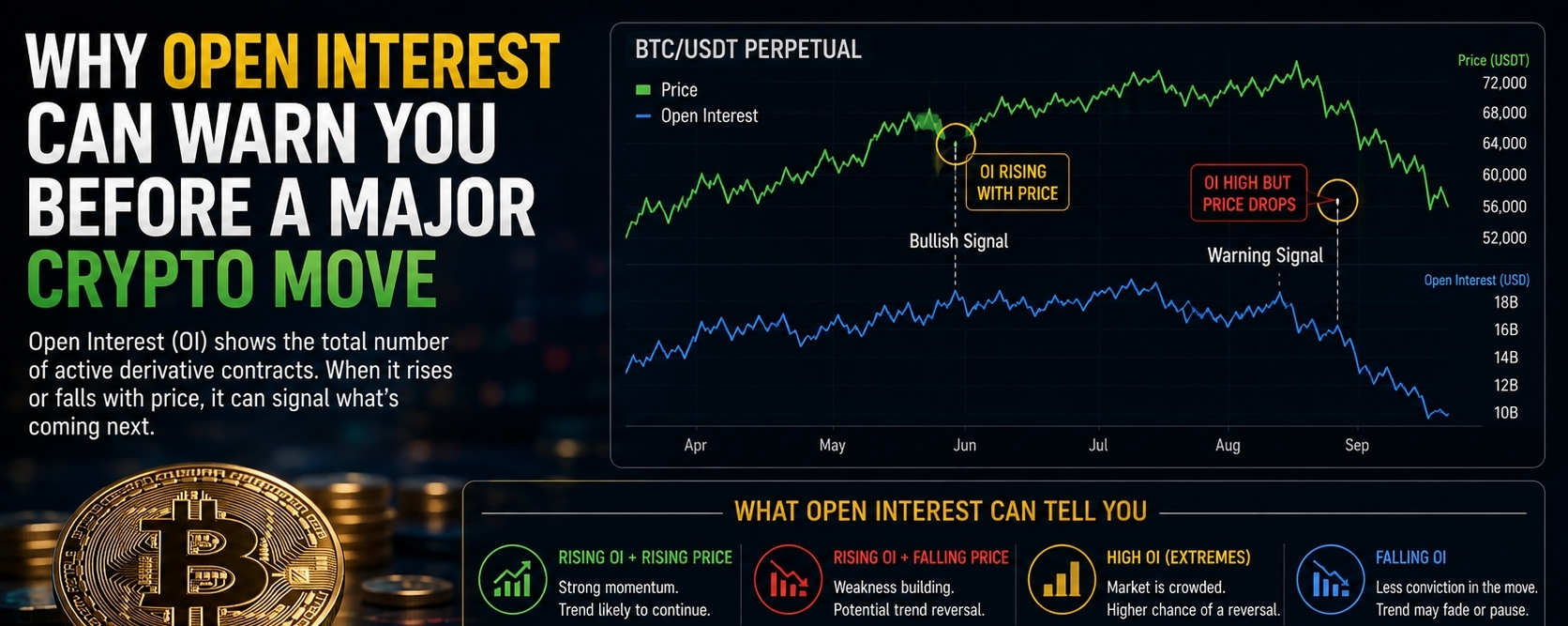
Price Rising + OI Rising
This is one of the most common combinations traders watch.
Suppose Bitcoin begins climbing and open interest increases alongside it.
That suggests new derivatives positions are entering while price rises.
It can support the idea that traders are becoming more active and confident in the move.
But there is an important catch.
If OI rises too aggressively and traders become heavily positioned long, the market can become crowded.
A relatively small price decline could then begin liquidating highly leveraged longs.
So rising price and rising OI can show strength—but extreme leverage can also create vulnerability.
Price Falling + OI Rising
Now imagine Bitcoin is falling while open interest continues increasing.
This can suggest traders are opening new positions during the decline.
Some may be aggressively shorting the market.
If bearish positioning becomes extremely crowded, something interesting can happen.
A sudden upward move could force shorts to close.
That creates additional buying pressure, potentially pushing price even higher.
This is how the conditions for a short squeeze can develop.
What Happens When OI Suddenly Drops?
A sharp decline in open interest often means large numbers of positions have been closed or liquidated.
Suppose Bitcoin drops quickly while OI collapses.
That can indicate leveraged positions were flushed from the market during the move.
You may sometimes hear traders describe this as a leverage reset.
After excessive leverage disappears, the market can become less crowded.
But that doesn't automatically mean the bottom is in.
Price can continue falling even after open interest declines.
OI tells you about positioning—not where the market must reverse.
Open Interest Can Reveal Hidden Risk
Imagine Bitcoin has been slowly climbing for several days.
The chart looks healthy.
But behind the scenes, open interest is exploding.
More and more traders are opening leveraged positions because they expect the rally to continue.
Eventually, the market becomes heavily crowded on one side.
If price suddenly moves against those traders, forced liquidations can turn a small reversal into a much larger move.
Without looking at OI, a trader watching only the chart might not realize how much leverage has accumulated.
Why Liquidations Matter
Liquidations are one reason open interest is so important in crypto.
When a leveraged position loses too much value relative to its collateral, an exchange can automatically close it.
If large numbers of leveraged longs are liquidated together, forced selling can push price lower.
Lower prices can then trigger another group of liquidations.
The result can be a long squeeze or liquidation cascade.
The opposite happens when shorts are forced out.
Short positions closing can add buying pressure, potentially producing a rapid upward squeeze.
Funding Rates Add Another Piece of the Puzzle
Open interest becomes more useful when combined with funding rates.
Funding payments are used by perpetual futures markets to help keep contract prices close to spot prices.
Positive funding generally means longs are paying shorts.
Negative funding generally means shorts are paying longs.
Imagine open interest is extremely high while funding is strongly positive.
That can suggest leveraged bullish positioning has become crowded.
If price starts dropping, those longs could become vulnerable.
Now imagine OI is high while funding becomes deeply negative.
Bearish positioning may be crowded instead.
A sudden rally could put shorts under pressure.
Neither situation guarantees a reversal, but they help reveal where risk may be concentrated.
Spot Buying and Leveraged Buying Aren't the Same
This distinction is important.
Suppose Bitcoin rises 5%.
In one scenario, the rally is driven mainly by spot investors buying actual BTC.
In another, much of the move comes from traders opening highly leveraged futures positions.
Both can produce a similar-looking chart.
But the structure underneath the move is different.
Leveraged positions can be forced to close when price moves against them. Spot holders generally don't face automatic liquidation simply because the market falls.
That's why traders often compare price, spot volume and open interest when judging the strength of a move.
High OI Doesn't Automatically Mean a Crash
A common mistake is assuming that high open interest means the market is about to dump.
It doesn't.
High OI simply tells you that substantial derivatives positioning is open.
Those positions include both long and short exposure because every derivatives contract has counterparties.
The useful question isn't simply:
“Is OI high?”
It is:
“How is OI changing, what is price doing, and does other positioning data suggest traders are becoming crowded?”
Context changes everything.
OI Can Help Identify Breakout Risk
Suppose Bitcoin has been trading inside a tight range for several days.
Price isn't doing much, but open interest keeps climbing.
This tells you that derivatives positions are accumulating while the market remains compressed.
Eventually, price may break out of the range.
If that breakout moves against heavily leveraged traders, liquidations can accelerate it.
This doesn't tell you beforehand whether the breakout will be upward or downward.
But it can tell you that the market may be becoming more sensitive to a sudden move.
OI Works on Altcoins Too
Open interest isn't useful only for Bitcoin.
Ethereum, Solana, XRP and many other actively traded cryptocurrencies have large derivatives markets.
In fact, OI can be particularly interesting during sudden altcoin rallies.
If an altcoin jumps while open interest rises extremely quickly, leverage may be chasing the move.
That doesn't mean the rally must end.
But it tells traders to consider whether the move is being supported by sustainable spot demand or increasingly aggressive derivatives speculation.
Never Use OI Alone
Open interest is powerful, but it isn't a magic indicator.
A trader should never assume:
High OI = dump
or
Low OI = pump
Instead, OI can be examined alongside price action, spot and futures volume, funding rates, liquidations, order-book liquidity and broader market conditions.
Each indicator provides another piece of the puzzle.
The goal isn't to predict every candle.
It's to understand what kind of positioning may be building underneath the market.
A Simple Way to Think About Open Interest
Think of open interest as measuring how crowded the derivatives market is becoming.
When OI rises, more positioning is being created.
When OI falls sharply, positioning is being closed or removed.
When leverage becomes extreme, the market can become more sensitive to sudden price movements.
That sensitivity is what makes OI valuable.
The indicator doesn't necessarily tell you where price will go.
It can help tell you how explosive the next move could become if traders are caught on the wrong side.
The Bottom Line
Open interest is one of the most useful indicators for understanding crypto derivatives.
Rising OI can show increasing participation and leverage. Falling OI can indicate positions are being closed or liquidated. Extreme positioning combined with aggressive funding and sudden price movement can create conditions for powerful squeezes.
But open interest should always be interpreted in context.
The next time Bitcoin or an altcoin sits quietly before suddenly exploding in either direction, don't look only at the candles.
Check what open interest was doing before the move. The warning signs may have been building underneath the market all along.
This article is for educational purposes only and is not financial advice.