

When I think about risk management, I don’t picture dashboards or stress charts. I picture rooms after something has already gone wrong. A delayed settlement. A disputed record. A regulator asking a very specific question that nobody anticipated. In those moments, speed and scale stop being impressive metrics and start being liabilities. What matters is whether the system can explain itself. That’s the lens through which I’ve come to understand Dusk.
Dusk doesn’t feel like an abstract experiment in cryptography. It feels like infrastructure designed for environments where privacy, disclosure, auditability, and trust all need to coexist, often uncomfortably. Financial systems don’t live in clean binaries. They operate through permissions, exceptions, reporting obligations, and fallback procedures. Dusk’s architecture reflects an awareness of that reality. Privacy isn’t treated as an ideological end state, but as a controllable property. Some data is shielded by default, some is selectively revealed, and some is provable without being exposed. That isn’t indecision; it’s risk aware intent.
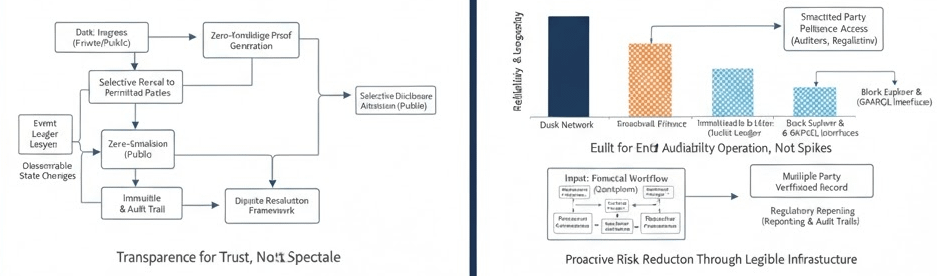
What really reinforces this impression is where the project spends its attention. Not just on settlement logic, but on how information moves through the system. Event handling, node APIs, data access layers, and explorer tooling are treated as first class components. That matters more than it sounds. In institutional contexts, execution is only half the job. Systems must be observable, auditable, and integrable. If monitoring for state changes, identifying patterns of user activity across time as well as reconciling event across disparate system cannot be achieved, there will be no reduction of risk and merely concealed risk, while Dusk’s focus on legible has evidenced an understanding that trust is constructed through transparency rather than lack thereof.
Really, both the block explorer and GraphQL interfaces play a part in the view of risk stated earlier. They aren’t optimized for spectacle or retail engagement. They’re optimized for shared understanding. Multiple parties need to independently verify what happened, when it happened, and under which conditions. In that context, an explorer isn’t a UI feature; it’s a control surface. Making the chain readable is a form of risk reduction.
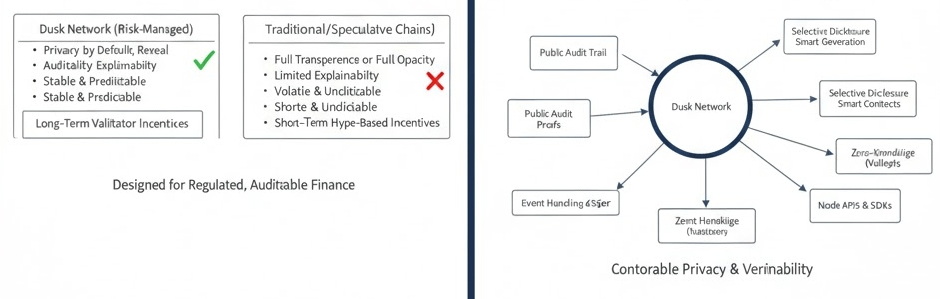
The same realism shows up in Dusk’s token design. There’s no pretense that speculation alone secures a network long term, especially one aimed at regulated finance. Emissions stretch far into the future, implicitly acknowledging that institutional adoption is slow, procedural, and often frustrating. Validator incentives are designed to persist through long quiet periods, not just hype cycles. That’s structural patience. It treats time itself as a risk factor that needs to be managed, not wished away.
Viewed this way, Dusk’s architecture feels less like a bet on rapid growth and more like an attempt to minimize failure modes. Selective disclosure isn’t a feature, it’s infrastructure. Tooling isn’t polish, it’s governance by other means. And success won’t look like sudden explosions in activity. It will look incremental and almost boring: more integrations, more workflows, more systems quietly relying on it.
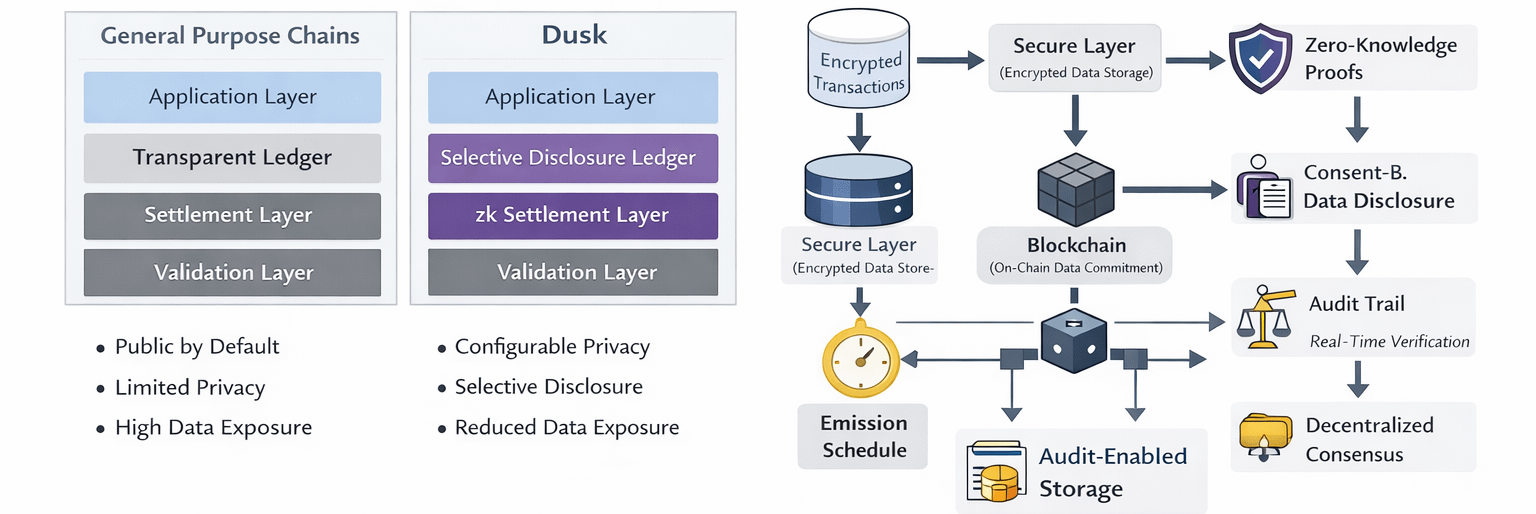
In risk managed environments, that’s usually how trust forms. Not through narratives, but through repetition. Systems that behave predictably, explain themselves clearly, and keep working when the stakes are high don’t announce their success loudly. They just keep getting invited back into the room.
