


Finance Minister Satsuki Katayama told reporters Friday that Prime Minister Sanae Takaichi's administration is committed to boosting Japan's economy and its global competitiveness, arguing that stronger growth is what will ultimately restore the market's trust in the yen. It's a message Tokyo has repeated for months now.
The currency isn't buying it.
USD/JPY traded at 159.664 Friday, up 0.271 yen, or 0.17%, on the session. The pair has climbed 2.29% over the past four weeks and 8.65% over the past year.
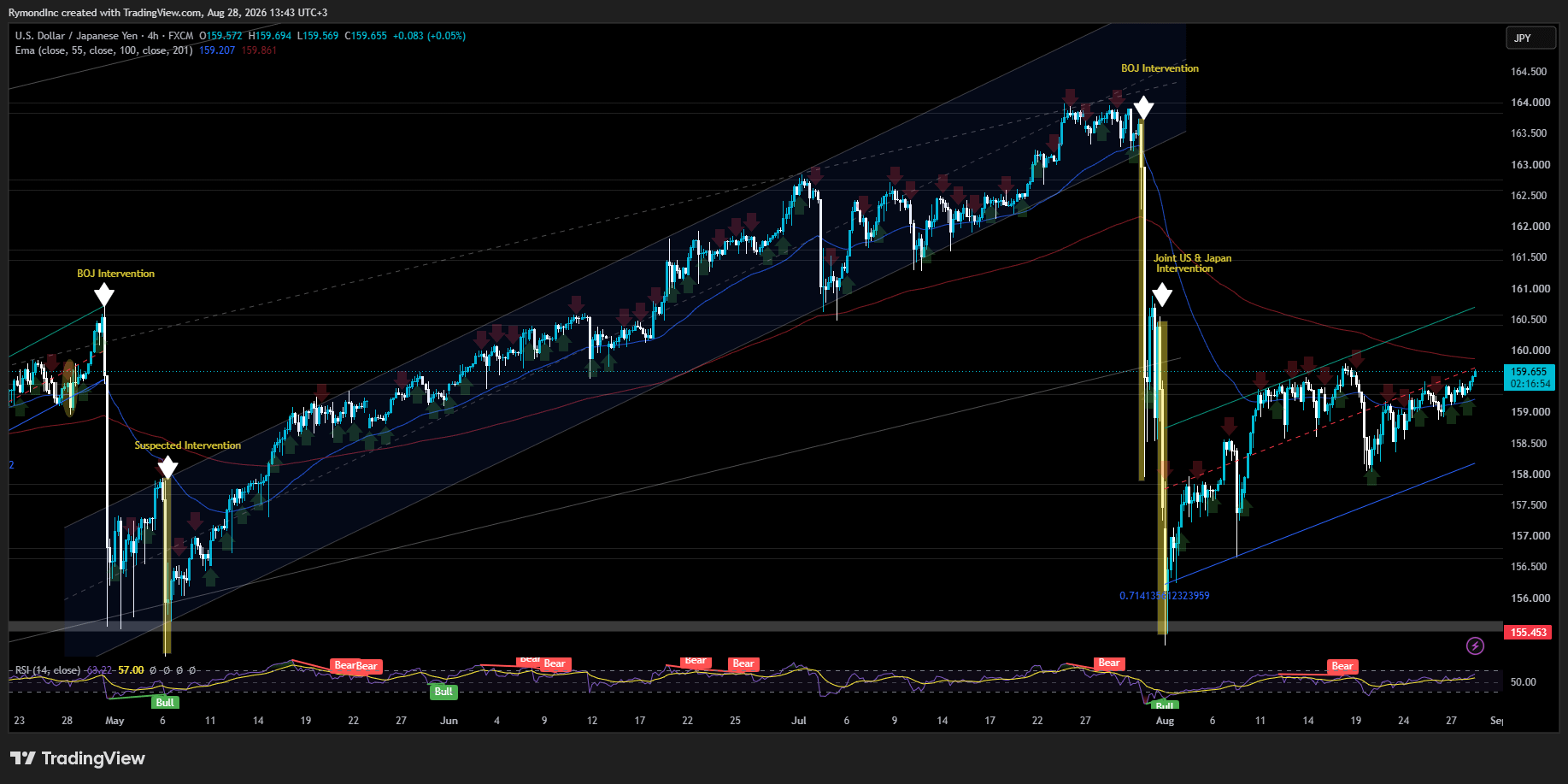
Will Japan reach for its checkbook again? That's the question running through every trading desk watching dollar-yen this week, because a currency that authorities fought hard to defend a month ago has quietly given back nearly half of what it won.
The scale of the reversal is easy to understate in prose. So here are the numbers. USD/JPY fell from around 163.68 to a low of 155.23 in early August, an 8.45-yen swing worth roughly 5.2% in the currency's favor. Since then, the pair has climbed back to 159.664, clawing back 4.43 yen. That means the yen has surrendered about 52% of its intervention-driven gain and is holding onto barely 48% of it.
A Bloomberg analysis of Bank of Japan accounts puts the price tag at roughly $87 billion (15 trillion yen) over two days. Tokyo spent an estimated $53 billion buying yen during New York trading hours on July 30, likely the largest single-day currency intervention on record, then followed with another $34 billion on July 31, when Washington joined in.
That second leg carried an unusual wrinkle. The Financial Times reported, citing people familiar with the matter, that the Federal Reserve Bank of New York funded the Treasury's purchase by selling euros rather than dollars, running the trades through Goldman Sachs and Morgan Stanley.
Reuters later confirmed the account through separate sources. Currency strategists read the choice as a way to prop up the yen without signaling that Washington wanted a broadly weaker dollar. HSBC called it close to unprecedented.
The retreat since then has renewed doubts about how much intervention alone can do. The yen's longer-term weakness is still driven by wide interest-rate differentials with the U.S., mounting worry over Japan's fiscal trajectory, and import costs that keep climbing alongside oil prices. A firmer dollar hasn't made the job any easier.
The Rate Question Tokyo Can't Duck
That leaves the real question: can the Bank of Japan back its currency defense with higher rates of its own?
The data isn't cooperating. Japan's household spending fell 3.3% in June from a year earlier, a seventh straight month of decline that badly missed forecasts for a roughly 1% increase, even as real wages kept rising.
The central bank held its policy rate at 1%, a three-decade high, at its July 30-31 meeting, in an 8-1 vote. Hajime Takata was the lone dissenter, pushing for an immediate quarter-point hike to 1.25%. Governor Kazuo Ueda's press conference afterward stopped short of committing to a September move, even as the board's own outlook flagged inflation risks tilted to the upside.
Deputy Governor Ryozo Himino picked up that thread Thursday, telling business leaders in Saitama that a weak yen is pushing inflation higher and that the bank needs to raise rates in a timely manner rather than wait for a spike that forces its hand later. He pointed to four forces pulling at prices at once: the Middle East conflict, AI-driven demand, the exchange rate, and financial conditions. Asked directly about the pace of the next move, he declined to say, offering only that the board would weigh it at each meeting.
The Poll That Moved the Market
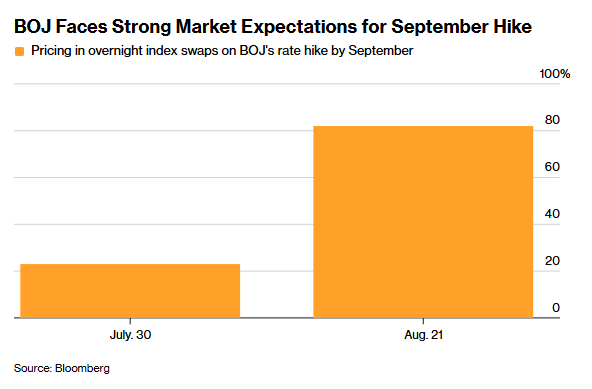
Whatever Himino wouldn't say, economists are saying it for him. Bloomberg Economics reports that BOJ September hike bets have surged, with overnight index swaps pricing nearly 80% probability of a rate increase by September, up sharply from about 20% on July 30, signaling much stronger market conviction.
A Reuters poll conducted Aug. 17-24 found 57% now expect the BOJ to raise its rate to 1.25% in September, up from just 5% in July, one of the sharpest one-month swings in sentiment the survey has produced.
Most expect the bank to move faster than its usual twice-a-year cadence from here. Ten of 58 economists see a follow-up hike to 1.5% as soon as October or December, and nearly two-thirds, 35 of 54, expect the rate to reach at least 1.5% by the end of March 2027, three months earlier than last month's poll implied. About 60% see it hitting 1.75% by the third quarter of 2027, and half of those asked named 1.75% as the eventual peak, up from just 19% a month earlier. More than a third now think the terminal rate lands at 2% or higher.
The same poll delivered a blunter verdict on last month's intervention: more than two-thirds of respondents called it "not very effective" or "not effective at all." And 89% said Takaichi's fiscal policy, heavy on spending, light on funding detail, will keep weighing on the currency no matter what the central bank does.
"Since the market has already largely priced in a September rate hike, postponing such a hike would likely destabilize the market," said Ayako Fujita, chief Japan economist at JPMorgan Securities.
Kyohei Morita, chief economist at Nomura Securities, put it more bluntly. The Takaichi administration's fiscal approach, he said, raises inflation expectations and intensifies concern that the BOJ is falling behind the curve, and a mishandled consumption-tax cut could accelerate yen selling as foreign investors dump Japanese government bonds.
Katayama, asked Friday about the currency's stubborn weakness, called the joint intervention statement with Treasury Secretary Scott Bessent "a very strong one" that "still lives." She's due in Asheville, North Carolina, next week for a meeting of G20 finance leaders, where Ueda is also expected to appear and where Bessent has said he's looking forward to seeing him.
Whether that produces anything beyond another round of the same reassurances Tokyo has offered all year is, for now, anyone's guess. The BOJ's Sept. 18-19 meeting is three weeks out. The yen has already spent half its head start.