#qatarextendslngforcemajeurebyonemonth
A supply disruption that began with a single missile strike in March has now stretched through most of the year — and it just got extended again.
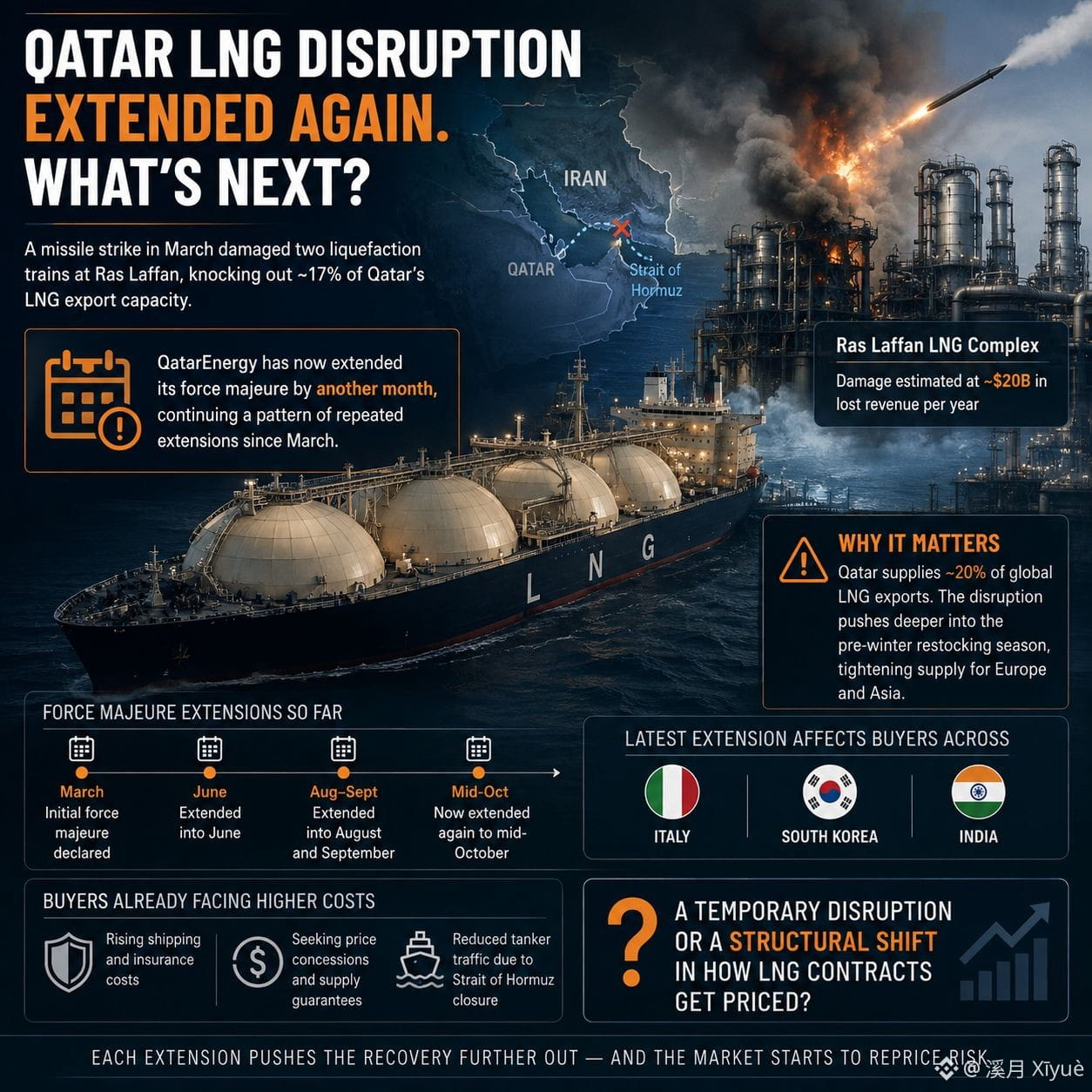
QatarEnergy has once again pushed back its force majeure on LNG shipments by another month, continuing a pattern of extensions that started after Iranian strikes damaged two liquefaction trains at the Ras Laffan complex in March, knocking out roughly 17% of Qatar's export capacity. That damage, estimated to cost around $20 billion a year in lost revenue, is expected to take three to five years to fully repair. Since then, the force majeure notice has been extended repeatedly — first into June, then August and September, then mid-October — as the broader war and the near-total closure of the Strait of Hormuz have kept tanker traffic from Qatar's terminals sharply reduced. The latest extension affects buyers across Europe and Asia, including customers in Italy, South Korea, and India.
This matters because Qatar accounts for roughly a fifth of global LNG exports, and the timing pushes the disruption deeper into the pre-winter restocking season, when Europe and Asia typically compete hardest for available cargoes. Buyers have already sought price concessions and supply guarantees given rising shipping-insurance costs tied to the region.
With each extension nudging the recovery timeline further out, does this start to look like a temporary disruption, or a structural shift in how long-term LNG contracts get priced going forward?
$HEMI $LIGHT $龙虾
A supply disruption that began with a single missile strike in March has now stretched through most of the year — and it just got extended again.
QatarEnergy has once again pushed back its force majeure on LNG shipments by another month, continuing a pattern of extensions that started after Iranian strikes damaged two liquefaction trains at the Ras Laffan complex in March, knocking out roughly 17% of Qatar's export capacity. That damage, estimated to cost around $20 billion a year in lost revenue, is expected to take three to five years to fully repair. Since then, the force majeure notice has been extended repeatedly — first into June, then August and September, then mid-October — as the broader war and the near-total closure of the Strait of Hormuz have kept tanker traffic from Qatar's terminals sharply reduced. The latest extension affects buyers across Europe and Asia, including customers in Italy, South Korea, and India.
This matters because Qatar accounts for roughly a fifth of global LNG exports, and the timing pushes the disruption deeper into the pre-winter restocking season, when Europe and Asia typically compete hardest for available cargoes. Buyers have already sought price concessions and supply guarantees given rising shipping-insurance costs tied to the region.
With each extension nudging the recovery timeline further out, does this start to look like a temporary disruption, or a structural shift in how long-term LNG contracts get priced going forward?
$HEMI $LIGHT $龙虾