

Dusk Network is one of those projects I keep coming back to, not because the privacy narrative is new, but because the problem it is trying to solve feels increasingly difficult to ignore. I’ve watched crypto go through enough cycles to become a little suspicious whenever a project presents itself as the answer to a big institutional problem. The technology can sound impressive, the roadmap can look convincing, and the market can get excited very quickly. But eventually, the noise disappears and you are left with a much simpler question: does the system actually solve something people need?
With Dusk, that question starts with privacy.
Most blockchains were designed around transparency. You can see wallets, follow transactions and inspect activity almost immediately. That openness has its advantages, especially for an asset meant to be publicly verifiable. But financial markets have a different relationship with information. A company may not want competitors watching every transaction. An investor may not want their entire financial history permanently visible. An institution may need to prove that a transaction followed the rules without exposing information that was never meant for the public.
That is where Dusk becomes interesting to me.
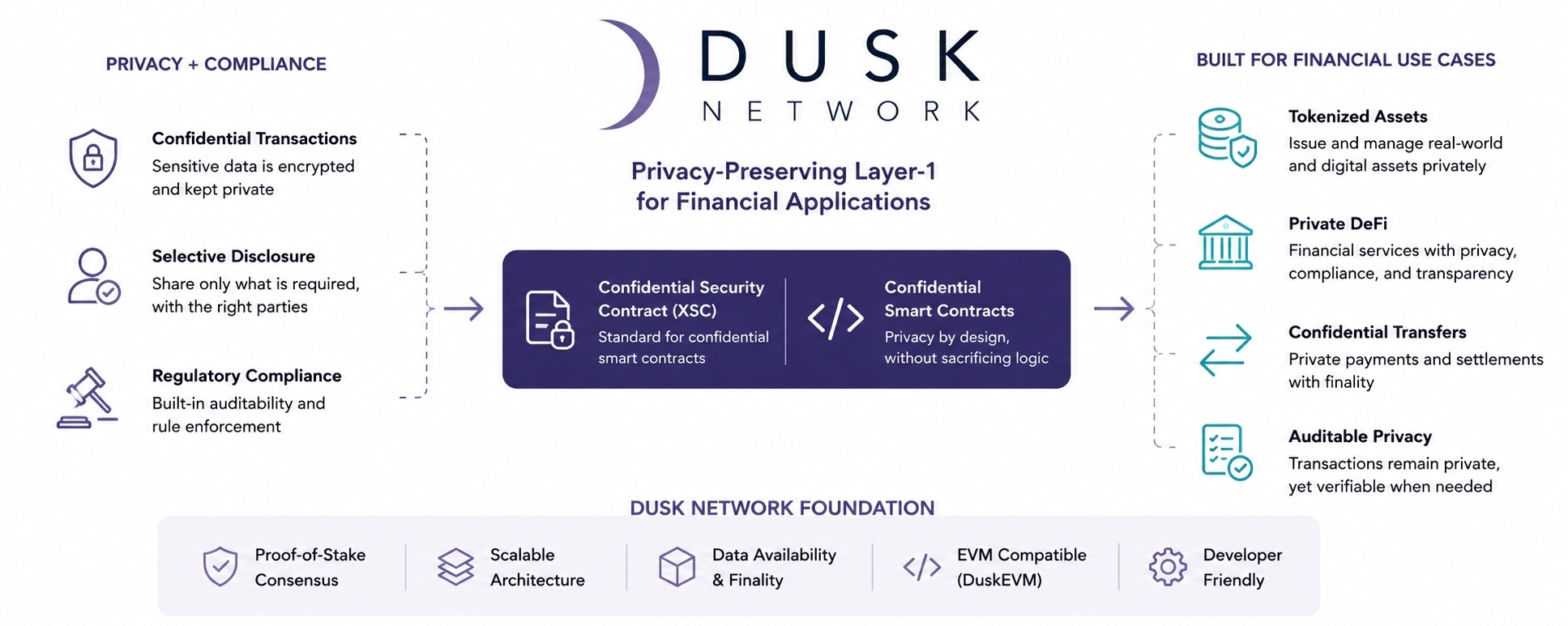
The network is a Layer-1 built around financial applications, with privacy and compliance sitting much closer to the core of the system. Its Confidential Security Contract, or XSC, standard is designed for confidential smart contracts, which is a slightly different idea from simply making transactions private.
The distinction matters.
Hiding information is one thing. Building a system that can hide sensitive information while still proving that certain rules were followed is much harder.
I keep thinking about a simple financial transaction. Imagine two parties transferring a regulated asset. There may be requirements about who can receive it, whether the transfer is permitted and what information a regulator needs to be able to verify later. On a completely transparent blockchain, proving the transaction is relatively easy, but everyone may also be able to see far more than they need to know.
A confidential system tries to change that balance.
Dusk uses zero-knowledge technology and selective disclosure as part of that approach. In simple terms, the goal is to allow certain facts to be proven without forcing every piece of underlying information into public view.
That sounds useful.
But I’ve also seen enough crypto projects to know that “useful” on paper does not necessarily mean useful in the real world.
Zero-knowledge proofs are powerful, but cryptography does not solve every problem. Someone still has to decide what information should be disclosed, who should be allowed to see it, how identities are handled and what happens when rules change.
Those details are where systems usually get tested.
Dusk’s approach to identity is therefore something I find worth watching as well. The idea of selective disclosure means a user could potentially prove a particular requirement without revealing an entire identity profile.
That is a much more natural way of thinking about privacy in financial markets.
Privacy does not always mean hiding from everyone.
Sometimes it simply means giving the right person the right information and keeping everything else private.
That sounds obvious, but implementing it on a decentralized network is another matter.
The more I look at Dusk, the more I notice that the project is not standing still either. Its architecture has been evolving, with different layers taking on different responsibilities. DuskDS is focused on areas such as consensus, staking, settlement and data availability, while DuskEVM gives developers a more familiar Ethereum-compatible environment.
I understand why that direction makes sense.
Developers tend to go where the tools are familiar and where there is already an ecosystem. A blockchain can have excellent technology, but if building on it feels unnecessarily difficult, most developers are not going to stay just because the architecture is elegant.
At the same time, EVM compatibility does not magically create users.
That is one of the lessons I have seen repeated across crypto.
A network can launch with good technology, attractive incentives and plenty of attention. Then the market cools down. Token prices stop doing the marketing for the project. Incentives disappear. Suddenly the only thing that matters is whether people actually need the network.
That is the point where I would want to watch Dusk most closely.
Not during the loudest part of the market.
During the quiet periods.
Are developers still building when nobody is talking about the project?
Are applications being used because they provide something genuinely useful?
Are regulated assets actually being issued and settled?
Do institutions find the privacy model easier to work with than existing alternatives?
Those questions matter more to me than another impressive announcement.
There is also the DUSK token itself, which is used for network fees and staking. That gives the token a functional role, but I think it is important to separate that from market speculation.
A token having a purpose does not automatically create lasting demand.
For that demand to become meaningful, the network needs meaningful activity. Someone has to be paying fees. Someone has to be staking. Applications have to exist. Users have to interact with them.
This is where crypto narratives can become confusing.
A project can be technically valuable without its token necessarily capturing all of that value.
And a token can attract enormous speculation without the underlying network having much real activity.
Those are two very different things.
Dusk is also attempting something I find particularly difficult: bringing privacy into a regulated environment.
Crypto has often treated privacy and regulation as opposites. The assumption was that more privacy meant less oversight, while more regulation meant more information being collected.
But financial markets have never really worked that way.
Banks, exchanges and other financial institutions already operate with different levels of information access. A customer does not see the same information as an auditor. An auditor does not necessarily have the same role as a regulator. A competitor should not automatically be able to see a company's entire financial activity.
So perhaps the real future of financial privacy is not complete invisibility.
Perhaps it is controlled visibility.
That seems closer to what Dusk is trying to build.
The difficult part is making sure that controlled visibility does not simply recreate the centralized systems blockchain technology was supposed to improve.
There is a very narrow balance here.
Too much transparency can make financial applications uncomfortable.
Too much privacy can make compliance difficult.
Too much central control can weaken the reason for using a blockchain.
Too much decentralization without workable compliance can make institutional adoption difficult.
And too much complexity can push developers toward simpler alternatives.
Those are the pressure points I would keep watching.
Dusk is also entering a crowded market. It is competing, directly or indirectly, with established blockchains, permissioned systems, tokenization platforms and other networks trying to bring financial assets onchain.
That means being technically different is not enough.
The network has to be better at something that matters.
Maybe that is privacy.
Maybe it is settlement.
Maybe it is the combination of privacy, identity and compliance.
But eventually, somebody has to choose Dusk over another system, and there needs to be a practical reason for that choice.
This is why I find the project more interesting as an experiment than as a finished story.
The idea is easy enough to understand. Put financial activity onchain while protecting information that should not be public. Allow the system to enforce rules. Give authorized parties a way to verify what they need to verify.
The difficult part is everything around that idea.
Security.
Governance.
Identity.
Regulation.
Developer adoption.
Liquidity.
Integration.
User experience.
Those are not problems that disappear because the underlying blockchain uses sophisticated cryptography.
If anything, they become more important.
I’ve learned over the years that infrastructure usually reveals its real strengths when the market stops being friendly. During a bull market, almost every project looks capable of changing the industry. During a quiet market, people become much less interested in promises and much more interested in whether something actually works.
That is the environment where I would want to judge Dusk.
Can the network remain reliable as activity grows?
Can its privacy features remain practical rather than becoming another layer of complexity?
Can selective disclosure satisfy the different requirements of financial institutions and regulators?
Can developers build applications without fighting the infrastructure?
Can real financial activity develop around the chain?
And perhaps the biggest question of all: can the network create enough genuine utility that it matters even when speculation moves somewhere else?
I don't think those questions have simple answers yet.
That is not necessarily a criticism.
Some projects are interesting precisely because the outcome is still uncertain.
Dusk is trying to operate in an uncomfortable middle ground where blockchain transparency meets financial privacy, and where decentralization meets regulation. There are obvious reasons to believe that such infrastructure could become useful. There are also plenty of ways the idea could become more complicated than expected.
For now, I would rather watch the evidence than make a prediction.
Watch the developers.
Watch the applications.
Watch the transactions.
Watch how institutions actually behave when they have to choose between Dusk and something they already understand.
Watch what happens when incentives disappear.
That is usually when a blockchain tells you what it really is.
And with Dusk, I think the most interesting part of the story is still ahead. The technology can provide the foundation, but eventually reality has to decide whether privacy-focused financial infrastructure is something people merely talk about or something they are actually willing to build their businesses around.
#BestBuyQ2RevenueTopsEstimatesLiftsOutlook #SP500Rises0.7%TechSectorGains3.3% #NvidiaRises8.74%AfterEarnings #OktaCrowdStrikeSurgeOnEarningsBeat