
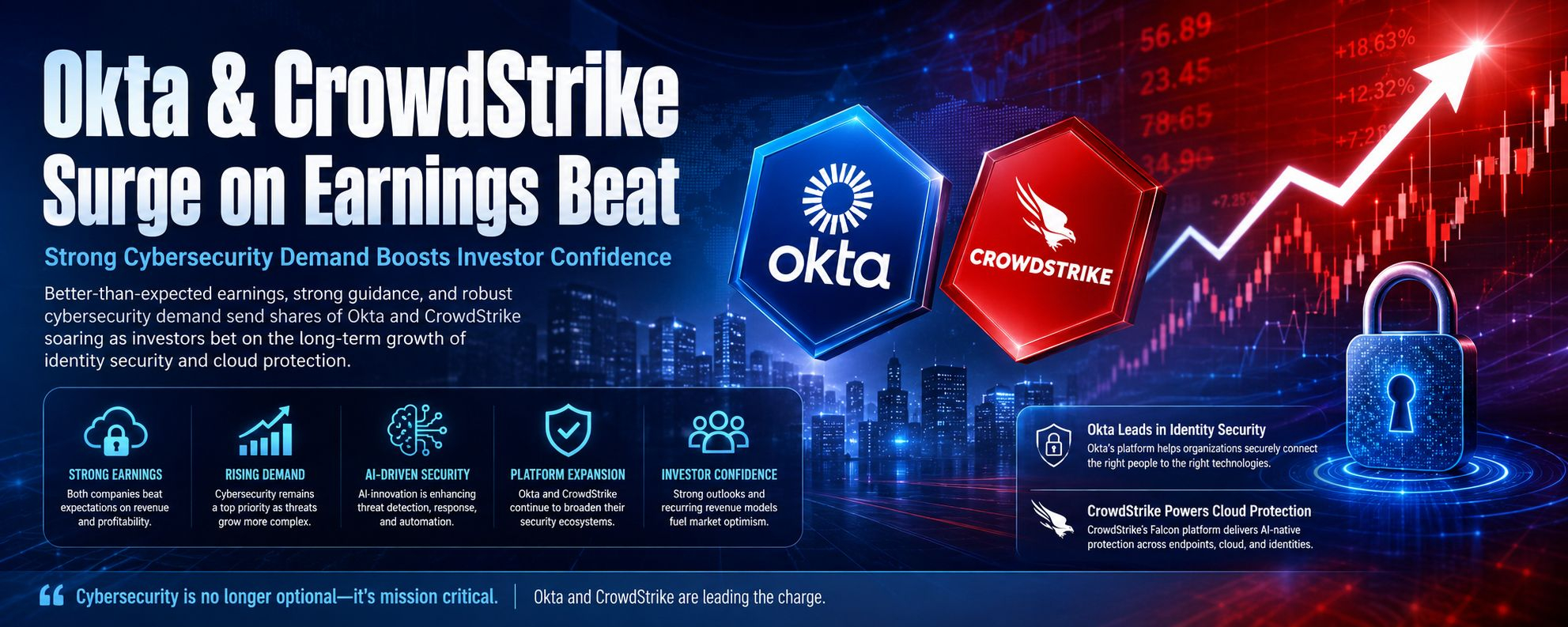

Okta and CrowdStrike delivered a powerful message to investors as both cybersecurity companies saw their shares surge following better-than-expected earnings results, reinforcing the view that demand for identity protection, endpoint security, cloud security and artificial-intelligence-driven cybersecurity solutions remains resilient. The market reaction reflected more than a simple quarterly earnings beat: investors appeared encouraged by evidence that organizations continue to prioritize cybersecurity spending even while businesses remain focused on controlling technology budgets and improving operational efficiency.
The results put two of the most closely watched names in cybersecurity back in the spotlight. Okta, best known for its identity and access-management platform, and CrowdStrike, a major provider of cloud-native endpoint and security operations technology, operate in different but increasingly interconnected parts of the cybersecurity market. Their performances therefore provide investors with a useful indication of how companies are spending on protecting users, applications, devices, data and increasingly complex digital environments.
Okta's business is built around the idea that secure digital access is fundamental to modern enterprises. Its platform helps organizations manage employee and customer identities, authenticate users, enforce access policies and reduce the risks associated with compromised credentials. As companies continue moving applications into the cloud, supporting remote and hybrid workforces and adopting artificial intelligence, controlling who can access what has become increasingly important.
CrowdStrike approaches cybersecurity from another critical point in the security chain. Its Falcon platform is designed to protect endpoints and workloads while also providing organizations with tools to detect threats, investigate suspicious activity and respond to attacks. The company has increasingly expanded beyond traditional endpoint protection into areas such as cloud security, identity protection, security operations and other cybersecurity capabilities.
That combination makes the latest earnings reaction particularly significant. Strong results from both companies suggest that businesses are not treating cybersecurity as an optional technology expense. Instead, security is increasingly being viewed as essential infrastructure.
The broader cybersecurity market has been supported by a number of structural trends. Cyberattacks have become more sophisticated, organizations have accumulated larger numbers of cloud applications and connected devices, and attackers continue to exploit stolen credentials, vulnerable systems and poorly protected identities. At the same time, the growing use of generative artificial intelligence creates opportunities for businesses but also introduces new security challenges.
For investors, the earnings beats therefore matter because they provide evidence that cybersecurity budgets can remain comparatively durable even when other areas of enterprise technology spending come under pressure.
The surge in Okta and CrowdStrike shares also highlights the importance of expectations in the stock market. A company can report strong absolute financial results and still see its shares decline if investors had expected even stronger performance. Conversely, when earnings, revenue, profitability or forward guidance exceed what the market had priced into the stock, the reaction can be substantial.
In this case, the positive response indicated that investors were looking beyond the headline numbers and paying close attention to the companies' outlooks, customer demand, profitability and ability to expand their platforms.
For CrowdStrike, one of the most important issues is the company's ability to continue transforming Falcon from an endpoint-security product into a broader cybersecurity platform. The cybersecurity industry has become increasingly competitive, with customers looking for integrated solutions that can reduce the number of individual security products they must purchase, deploy and manage.
CrowdStrike's platform strategy is designed to take advantage of that trend. If customers can consolidate several security functions onto a single platform, vendors with broad product portfolios can potentially increase revenue per customer while also making their products more deeply embedded in customers' security operations.
This platform expansion is particularly important because cybersecurity vendors are increasingly competing not only on individual product performance but also on the breadth of their ecosystems. Security teams often face an overwhelming number of alerts, tools and dashboards. A platform capable of bringing endpoint, identity, cloud, threat intelligence and security operations data together can offer significant operational advantages.
Artificial intelligence is another major factor in CrowdStrike's growth story. Security companies are investing heavily in AI to analyze enormous quantities of telemetry, identify unusual behavior and help security analysts investigate threats more quickly. AI can potentially reduce the amount of manual work required by security teams while allowing organizations to respond to incidents faster.
But AI is also changing the threat landscape. Attackers can use automation and AI to improve phishing campaigns, create convincing social-engineering attacks, discover vulnerabilities and scale malicious activity. That creates a cycle in which companies need stronger security capabilities precisely because the tools available to attackers are becoming more powerful.
Okta faces a similarly important opportunity around identity security. Identity has increasingly become a central security boundary because traditional network boundaries are less relevant in cloud-based environments. Employees can access applications from different locations and devices, while customers and partners may also require access to digital services.
A compromised password or stolen authentication token can provide an attacker with a pathway into multiple systems. As a result, organizations are placing greater emphasis on multifactor authentication, adaptive access controls, privileged access management and continuous verification.
The rise of AI agents could make identity security even more important. As organizations deploy software agents capable of performing tasks, interacting with applications and potentially making decisions, companies will need to determine what those agents are allowed to access and what actions they can perform. That creates a new identity-management challenge extending beyond human users.
Okta's position in identity management gives it an opportunity to participate in this emerging market. The company's long-term growth will depend on how effectively it expands its platform, increases adoption among existing customers and demonstrates that its technology can address the increasingly complicated identity requirements created by cloud computing and AI.
The positive market reaction also reflects improving investor interest in cybersecurity companies that can combine growth with profitability. During periods when investors are less willing to reward companies solely for rapid revenue expansion, cybersecurity businesses must demonstrate stronger operating discipline.
That means investors are closely watching margins, cash flow, sales efficiency and the cost of acquiring customers. A company that grows quickly while simultaneously improving profitability can be particularly attractive because it demonstrates that its business model is becoming more efficient as it scales.
CrowdStrike has spent considerable effort demonstrating that its cloud-native platform can generate substantial recurring revenue while expanding its product portfolio. Okta, meanwhile, has focused on improving execution and profitability while continuing to grow its identity platform.
The earnings reaction suggests that the market is increasingly willing to reward cybersecurity companies when they demonstrate both demand and financial discipline.
Another important element is recurring revenue. Subscription-based cybersecurity models provide vendors with relatively predictable revenue streams compared with traditional one-time software licensing. Customers typically pay recurring fees for access to security platforms, updates, support and new capabilities.
This model can create strong visibility into future revenue, although it also places pressure on companies to retain customers and continually demonstrate value. Cybersecurity products must keep pace with new threats, regulatory requirements and technological changes. A vendor that stops innovating can quickly become vulnerable to competitors.
For customers, however, the economic argument for cybersecurity is becoming more compelling. The cost of a major breach can include regulatory penalties, legal expenses, incident-response costs, business interruption, lost customer trust and reputational damage. In industries such as financial services, healthcare and critical infrastructure, the consequences can be especially severe.
That makes cybersecurity spending different from many discretionary technology purchases. Companies may delay replacing certain software systems or purchasing new productivity tools, but they cannot easily ignore a growing threat environment.
This resilience is one reason investors continue to pay close attention to earnings from major cybersecurity companies. Results from Okta and CrowdStrike can serve as a broader indicator of enterprise security demand.
The market reaction should nevertheless be interpreted carefully. A strong earnings report does not automatically mean that the stocks will continue rising indefinitely. Cybersecurity companies operate in a competitive market, and their valuations can become demanding when investor enthusiasm increases.
Competition is intense across endpoint protection, identity security, cloud security and security operations. Large technology companies also have the financial resources and customer relationships needed to expand into cybersecurity. Microsoft, in particular, has built an extensive security portfolio that competes across multiple categories.
That competition means Okta and CrowdStrike must continue demonstrating differentiated technology, strong customer outcomes and an ability to expand their platforms without sacrificing profitability.
Investors will also continue watching guidance. In software, future expectations can matter as much as the quarter that has already been completed. If management expects strong demand to continue, that can support higher valuations. If executives warn of slower deal activity, longer sales cycles or increased customer budget scrutiny, the initial earnings excitement can fade quickly.
The latest surge therefore represents a combination of financial performance and renewed confidence in the long-term cybersecurity investment thesis.
For CrowdStrike, the central question is whether its platform can continue gaining share while increasing the number of products purchased by existing customers. Cross-selling can be an important growth engine because selling additional products to an existing customer can be more efficient than acquiring an entirely new account.
For Okta, the key question is how successfully the company can reinforce its leadership in identity while expanding into adjacent security opportunities. Identity is becoming increasingly connected to endpoint, cloud and application security, meaning the boundaries between different cybersecurity categories are becoming less distinct.
That convergence could benefit companies capable of integrating multiple security functions. It could also increase competitive pressure because vendors are expanding into neighboring markets.
The role of artificial intelligence adds another layer to the story. Investors are trying to determine whether AI will primarily increase cybersecurity spending, disrupt existing security products, or create opportunities for entirely new categories of security software.
The most likely outcome is a combination of all three. AI can improve security products by automating detection and investigation, but it also creates new attack surfaces and increases the speed at which threats can develop. Organizations will therefore need security platforms capable of operating at machine speed while still providing human analysts with meaningful control and visibility.
Okta and CrowdStrike are positioned in different parts of that ecosystem, but their strategies increasingly overlap around the broader concept of securing digital identities and activity.
The strong earnings response also arrives at a time when cybersecurity has become a board-level issue. Corporate executives and directors increasingly understand that a security incident can affect not only an IT department but the entire company. Cybersecurity can influence customer relationships, regulatory compliance, insurance costs and investor confidence.
That elevated importance can support long-term spending.
For the broader technology sector, the results offer a constructive signal. Enterprise technology spending is not necessarily collapsing simply because companies are demanding greater efficiency. Instead, organizations may be reallocating budgets toward technologies that provide clear strategic or risk-management value.
Cybersecurity fits that category particularly well.
The market's enthusiasm for Okta and CrowdStrike therefore reflects a larger narrative: companies are willing to invest in protecting digital infrastructure even as they scrutinize other technology expenses. Security remains one of the areas where the cost of doing too little can be dramatically greater than the cost of doing enough.
The earnings beats also reinforce the growing importance of platform consolidation. Security teams increasingly want fewer tools that provide broader coverage, rather than an ever-growing collection of disconnected products. Vendors that can demonstrate strong integration across endpoint, identity, cloud and security operations may have an advantage as customers simplify their technology stacks.
That does not eliminate competition. Instead, it raises the stakes.
Okta and CrowdStrike now face the challenge of converting positive investor sentiment into sustained business performance. They will need to continue innovating, retaining customers, expanding their platforms and demonstrating disciplined spending.
For investors, the next phase will be about execution. Revenue growth, recurring subscription revenue, customer expansion, profitability, free cash flow, product adoption and management guidance will remain critical indicators.
The immediate stock-market surge following the earnings results is therefore only one part of the story. The more important question is whether the companies can maintain the momentum suggested by their latest performance.
If they can, the results could strengthen the argument that cybersecurity remains one of the most durable areas of enterprise technology spending. If growth begins to slow or competition intensifies more rapidly than expected, investors may become more selective.
For now, however, the earnings reaction sends a clear message. Cybersecurity remains a priority, identity is becoming a fundamental component of digital security, endpoint protection is evolving into broader security platforms, and artificial intelligence is creating both new risks and new opportunities.
Okta and CrowdStrike's strong market response demonstrates how closely investors are watching these trends. Their latest performance provides another indication that companies continue to view cybersecurity not simply as an IT expense, but as an essential investment in business continuity, digital trust and long-term resilience.
The surge in the two stocks consequently represents more than a one-day earnings reaction. It reflects a market increasingly focused on the idea that the cybersecurity industry can continue growing as businesses become more dependent on cloud applications, digital identities, connected devices and artificial intelligence. Whether that optimism ultimately translates into sustained shareholder returns will depend on execution, valuation and the companies' ability to remain ahead of an evolving threat landscape.