$BICO Sovereign Credit and the Lessons of China's Property Collapse
In 1935, H.M. Gartley wrote in Profits in the Stock Market that all credit and fiat currency are ultimately built on the foundation of government credit. It's a foundational principle in monetary theory — when a state's finances are strained, the money built on top of that credit is affected too.
China's property sector has become a real-world illustration of this dynamic. The collapse of developers like Evergrande exposed the risks of a growth model built on heavy debt, and it shook the long-held assumption that real estate is always a safe haven for capital.
These aren't abstract concerns — they're playing out in real economies right now, and they're a reminder that no asset class, however established, is immune to structural pressure when the credit underneath it is overextended.
A smaller-scale echo in crypto: $BICO
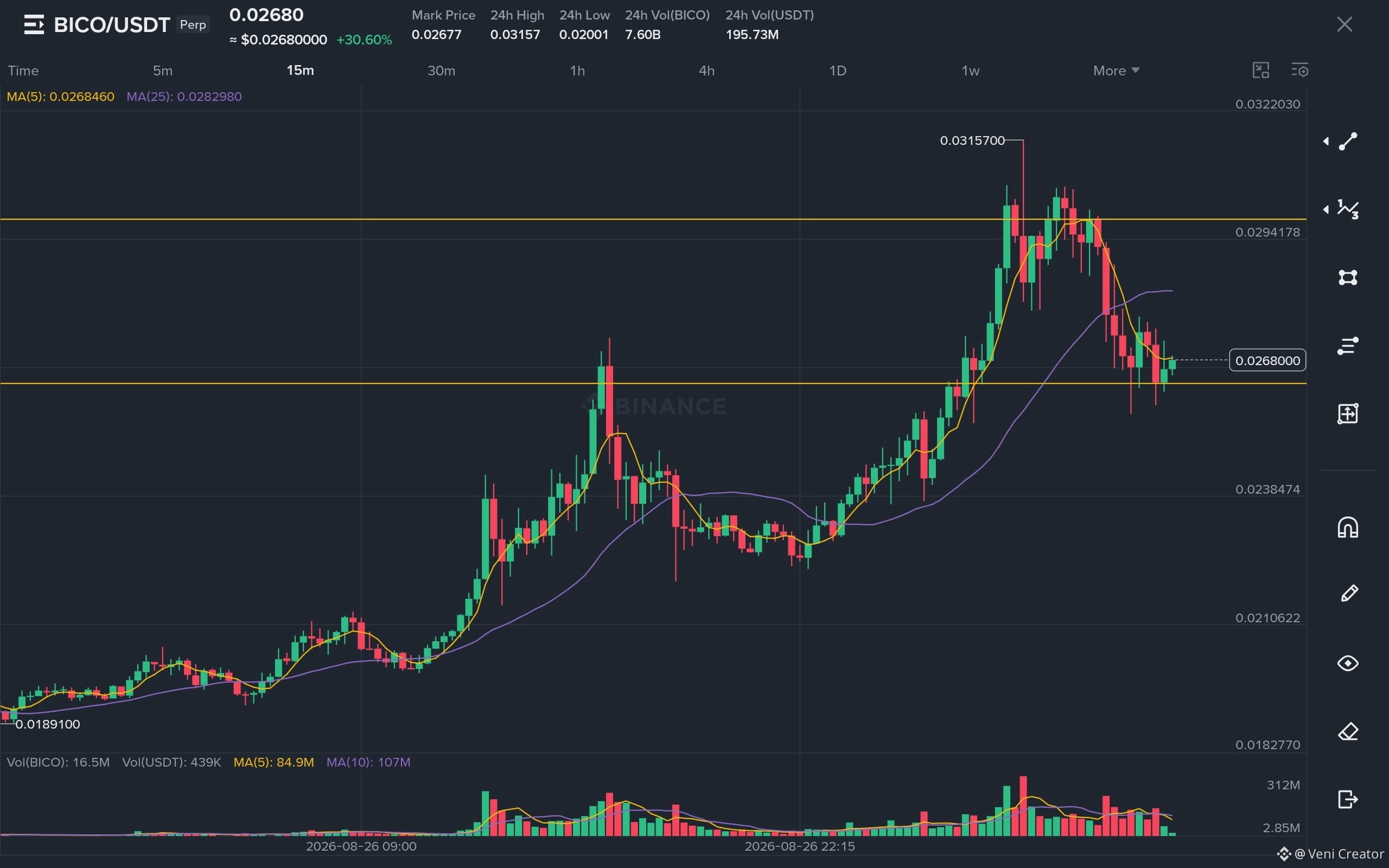
You can see a compressed version of "boom, then reckoning with reality" in altcoins too. BICO recently ran from ~$0.0189 to a high of $0.0316 — a 67% spike — before sellers stepped in hard and knocked it back down to the $0.0266–0.0268 zone it's consolidating in now. The volume that drove the spike has since dried up, which often signals the move was more speculative excess than sustainable demand — not unlike credit-fueled growth that outruns its underlying fundamentals.
Watching $0.0266 support here: a hold could set up a move back toward $0.03, while a breakdown would confirm the exhaustion read.
Not financial advice — just an observation on how credit cycles, big and small, tend to rhyme.
In 1935, H.M. Gartley wrote in Profits in the Stock Market that all credit and fiat currency are ultimately built on the foundation of government credit. It's a foundational principle in monetary theory — when a state's finances are strained, the money built on top of that credit is affected too.
China's property sector has become a real-world illustration of this dynamic. The collapse of developers like Evergrande exposed the risks of a growth model built on heavy debt, and it shook the long-held assumption that real estate is always a safe haven for capital.
These aren't abstract concerns — they're playing out in real economies right now, and they're a reminder that no asset class, however established, is immune to structural pressure when the credit underneath it is overextended.
A smaller-scale echo in crypto: $BICO
You can see a compressed version of "boom, then reckoning with reality" in altcoins too. BICO recently ran from ~$0.0189 to a high of $0.0316 — a 67% spike — before sellers stepped in hard and knocked it back down to the $0.0266–0.0268 zone it's consolidating in now. The volume that drove the spike has since dried up, which often signals the move was more speculative excess than sustainable demand — not unlike credit-fueled growth that outruns its underlying fundamentals.
Watching $0.0266 support here: a hold could set up a move back toward $0.03, while a breakdown would confirm the exhaustion read.
Not financial advice — just an observation on how credit cycles, big and small, tend to rhyme.