

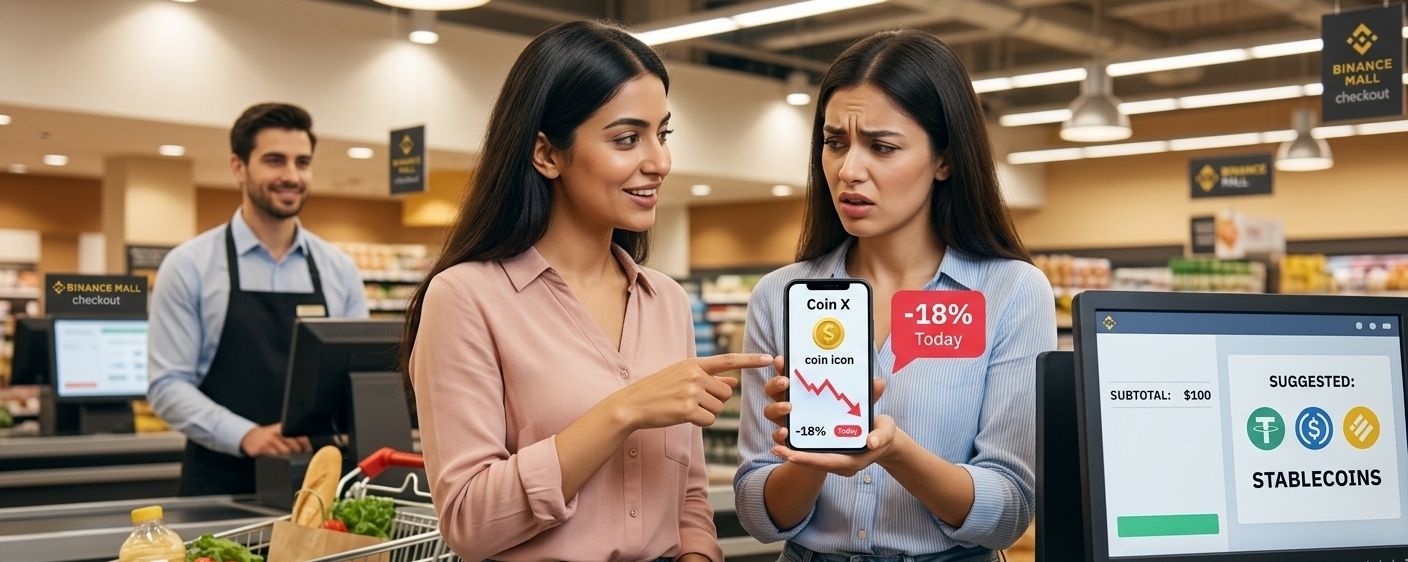


Nadine und Maryam hatten fast eine Stunde damit verbracht, durch das Binance Mall zu laufen.
Ihr Einkaufswagen war bereits voll.
Als sie an der Kasse ankamen, zog Nadine ihr Handy heraus und lächelte.
„Ich bezahle mit Coin X.“
Maryam sah auf den Bildschirm.
„Bist du dir sicher?“
„Natürlich. Warum?“
Maryam zeigte auf den Preis.
„Gestern waren es 100 Dollar. Heute sind es 82.“
Nadine wirkte überrascht.
„Aber ich muss doch nur 100 Dollar bezahlen.“
Der Kassierer lächelte höflich.
„Das ist das Problem, wenn man eine volatile Kryptowährung für alltägliche Zahlungen nutzt.“
Nadine runzelte die Stirn.
„Und was soll ich dann machen? Jedes Mal den Preis überprüfen, wenn ich etwas kaufe?“
Maryam lachte.
„Dann wäre Einkaufen ja anstrengend.“
Die Kassiererin drehte sein Display zu ihnen um.
„Du könntest einen Stablecoin verwenden.“
Nadine wirkte neugierig.
„Ein Stablecoin? Was macht ihn stabil?“
„Er ist so konzipiert, dass er seinen Wert relativ stabil hält – meist, indem er an etwas wie den US-Dollar gekoppelt ist.“
„Wenn ich also einen an den Dollar gekoppelten Stablecoin benutze, muss ich mir keine Sorgen machen, dass er plötzlich 20 % seines Werts verliert, bevor ich an der Kasse ankomme?“
„Genau. Dafür ist es zumindest gedacht.“
Nadine sah Maryam an.
„Also wurden Stablecoins geschaffen, weil die Leute einige der Vorteile von Krypto haben wollten, ohne sich mit demselben Maß an Preisvolatilität herumschlagen zu müssen?“
Maryam lächelte.
„Jetzt verstehst du es.“
Nadine schaute in den Einkaufswagen.
„Schnelles digitales Geld… aber mit einer stabileren Rechnungseinheit.“
Der Kassierer nickte.
„Das ist die Idee.“
Nadine steckte ihr Handy weg.
„Interessant. Ich dachte, Stablecoins wären nur eine weitere Art von Kryptowährung.“
Maryam lachte.
„Das sind Krypto.“
Sie versuchen einfach, dass sich der Preis ein bisschen mehr wie Geld verhält.
Die beiden Freunde bezahlten ihren Einkauf und gingen los, während sie noch darüber diskutierten, was sie mit ihren digitalen Dollars sonst noch kaufen könnten.
Und Nadine hatte etwas gelernt, das sie wahrscheinlich nicht vergessen würde:
Manchmal ist die nützlichste Innovation nicht, Geld schneller in Bewegung zu bringen.
Es macht seinen Wert leichter zu verstehen.
Warum sind Stablecoins also entstanden?
Weil es nicht immer praktisch ist, eine Währung zu verwenden, die sich im Wert drastisch ändern kann – für alltägliche Zahlungen, Überweisungen oder Finanzanwendungen.