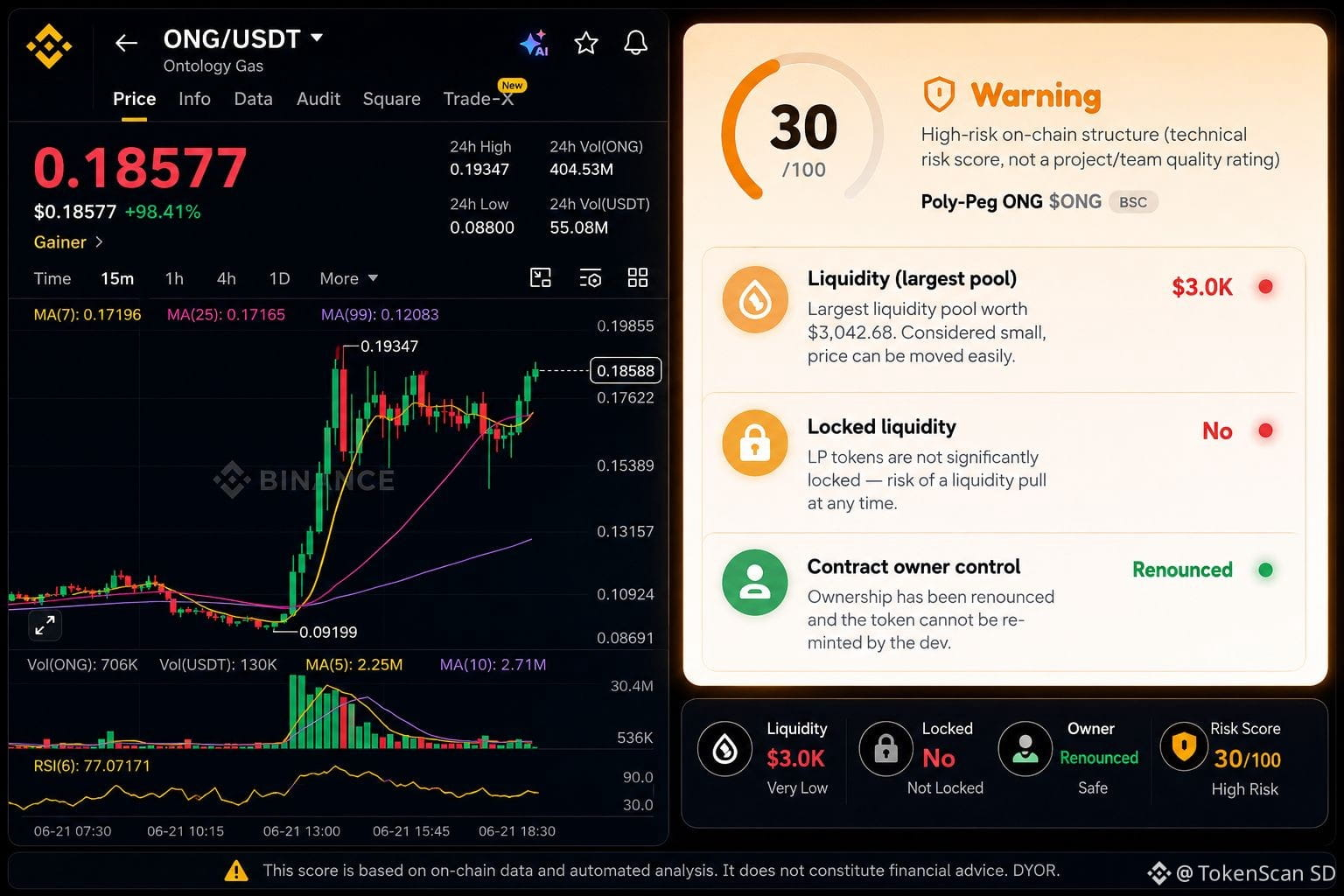
$ONG is +98% on Binance. The BSC token with the same ticker is not the same asset. LP $3K. One wallet holds \~100%.
$ONG
Two screenshots. Two different products.
What the Binance chart is
ONG/USDT on Binance is Ontology Gas — the old CEX-listed gas token.
Price: $0.18577 (+98.41%)
24h: $0.088 – $0.193
Volume: 404.53M ONG / $55.08M USDT
RSI(6): 77
That pump lives on a CEX order book. It is not a $3K pancake pool.
What the BSC contract is
Name on BscScan: Poly-Peg ONG
Contract: 0x308bfaeAaC8BDab6e9Fc5Ead8EdCb5f95b0599d9
TokenScan SD score: 30/100
Largest LP: $3,042 — unlocked
Ownership: renounced
Tax: 0% / 0%
Honeypot sim: can sell
Holders: \~1,663
Largest wallet: 999,580,115 ONG (0x8d12…3de2) ≈ 100% of 1B supply
Deployer flagged for 27 prior contracts
DeBank shows that wallet at $167.4M. That number is CEX price × illiquid wrapper tokens. You cannot exit $167M into a $3K pool. The FDV is a screenshot. The pool is the reality.
The trap
Someone sees $ONG +98% on Binance, copies the ticker, buys Poly-Peg on BSC, then wonders why a $200 buy moves the chart and a $200 sell cannot get out clean.
Same ticker. Different chain. Different liquidity. Different risk.
Scan the contract first. Then decide if you even care about the CEX candle.
Question:
Do you check the contract, or do you trust the ticker?
NFA. Structure scan only. Not a buy or sell call. DYOR.
$ONG
Two screenshots. Two different products.
What the Binance chart is
ONG/USDT on Binance is Ontology Gas — the old CEX-listed gas token.
Price: $0.18577 (+98.41%)
24h: $0.088 – $0.193
Volume: 404.53M ONG / $55.08M USDT
RSI(6): 77
That pump lives on a CEX order book. It is not a $3K pancake pool.
What the BSC contract is
Name on BscScan: Poly-Peg ONG
Contract: 0x308bfaeAaC8BDab6e9Fc5Ead8EdCb5f95b0599d9
TokenScan SD score: 30/100
Largest LP: $3,042 — unlocked
Ownership: renounced
Tax: 0% / 0%
Honeypot sim: can sell
Holders: \~1,663
Largest wallet: 999,580,115 ONG (0x8d12…3de2) ≈ 100% of 1B supply
Deployer flagged for 27 prior contracts
DeBank shows that wallet at $167.4M. That number is CEX price × illiquid wrapper tokens. You cannot exit $167M into a $3K pool. The FDV is a screenshot. The pool is the reality.
The trap
Someone sees $ONG +98% on Binance, copies the ticker, buys Poly-Peg on BSC, then wonders why a $200 buy moves the chart and a $200 sell cannot get out clean.
Same ticker. Different chain. Different liquidity. Different risk.
Scan the contract first. Then decide if you even care about the CEX candle.
Question:
Do you check the contract, or do you trust the ticker?
NFA. Structure scan only. Not a buy or sell call. DYOR.