Spent the afternoon tracing $DUSK 's RWA tokenization story for CreatorPad, and something stuck with me that doesn't fit the main narrative.#dusk
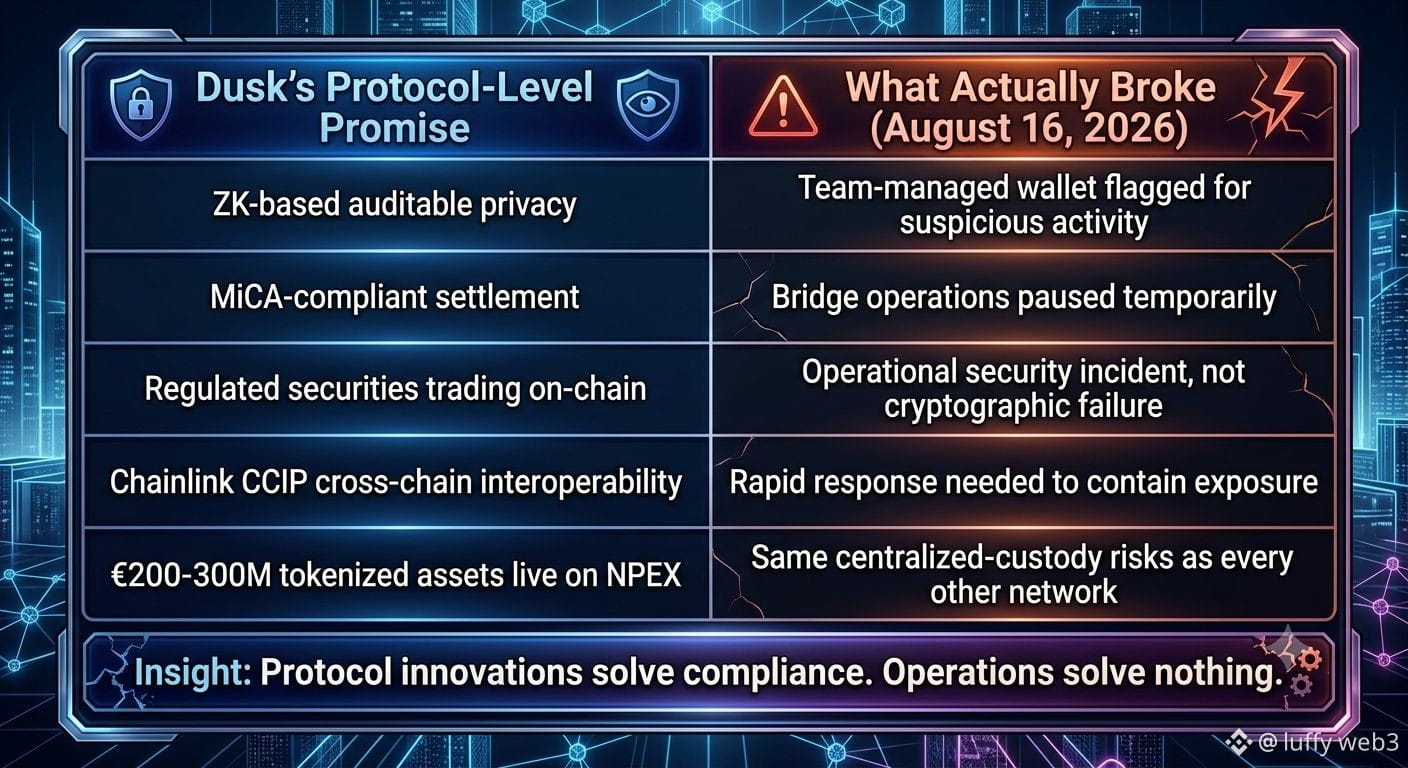
Dusk markets itself as the institutional fix—compliant privacy, zero-knowledge proofs solving the central tension in regulated finance. On paper, it works. The Chainlink integration (January 2026) handles cross-chain settlement. NPEX is live on mainnet moving €200-300M in tokenized securities. The protocol layer does what it promises. But then August 16 hit. Team-managed wallet, bridge operations, suspicious activity flagged by monitoring. They moved fast—recycled addresses, paused the bridge, Binance coordination—and no user funds got taken. Good incident response, honestly. Here's what's weird though: Dusk solved the hard problem. They built auditable privacy, programmable compliance, cryptographic proofs that let institutions move regulated assets on-chain without exposing the entire ledger to everyone. That's real innovation. What they didn't solve—what no chain really solves—is the bridge itself. It's still keys and wallets and operational risk, just like every other network.@Dusk
The insight that won't let go: Dusk's whole pitch is "privacy + regulation." But the bottleneck isn't the protocol anymore. It's the same thing that's always been fragile—the humans, the keys, the bridges between worlds.
Makes me wonder what happens when institutional RWA volumes actually scale.