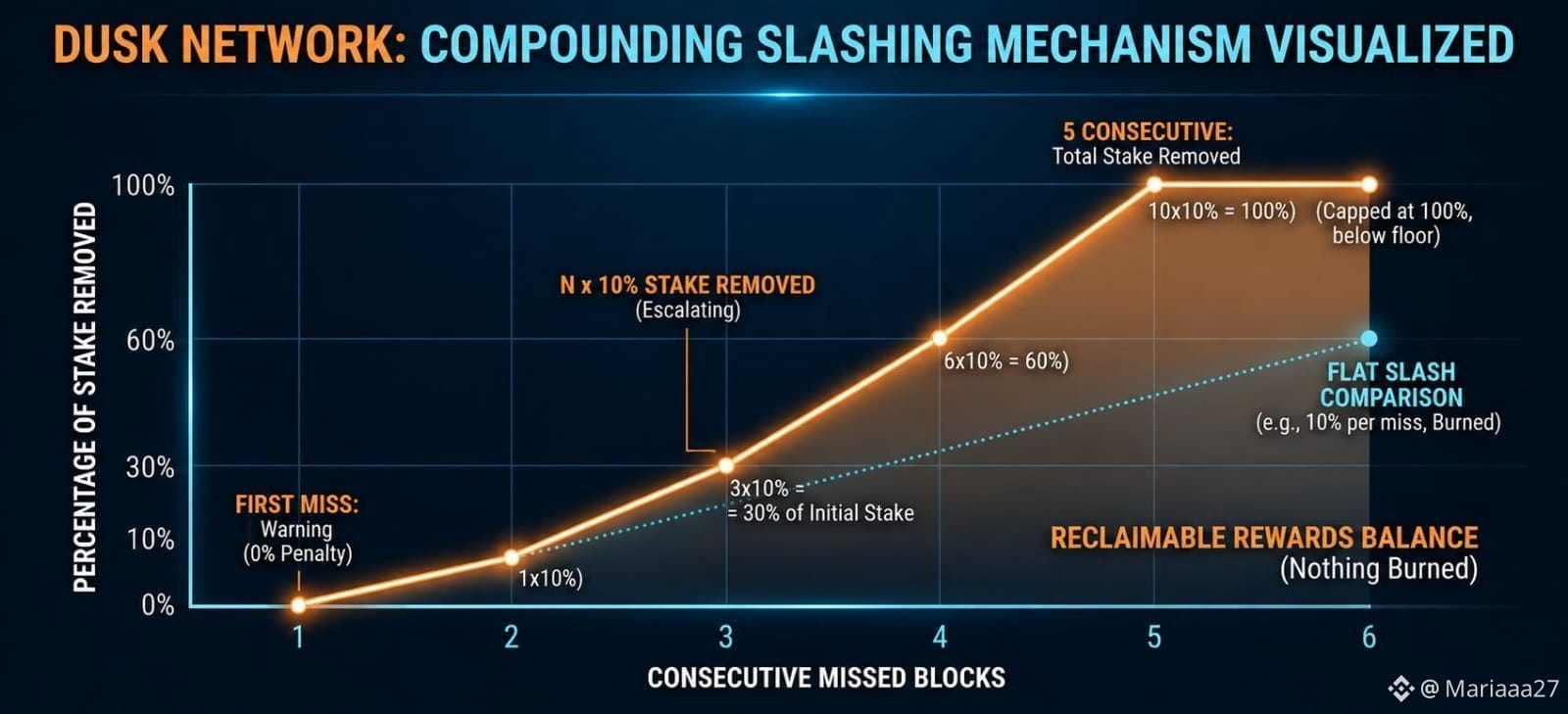
#dusk $DUSK @Dusk Went through the slashing documentation on docs dusk network. The mechanism scales and most people miss that:
• First missed block warning only. Zero penalty.
• Every consecutive miss after that N × 10% of stake removed N being the streak count
• Nothing burned. Removed stake shifts straight to the node's reclaimable rewards balance
• Node sits out of consensus for N epochs before it's eligible again
• The 10% keeps stacking until stake drops below the 1,000 DUSK floor
One miss, almost nothing. Five in a row, and the math turns brutal fast.
I assumed slashing meant a flat cut, same penalty every time. Wrong. After reading closer, the real risk isn't a single bad block it's a losing streak. Occasional downtime is nearly free. Sustained downtime compounds against you hard.
Mechanically, that's a sharper design than a flat slash it punishes pattern, not accident.
Does a compounding reclaimable penalty actually deter sustained downtime harder than a flat burn would, or does "nothing's really lost" make operators careless? What do you think?
$DUSK #DUSK @Dusk
• First missed block warning only. Zero penalty.
• Every consecutive miss after that N × 10% of stake removed N being the streak count
• Nothing burned. Removed stake shifts straight to the node's reclaimable rewards balance
• Node sits out of consensus for N epochs before it's eligible again
• The 10% keeps stacking until stake drops below the 1,000 DUSK floor
One miss, almost nothing. Five in a row, and the math turns brutal fast.
I assumed slashing meant a flat cut, same penalty every time. Wrong. After reading closer, the real risk isn't a single bad block it's a losing streak. Occasional downtime is nearly free. Sustained downtime compounds against you hard.
Mechanically, that's a sharper design than a flat slash it punishes pattern, not accident.
Does a compounding reclaimable penalty actually deter sustained downtime harder than a flat burn would, or does "nothing's really lost" make operators careless? What do you think?
$DUSK #DUSK @Dusk