
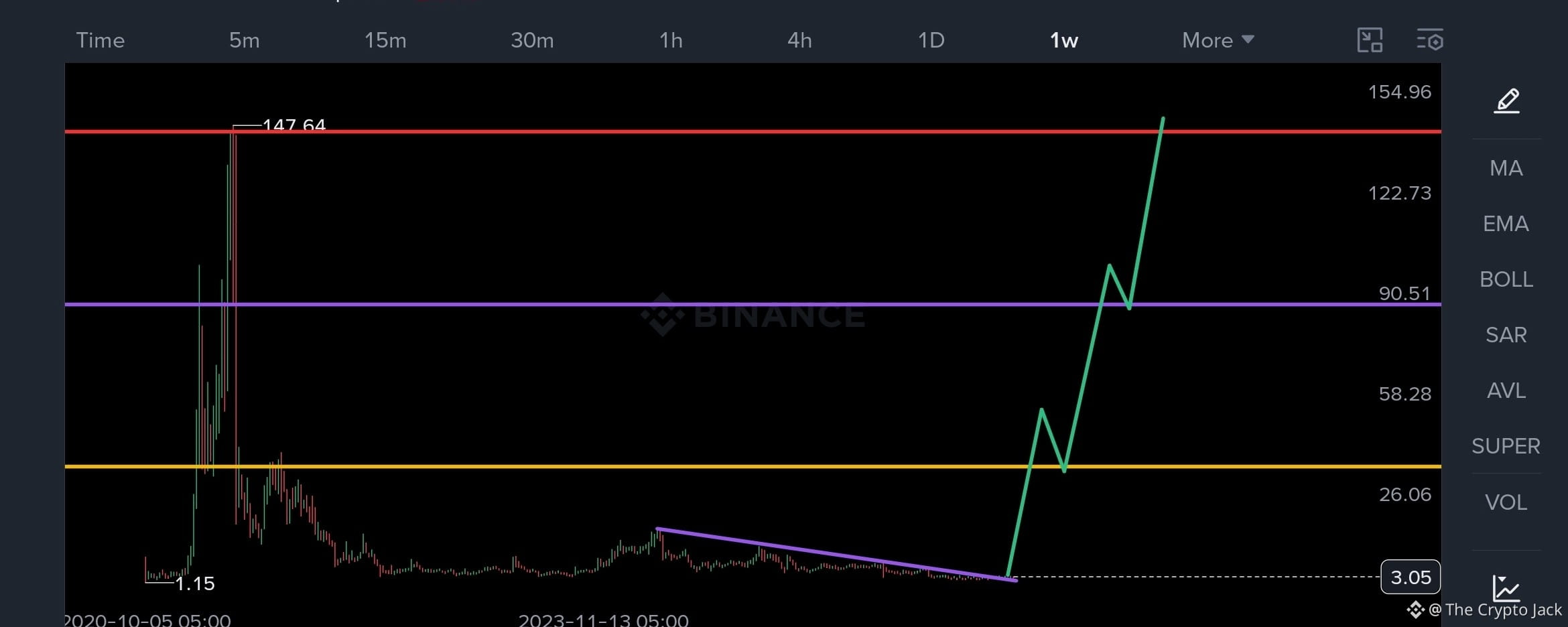


Venus is a live lending protocol that still holds over a billion dollars of real deposits while the token trades near $3 and a ~$50 million market cap. That gap is the whole thesis.
Where we are right now
Price: about $3
Market cap: roughly $50 million
Circulating supply: ~16.4–16.9 million XVS
Max supply: 30 million
All-time high: ~$147 in May 2021
Protocol TVL: about $1.27 billion on DefiLlama (almost all on BNB Chain); the app and other snapshots have shown $1.4–1.7B+, and the protocol has previously reached around $2.8 billion
Active loans: roughly $450 million
Fees: ~$19–20 million annualized
Protocol revenue: ~$3.5–3.6 million annualized
Treasury: ~$21 million
At $200, circulating market cap would be about $3.3 billion. That is a big number but it is not science fiction if crypto enters a real risk-on cycle and Venus keeps the position it already has on BNB Chain.
1. The protocol is large; the token is tiny
Venus is still one of the main money markets on BNB Chain. People actually deposit BTCB, $BNB , USDT, liquid $BTC wrappers, and more. Utilization and loan books exist. Fees keep coming in.
Yet the token is priced like a side project. Market cap of ~$50M against $1B+ of deposits is an extreme discount. In past cycles, DeFi blue chips have re rated hard when liquidity returned. If Venus only partially closes that gap not even to Aave’s scale the token can move a long way from $3.
2. It already ran to $147 once
In 2021, with fewer coins out and less product, XVS hit about $147. Supply is higher now, so the same price needs a bigger market. But the path has been walked: the market has already paid a high multiple for Venus when risk appetite was strong.
A new cycle does not have to copy 2021 exactly. It only has to decide that the leading BNB Chain lender is worth several billion again. $200 is a new high, not a random number with no history behind it.
3. Fair launch + full DAO = asymmetric upside if narrative returns
Venus was not a private sale VC farm. Token distribution was mostly:
Liquidity mining / ecosystem incentives
Binance Launchpool
A small ecosystem grant slice
Founders and team did not take a large pre-mine. Control sits with XVS holders through on chain votes (hundreds of VIPs executed). Development is paid from the treasury via community approval, not endless equity dilution.
In a bull market, “real usage + community ownership + low float relative to deposits” is a powerful story. Tokens with that profile can re rate faster than heavily unlocked VC coins.
4. Product surface area is expanding into institutions and RWAs
This is not the same Venus as 2021.
Core + isolated pools for risk separation
Venus Prime V2 revenue funded boosts for committed XVS stakers
Venus Flux (with Fluid) more capital efficient liquidity
Fixed term institutional vaults
RWA and tokenized collateral: Asseto’s CASH+, United Stables’ $U, tokenized equities (e.g. Tesla/Nvidia/SpaceX-related markets), tokenized gold, custody links with names like Ceffu and Cactus
Institutions do not need to self custody to touch Venus liquidity. That is a different buyer class than pure DeFi yield farmers. If even a fraction of that capital scales, deposits, loans, and fees rise and the market starts pricing Venus as infrastructure, not a leftover BSC token.
5. Revenue and token value capture can improve together
Annualized fees near $20M and protocol revenue in the low millions already exist at current scale. Mechanisms that share value with XVS (vault rewards, Prime, buybacks from reserves, governance power) mean growth in usage is not purely abstract.
In a cycle where:
BNB Chain activity rises
BTC and BNB collateral expand
stablecoin borrowing demand returns
institutional vaults fill
…fee revenue can climb while the market assigns a higher multiple to that revenue and to the governance token. Low absolute market cap means even moderate multiple expansion moves the price a lot.
6. Cycle math favors high beta DeFi names with real books
When Bitcoin runs and money rotates into alt liquidity, capital often chases:
Chains that are active
Protocols with visible TVL and loans
Tokens that still look “cheap” on a market-cap-to-TVL basis
Venus checks those boxes on BNB Chain. It does not need to become larger than Aave overnight. It needs the market to stop pricing it as if the protocol barely exists. From $50M to a few billion is a large move in percentage terms, but it is the kind of re rating crypto has done repeatedly for functioning DeFi names in strong cycles.
7. What the path to $200 actually requires
Not magic a stack of conditions that have happened before in crypto:
A broad bull market and risk appetite
Venus defending or growing its BNB Chain lead (TVL back toward prior peaks or beyond)
Institutional and RWA products moving from announcements to sustained volume
XVS utility (staking, Prime, governance) keeping holders locked and speculative demand rising
Enough volume that a multi-billion valuation can form
If circulating market cap moves toward the $3B+ zone in that environment, $200 is the arithmetic outcome.
The thesis in one paragraph
Venus already runs a billion dollar plus lending book, generates real fees, sits at the center of BNB Chain credit, is expanding into institutional and RWA products, and is governed by a token that still only carries a ~$50 million market cap near $3. It has already traded near $147 once. In a full-cycle re-rating of DeFi, a protocol of this size with improving product and low token valuation can support a multi-billion market cap.