
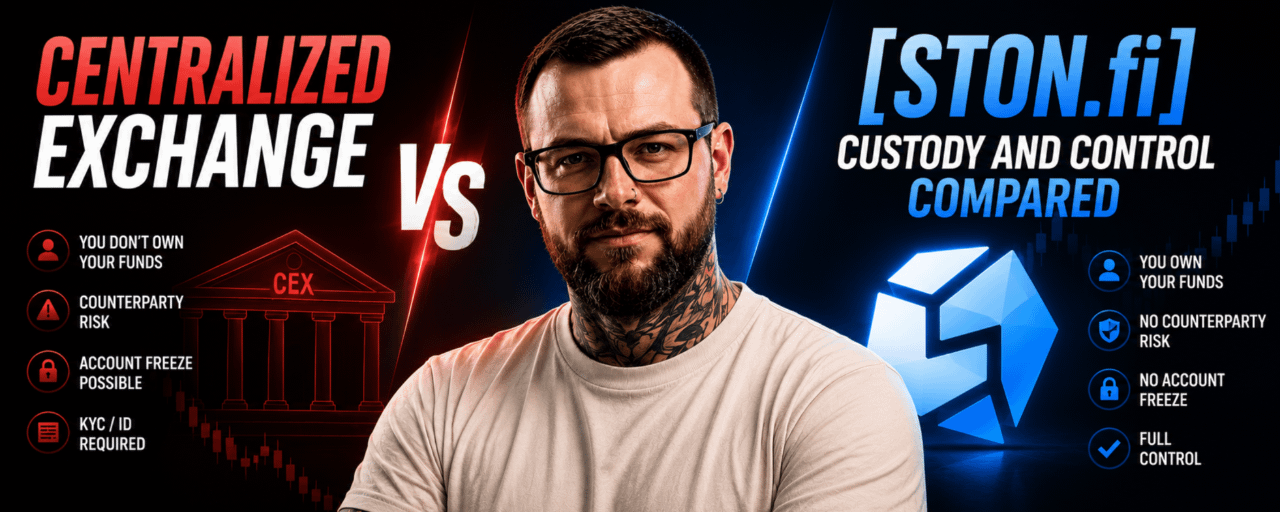

"Not your keys, not your coins" gets repeated so often it's become a cliché — which is exactly why it's worth actually walking through what custody and control mean in practice, step by step, rather than just nodding along to the slogan.
Every time you move funds onto a centralized exchange, you're making a decision that's easy to skip past: you're handing control of those assets to someone else, in exchange for convenience. Every time you connect a wallet to STON.fi instead, you're making the opposite trade — you keep control the entire time, and take on the responsibility that comes with it. Neither choice is automatically correct. But most people have never actually compared what "custody" and "control" mean mechanically in each case, only heard the slogan version.
💭 My honest take: the custody question isn't really about which platform is "safer" in the abstract. It's about which specific risks you're choosing to hold personally versus hand off to someone else — and most people don't realize they're making that choice at all until something goes wrong.
✅ Key Takeaways
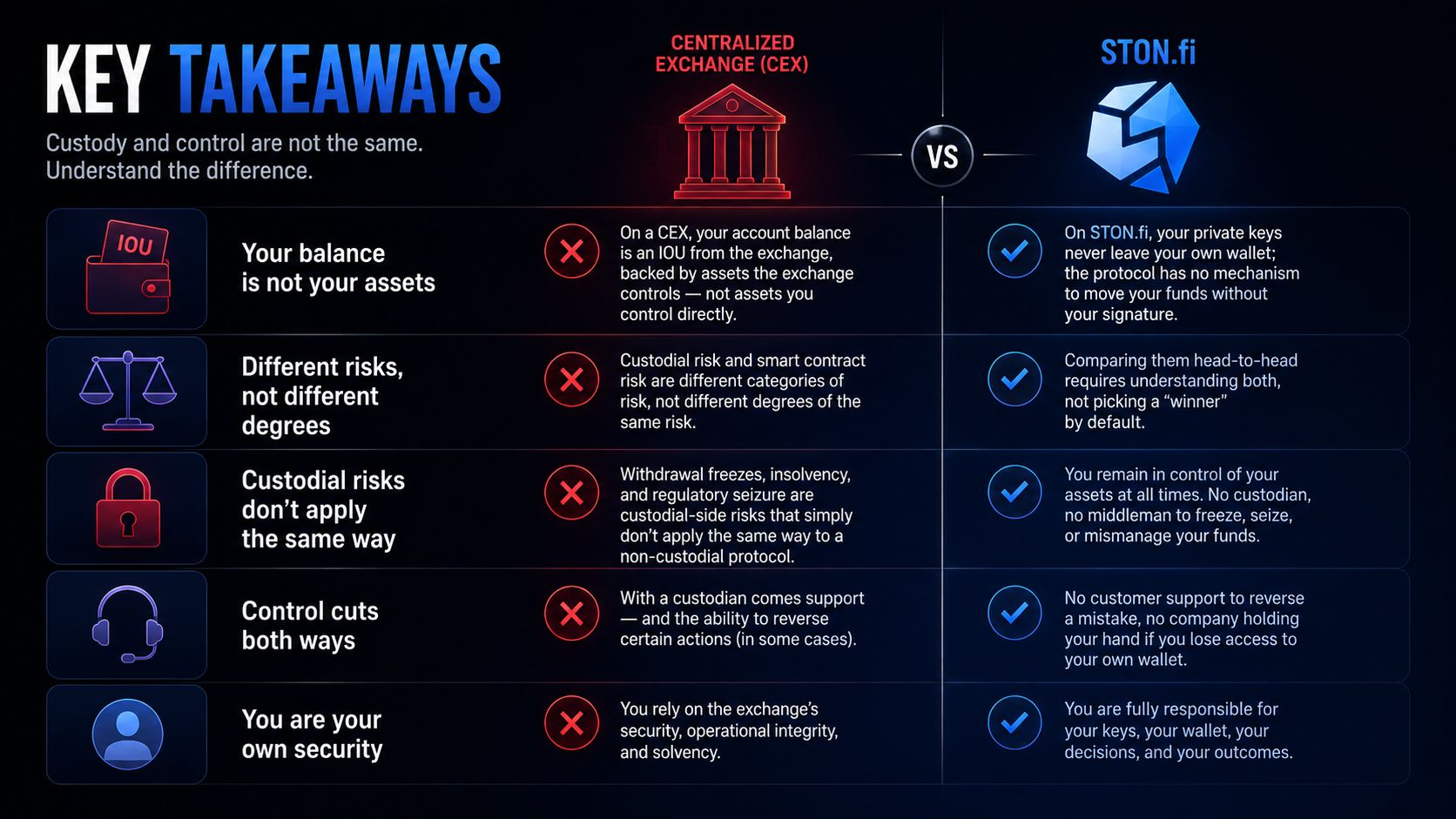
On a CEX, your account balance is an IOU from the exchange, backed by assets the exchange controls — not assets you control directly.
On STON.fi, your private keys never leave your own wallet; the protocol has no mechanism to move your funds without your signature.
Custodial risk and smart contract risk are different categories of risk, not different degrees of the same risk — comparing them head-to-head requires understanding both, not picking a "winner" by default.
Withdrawal freezes, insolvency, and regulatory seizure are custodial-side risks that simply don't apply the same way to a non-custodial protocol.
Control cuts both ways: no customer support to reverse a mistake, no company holding your hand if you lose access to your own wallet.
🔑 What "Custody" Actually Means, Mechanically
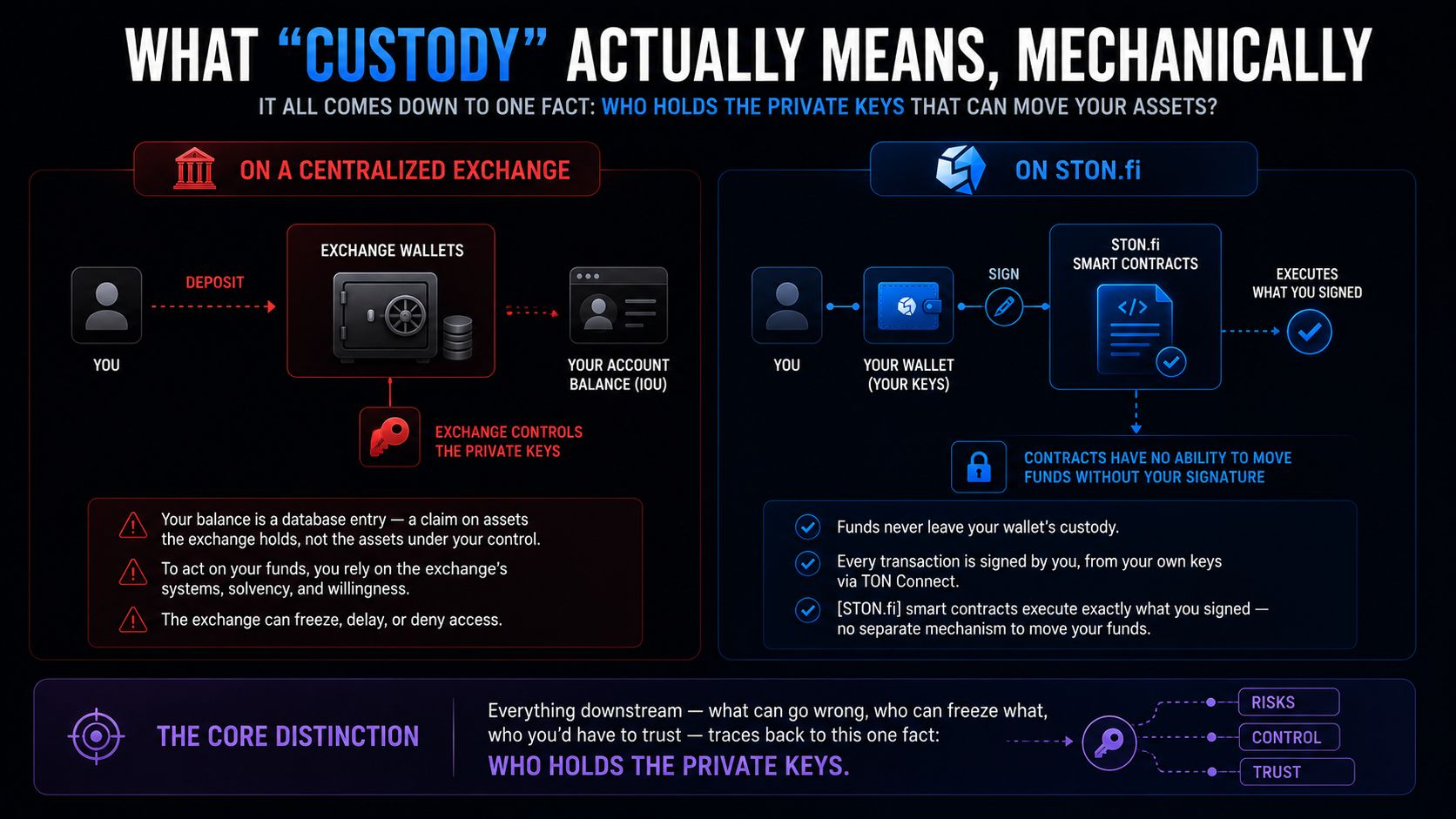
Custody isn't a vague concept — it comes down to one specific, checkable fact: who holds the private keys that can move the asset?
On a centralized exchange: when you deposit funds, they move into wallets controlled by the exchange. Your account balance is a database entry — a claim on assets the exchange holds, not the assets themselves under your control. To act on your own funds, you're relying on the exchange's systems, solvency, and willingness to process your request.
On STON.fi: funds never leave your own wallet's custody at any point during a swap or liquidity deposit. Every transaction is signed by you, from your own keys, through a standard like TON Connect. STON.fi's smart contracts execute what you signed — they have no separate mechanism to move your funds independently of your own signature.
This is the entire distinction underneath every other difference on this list. Everything downstream — what can go wrong, who can freeze what, who you'd have to trust — traces back to this one fact.
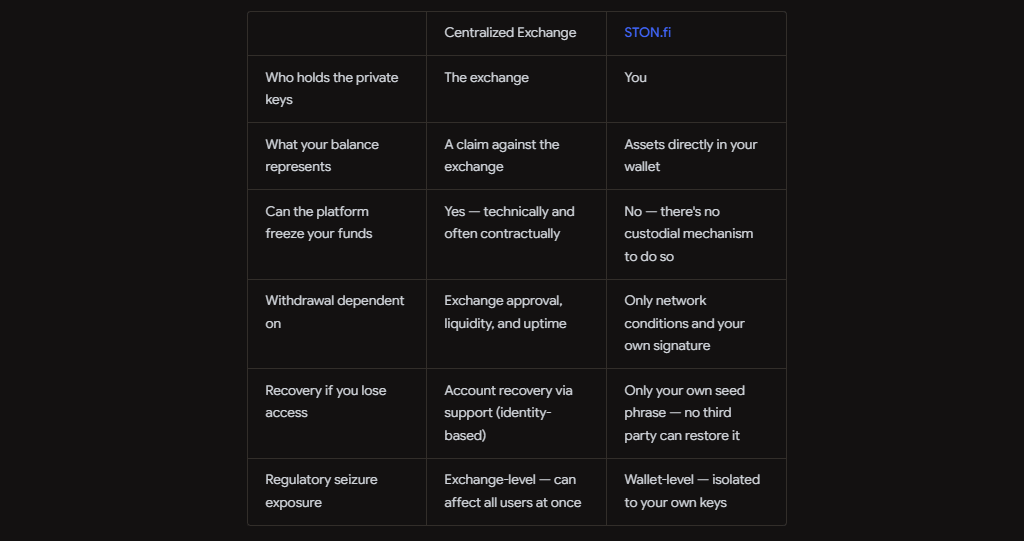
⚖️ Side-by-Side: Where Control Actually Sits
🏦 The Risks You Take On With a Centralized Exchange
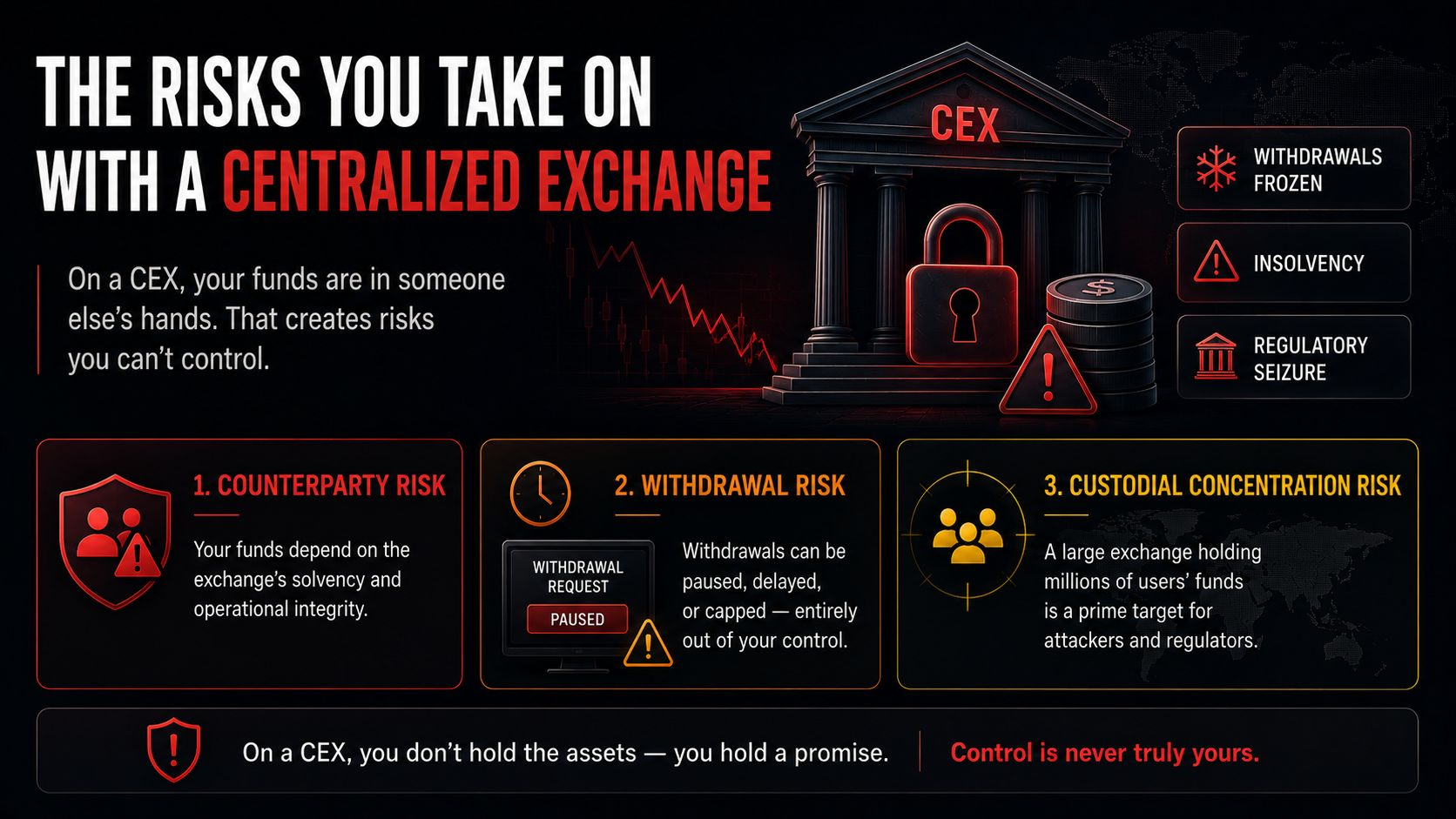
Custodial risk isn't hypothetical — it has a well-documented history. Exchanges have frozen withdrawals during liquidity crunches, become insolvent while owing users far more than they held in reserve, and had assets seized or restricted by regulators, all while the affected users had no on-chain claim of their own to fall back on. None of this requires assuming bad faith — even a well-run exchange is still a single point of failure between you and your own money, by design.
Counterparty risk: your funds' safety depends on the exchange's solvency and operational integrity, not just the underlying blockchain's security.
Withdrawal risk: withdrawals can be paused, delayed, or capped — a decision entirely outside your control.
Custodial concentration risk: a large exchange holding millions of users' funds is an extremely attractive single target, both for attackers and for regulatory action.
🔐 The Risks You Take On With STON.fi Instead
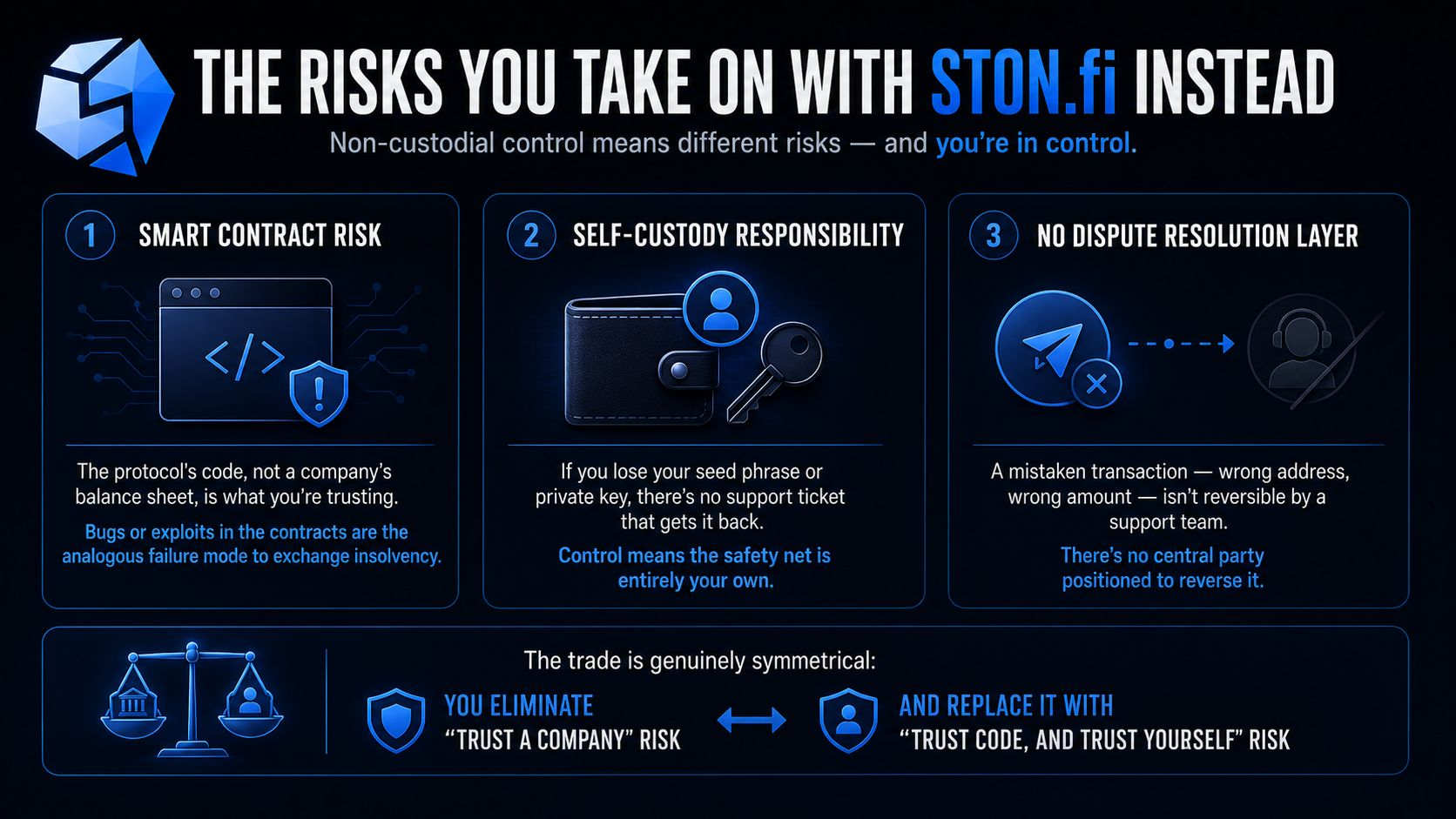
Non-custodial control doesn't mean risk-free — it means a different category of risk that you're now personally responsible for managing:
Smart contract risk: the protocol's code, not a company's balance sheet, is what you're trusting. Bugs or exploits in the contracts themselves are the analogous failure mode to exchange insolvency.
Self-custody responsibility: if you lose your seed phrase or private key, there's no support ticket that gets it back. Control means the safety net is entirely your own.
No dispute resolution layer: a mistaken transaction — wrong address, wrong amount — isn't reversible by a support team, because there's no central party positioned to reverse it.
The trade is genuinely symmetrical: you eliminate the "trust a company" risk and replace it with "trust code, and trust yourself to manage your own keys correctly."
🧩 What This Actually Means for How You Use Each One
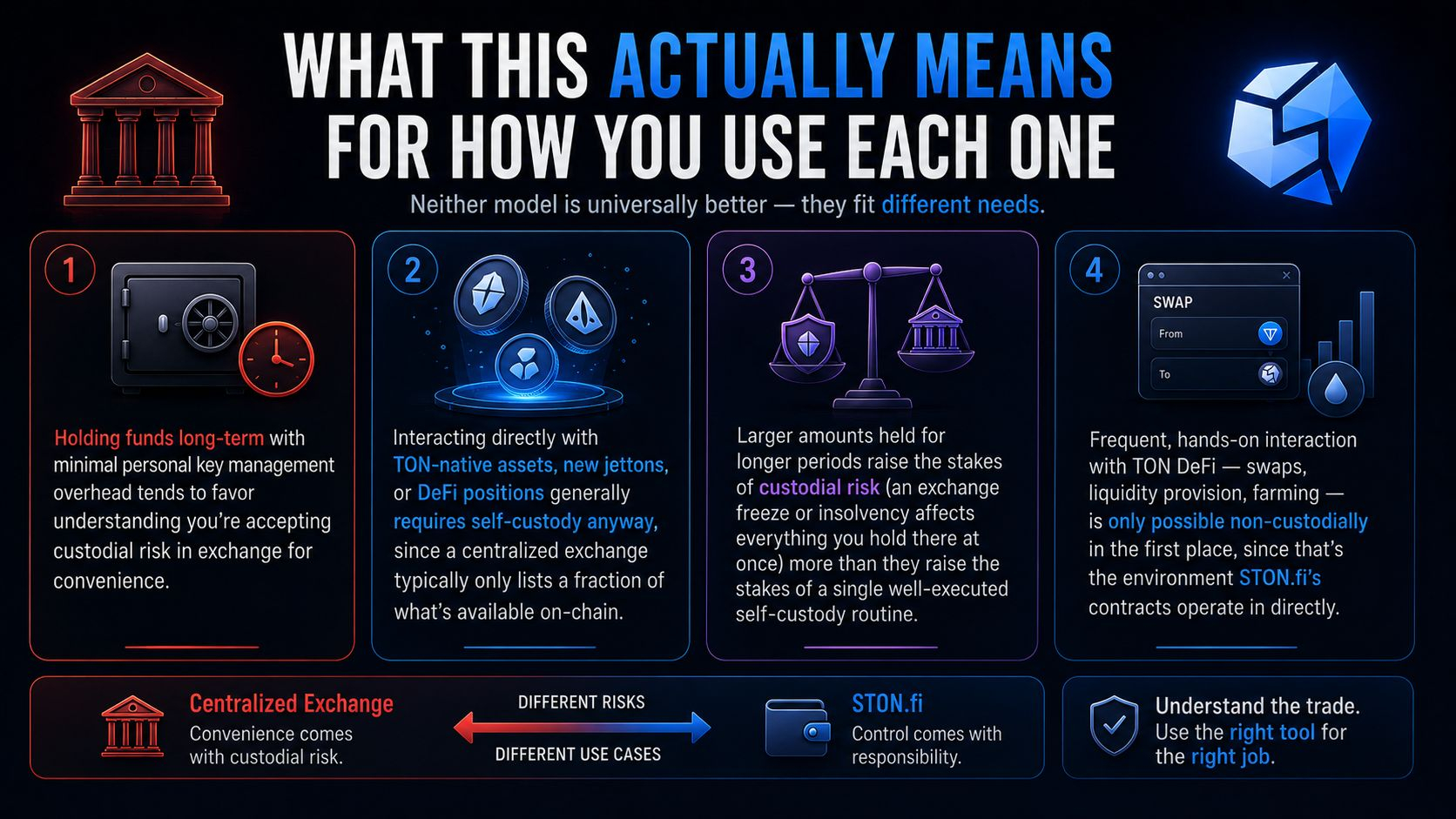
Neither model is universally better — they fit different needs:
Holding funds long-term with minimal personal key management overhead tends to favor understanding you're accepting custodial risk in exchange for convenience.
Interacting directly with TON-native assets, new jettons, or DeFi positions generally requires self-custody anyway, since a centralized exchange typically only lists a fraction of what's available on-chain.
Larger amounts held for longer periods raise the stakes of custodial risk (an exchange freeze or insolvency affects everything you hold there at once) more than they raise the stakes of a single well-executed self-custody routine.
Frequent, hands-on interaction with TON DeFi — swaps, liquidity provision, farming — is only possible non-custodially in the first place, since that's the environment STON.fi's contracts operate in directly.
🛠 Questions Worth Asking Before You Choose
If this platform froze withdrawals tomorrow, would I even find out why, or when it would be lifted?
If I lose access to my own wallet, do I have a real backup of my seed phrase — not just an assumption that I do?
Am I holding this amount here because it's actually the best fit, or because it's simply where I first put it?
Does this specific asset even exist on a centralized exchange, or is self-custody the only way to hold it at all?
🧭 Conclusion
"Custody and control" isn't marketing language — it's a mechanical fact about who can move your funds and under what conditions. A centralized exchange trades your direct control for convenience and a support team standing between you and mistakes. STON.fi keeps that control with you the entire time, and hands you the responsibility that comes with it. Neither is the "correct" answer in the abstract — but knowing exactly which risks you're accepting, instead of just repeating a slogan, is what actually lets you choose deliberately instead of by default.
❓ Frequently Asked Questions
Is STON.fi automatically safer than a centralized exchange because it's non-custodial? Not automatically. It removes custodial risk — exchange insolvency, withdrawal freezes, counterparty failure — but replaces it with smart contract risk and full personal responsibility for key management. Which is "safer" depends on which risks you're better equipped to manage.
Can STON.fi freeze or reverse my transaction the way an exchange might? No. Because STON.fi never takes custody of your funds, it has no mechanism to freeze, reverse, or hold a transaction — every action is executed based on a transaction you signed yourself.
What happens if I send funds to the wrong address on STON.fi? There's no central party positioned to reverse it, unlike a support-driven dispute process some centralized exchanges offer for certain cases. Double-checking addresses before confirming matters more in a non-custodial environment for exactly this reason.
Does using a centralized exchange mean my funds are guaranteed to be safe? No. Centralized exchanges carry counterparty and solvency risk regardless of reputation size — history includes multiple cases of large, established exchanges freezing withdrawals or becoming insolvent while still holding customer deposits on their books.
$BTC
