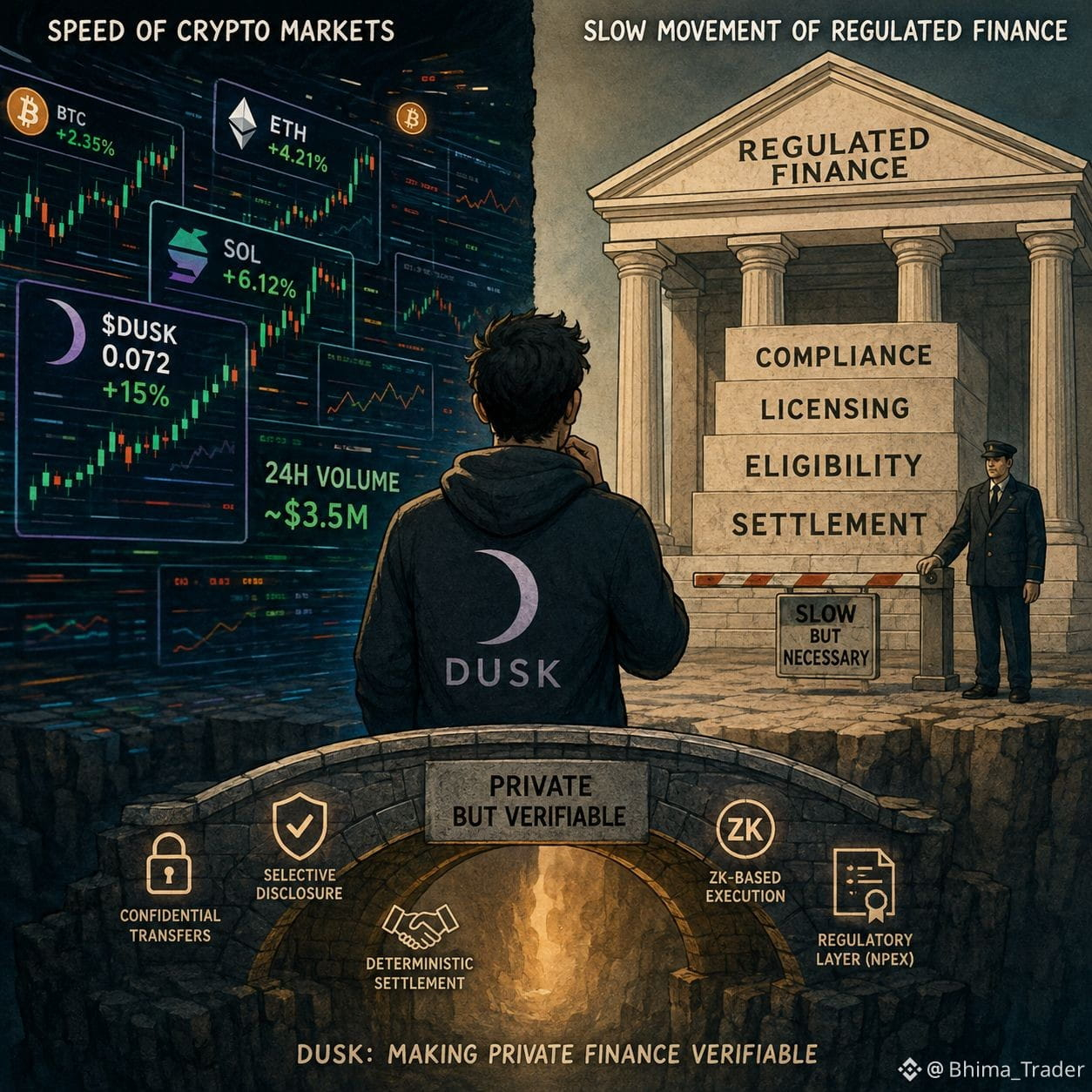
Ich finde das Interessante an $DUSK im Moment ist nicht nur der Preis. Es ist der Widerspruch zwischen der Geschwindigkeit, mit der Krypto-Märkte handeln, und der Langsamkeit, mit der reguliertes Finanzwesen tatsächlich vorankommen kann.
Heute liegt DUSK bei etwa 0,072 $, mit einem Volumen von rund 3,5 Mio. $ in 24 Stunden und einem ~15-%-Plus über die vergangenen 7 Tage.
Aber das hat meine Aufmerksamkeit geweckt:
Je privater die Finanzmärkte werden, desto wichtiger wird Verifizierbarkeit.
Das klingt zunächst widersprüchlich.
Wenn sensible Finanzdaten verborgen sind, wie sollen dann Regulierer, Gegenparteien oder Institutionen wissen, dass die Regeln eingehalten wurden?
Dusk’s Architektur ist genau um diese Spannung herum gebaut.
Die native Layer 1 kombiniert vertrauliche Übertragungen, selektive Offenlegung, deterministisches Settlement und ZK-basierte Ausführung. Auf der EVM-Seite kombiniert Hedger homomorphe Verschlüsselung mit Zero-Knowledge-Beweisen, sodass Berechnungen auf geschützten Daten stattfinden können und dennoch verifizierbare Ergebnisse produziert werden.
Dann gibt es noch die regulatorische Ebene.
Die NPEX-Beziehung von Dusk bietet Zugang zu MTF-, Broker- und ECSP-Lizenzen, wobei DLT-TSS als „in Fortschritt“ beschrieben wird. Die wichtige Idee ist nicht einfach, Lizenzen zu haben – es geht darum, Compliance näher an das Protokoll und den Asset-Lifecycle selbst heranzubringen.
Das verändert, wie ich Tokenisierung betrachte.
Das eigentliche Problem ist nicht, einen Vermögenswert auf die Chain zu bringen.
Es ist, Privatsphäre, Berechtigung, Compliance, Handel und Settlement so zusammenarbeiten zu lassen, dass nicht alles für jeden offengelegt wird.
Mein Fazit ist also ganz einfach:
Dusk versucht nicht nur, Finanzen privat zu machen.
Es versucht, privates Finanzwesen verifizierbar zu machen.
Und bei regulierten On-Chain-Märkten könnte dieser Unterschied der Zünglein an der Waage sein – zwischen einem Blockchain-Experiment und einer echten finanziellen Infrastruktur.
@Dusk #dusk $DUSK
Heute liegt DUSK bei etwa 0,072 $, mit einem Volumen von rund 3,5 Mio. $ in 24 Stunden und einem ~15-%-Plus über die vergangenen 7 Tage.
Aber das hat meine Aufmerksamkeit geweckt:
Je privater die Finanzmärkte werden, desto wichtiger wird Verifizierbarkeit.
Das klingt zunächst widersprüchlich.
Wenn sensible Finanzdaten verborgen sind, wie sollen dann Regulierer, Gegenparteien oder Institutionen wissen, dass die Regeln eingehalten wurden?
Dusk’s Architektur ist genau um diese Spannung herum gebaut.
Die native Layer 1 kombiniert vertrauliche Übertragungen, selektive Offenlegung, deterministisches Settlement und ZK-basierte Ausführung. Auf der EVM-Seite kombiniert Hedger homomorphe Verschlüsselung mit Zero-Knowledge-Beweisen, sodass Berechnungen auf geschützten Daten stattfinden können und dennoch verifizierbare Ergebnisse produziert werden.
Dann gibt es noch die regulatorische Ebene.
Die NPEX-Beziehung von Dusk bietet Zugang zu MTF-, Broker- und ECSP-Lizenzen, wobei DLT-TSS als „in Fortschritt“ beschrieben wird. Die wichtige Idee ist nicht einfach, Lizenzen zu haben – es geht darum, Compliance näher an das Protokoll und den Asset-Lifecycle selbst heranzubringen.
Das verändert, wie ich Tokenisierung betrachte.
Das eigentliche Problem ist nicht, einen Vermögenswert auf die Chain zu bringen.
Es ist, Privatsphäre, Berechtigung, Compliance, Handel und Settlement so zusammenarbeiten zu lassen, dass nicht alles für jeden offengelegt wird.
Mein Fazit ist also ganz einfach:
Dusk versucht nicht nur, Finanzen privat zu machen.
Es versucht, privates Finanzwesen verifizierbar zu machen.
Und bei regulierten On-Chain-Märkten könnte dieser Unterschied der Zünglein an der Waage sein – zwischen einem Blockchain-Experiment und einer echten finanziellen Infrastruktur.
@Dusk #dusk $DUSK