🇨🇦 CANADA’S 50% RETALIATORY TARIFFS PUT BITCOIN UNDER MACRO PRESSURE
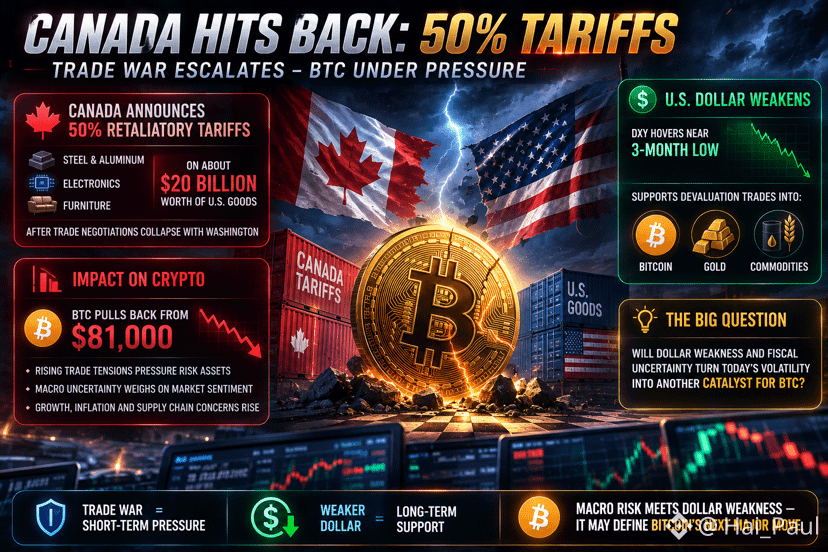
Canada has announced retaliatory tariffs of up to 50% on roughly $20 billion worth of U.S. goods, including steel, aluminum, electronics and furniture, following the breakdown of trade negotiations with Washington. The move comes as tensions between the two economies intensify, adding another layer of uncertainty to an already fragile global market.
RISK ASSETS FEEL THE PRESSURE
Rising trade tensions are increasing concerns over global growth, inflation and supply-chain disruption. Bitcoin, which has become increasingly sensitive to macroeconomic conditions, has also faced selling pressure. After approaching the $81,000 area, BTC pulled back as investors reassessed risk amid growing uncertainty.
The key issue is not simply the tariff itself. Markets are watching whether escalating trade restrictions could trigger a broader risk-off environment, potentially reducing liquidity flowing into higher-risk assets such as cryptocurrencies.
💵 A WEAKER DOLLAR CHANGES THE PICTURE
At the same time, the U.S. Dollar Index has been hovering near a three-month low. A weaker dollar can strengthen the relative appeal of scarce and alternative assets, including Bitcoin, gold and commodities.
This creates an interesting macro tension: trade wars can initially pressure BTC through risk-off sentiment, while dollar weakness and concerns about currency purchasing power may strengthen Bitcoin’s long-term “debasement hedge” narrative.
THE BIG QUESTION
Will Bitcoin continue reacting as a risk asset, or could persistent dollar weakness and rising fiscal uncertainty eventually turn the current volatility into another catalyst for BTC?
For traders, the battle between macro risk and dollar weakness may define Bitcoin’s next major move.
$BTC
Canada has announced retaliatory tariffs of up to 50% on roughly $20 billion worth of U.S. goods, including steel, aluminum, electronics and furniture, following the breakdown of trade negotiations with Washington. The move comes as tensions between the two economies intensify, adding another layer of uncertainty to an already fragile global market.
RISK ASSETS FEEL THE PRESSURE
Rising trade tensions are increasing concerns over global growth, inflation and supply-chain disruption. Bitcoin, which has become increasingly sensitive to macroeconomic conditions, has also faced selling pressure. After approaching the $81,000 area, BTC pulled back as investors reassessed risk amid growing uncertainty.
The key issue is not simply the tariff itself. Markets are watching whether escalating trade restrictions could trigger a broader risk-off environment, potentially reducing liquidity flowing into higher-risk assets such as cryptocurrencies.
💵 A WEAKER DOLLAR CHANGES THE PICTURE
At the same time, the U.S. Dollar Index has been hovering near a three-month low. A weaker dollar can strengthen the relative appeal of scarce and alternative assets, including Bitcoin, gold and commodities.
This creates an interesting macro tension: trade wars can initially pressure BTC through risk-off sentiment, while dollar weakness and concerns about currency purchasing power may strengthen Bitcoin’s long-term “debasement hedge” narrative.
THE BIG QUESTION
Will Bitcoin continue reacting as a risk asset, or could persistent dollar weakness and rising fiscal uncertainty eventually turn the current volatility into another catalyst for BTC?
For traders, the battle between macro risk and dollar weakness may define Bitcoin’s next major move.
$BTC