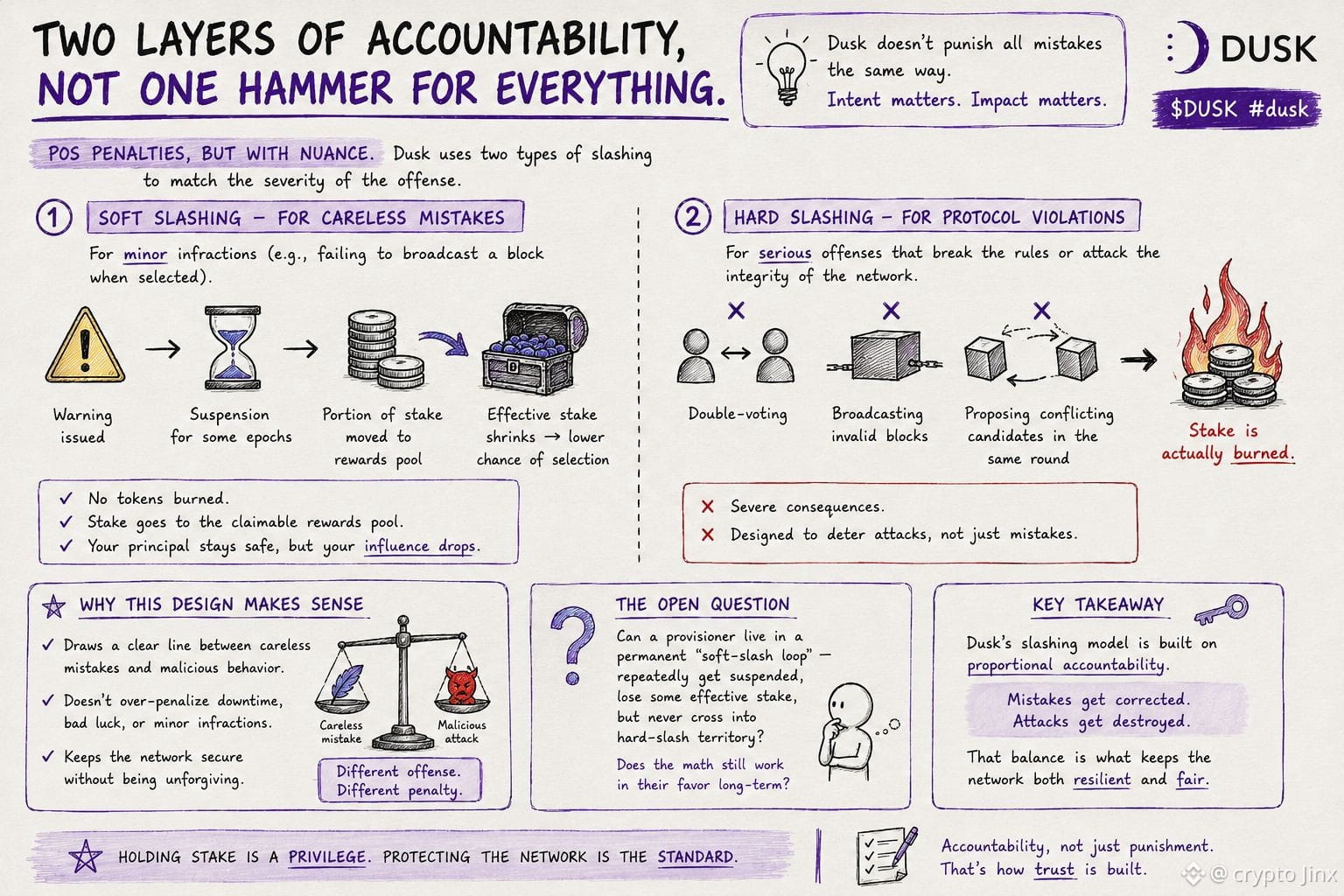
Read through the slashing section of @Dusk 's docs tonight with nothing else going on, and it stopped me for a minute. I'd always assumed PoS penalties worked on one axis — mess up, lose stake, harsher mistake means harsher burn. Simple and blunt. Dusk splits it into two genuinely different mechanisms instead.
Minor infractions — like a provisioner failing to broadcast a block when selected — trigger soft slashing. Nothing gets burned. Instead you get a warning, then suspension for a number of epochs, and a portion of your stake gets moved out of active participation into the claimable rewards pool, which just shrinks your effective weight in the next selection lottery. Your principal is intact. You're just less likely to get picked for a while.
Hard slashing is the one that actually burns tokens, and it's reserved for real protocol violations — double-voting, broadcasting invalid blocks, proposing conflicting candidates in the same round. That's the tier where stake actually gets destroyed, not just sidelined.
What I find genuinely well thought out here: the design draws a real line between "made a careless mistake" and "actively attacked the network," and only the second one costs you money. Most PoS systems I've looked at blur that line — any fault gets treated as financially punishable, which arguably over-penalizes simple downtime or bad luck. This tiering gives room to be sloppy without bleeding out for it.
The open question I can't fully resolve myself: does that mean a provisioner can sit in a permanent low-grade "soft slack" state — never crossing into hard-slash territory, just repeatedly eating suspensions — and still come out ahead long-term? The docs don't run that math, and I haven't worked it out either.
Curious if anyone's seen this exact soft/hard tiered slashing split on other PoS chains — drop a name and I'll go dig into it.
$DUSK #dusk @Dusk $BMT $TMX
Minor infractions — like a provisioner failing to broadcast a block when selected — trigger soft slashing. Nothing gets burned. Instead you get a warning, then suspension for a number of epochs, and a portion of your stake gets moved out of active participation into the claimable rewards pool, which just shrinks your effective weight in the next selection lottery. Your principal is intact. You're just less likely to get picked for a while.
Hard slashing is the one that actually burns tokens, and it's reserved for real protocol violations — double-voting, broadcasting invalid blocks, proposing conflicting candidates in the same round. That's the tier where stake actually gets destroyed, not just sidelined.
What I find genuinely well thought out here: the design draws a real line between "made a careless mistake" and "actively attacked the network," and only the second one costs you money. Most PoS systems I've looked at blur that line — any fault gets treated as financially punishable, which arguably over-penalizes simple downtime or bad luck. This tiering gives room to be sloppy without bleeding out for it.
The open question I can't fully resolve myself: does that mean a provisioner can sit in a permanent low-grade "soft slack" state — never crossing into hard-slash territory, just repeatedly eating suspensions — and still come out ahead long-term? The docs don't run that math, and I haven't worked it out either.
Curious if anyone's seen this exact soft/hard tiered slashing split on other PoS chains — drop a name and I'll go dig into it.
$DUSK #dusk @Dusk $BMT $TMX