
I’ve been watching how Vanar positions itself, and the thing that keeps standing out to me is how consistently it tries to solve a very unglamorous problem that most chains avoid talking about, which is the uncomfortable gap between “a blockchain that works” and “an application that feels normal to real users who don’t want to learn anything new just to click a button.”
When I look at Vanar through that lens, I don’t end up thinking about it as another speed race or another technical flex, because the story it’s building is more about making Web3 act like a quiet engine in the background while the front-end experience stays smooth, familiar, and fast enough that people stop noticing they’re using a blockchain at all, which is exactly the kind of approach you see in products that want mass adoption rather than attention from only the crypto crowd.
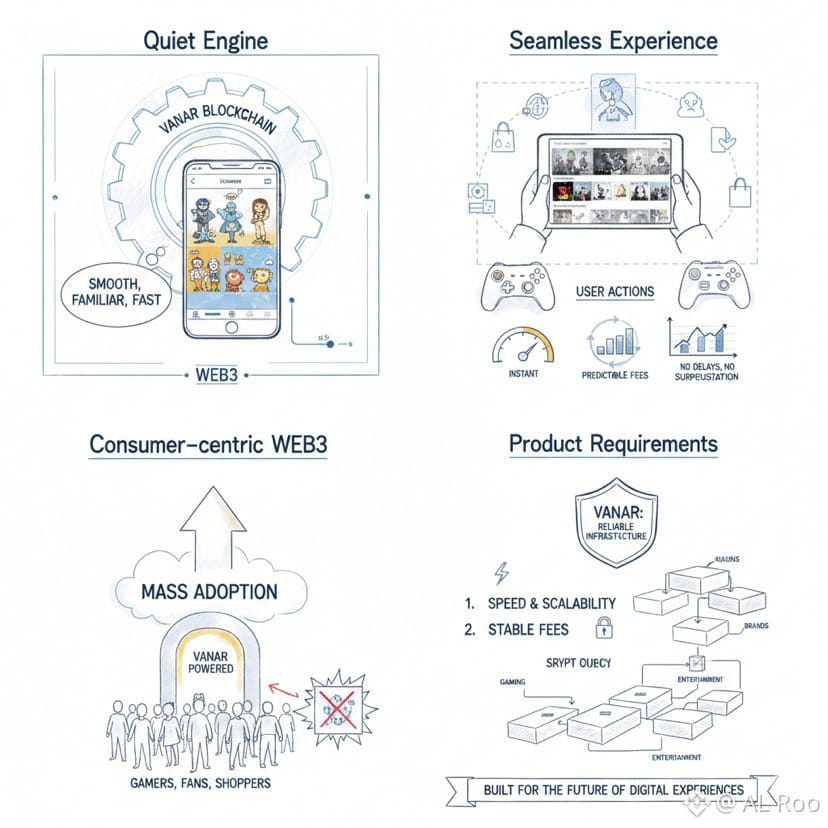
The consumer focus also doesn’t feel random to me, because gaming, entertainment, and brand-led experiences are the types of environments where users take hundreds of small actions without thinking, and where a delay of a few seconds or a fee that changes unpredictably turns into frustration very quickly, so a chain that wants to be taken seriously in those verticals has to treat speed and fee stability like product requirements rather than marketing claims, and Vanar repeatedly frames itself like it understands that pressure.
What I find most interesting is the way Vanar tries to make “fees” and “onboarding” feel less like a crypto tax and more like a normal product behavior, because if you want applications that scale beyond early adopters then the fee experience has to be predictable enough for builders to design around it, and the onboarding path has to be simple enough that users don’t feel like they’re being trained, which is why I keep coming back to the idea that Vanar’s real fight is not against other chains but against friction itself.
When a project starts leaning into “fixed fee” logic, I usually pay attention, not because fixed fees are flashy, but because they signal the team is thinking in the same way consumer product teams think, meaning they’re trying to make costs feel stable and boring rather than volatile and surprising, since surprises are fine in trading but they destroy trust in mainstream applications where users want consistency and brands want predictable operating costs.
The other layer that I’ve noticed in Vanar’s direction is that it doesn’t only talk like a chain that settles transactions, because it increasingly describes itself like a broader stack that wants to support smarter application behavior, and I read that as an attempt to move closer to where the world is heading, where applications are not just “do a transaction” machines but systems that interpret data, personalize flows, and automate choices in ways that feel natural for users, while still keeping ownership and state verifiable.
From an observer’s perspective, that shift matters because it changes what success looks like, and it forces a more honest measurement, since a chain can be fast and cheap and still fail if it doesn’t become a place where builders actually ship products people use daily, and that’s why I’m less interested in one-off announcements and more interested in whether Vanar’s ecosystem starts producing repeatable usage that looks like real product-market fit rather than seasonal attention.
When I think about the token, I don’t try to make it complicated, because a token story becomes strong when it is tied to repeated necessity rather than optional hype, and the cleanest way to view $VANRY is as the fuel that becomes more important when the network becomes busier, with the long-term question being whether Vanar can create enough genuine activity that demand begins to feel structural instead of purely speculative.
The on-chain presence of the ERC-20 contract you shared is also a useful anchor for me, because it gives a reality check that doesn’t depend on anyone’s narrative, since holders, transfers, and supply information create a live heartbeat you can look at whenever you want, and I’ve learned over time that having at least one reliable, verifiable reference point keeps analysis from drifting into wishful thinking.
If I had to explain why Vanar could matter in a way that feels grounded, I’d say it comes down to whether it can become a chain where consumer-scale applications can operate with a fee model and responsiveness that developers can confidently build around, because once developers can predict cost and performance they can design better experiences, and once experiences feel simple the user base expands, and once the user base expands volume starts showing up in a way that changes how the whole ecosystem feels.
At the same time, I also think the evaluation is brutally simple, because none of the positioning matters if the ecosystem doesn’t translate into sticky products, so the next phase for Vanar, at least from how I’m observing it, should be judged on application growth, retained usage, and visible on-chain activity that comes from real behavior rather than short bursts of attention.
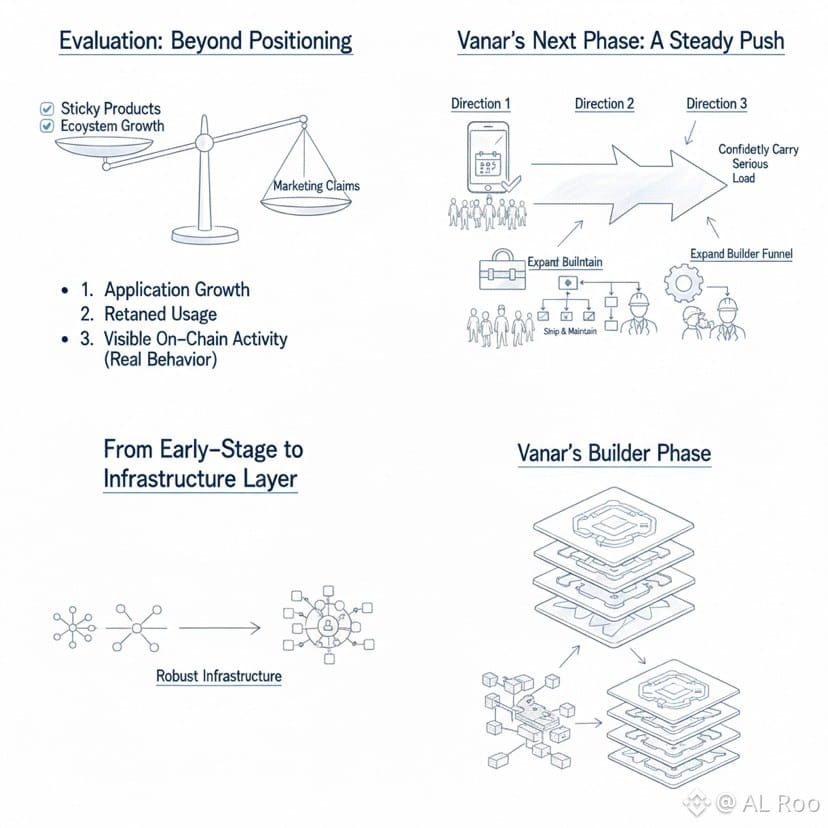
When people ask me what I think is “next,” I don’t jump to big predictions, because what I expect is a steady push in three directions that naturally follow from Vanar’s own framing, where the first direction is proving the consumer thesis through applications that can sustain daily usage, the second direction is expanding the builder funnel so teams feel it is easier to ship and maintain products inside the ecosystem, and the third direction is maturing participation mechanics over time so the network looks less like an early-stage system and more like an infrastructure layer that can confidently carry serious load.
My takeaway, based purely on observation and the way the project is choosing to present itself, is that Vanar is trying to win by making blockchain feel less like an event and more like a default background layer, and if it manages to turn that philosophy into real usage then the entire conversation around the chain becomes more practical, because at that point you stop debating narratives and you start watching metrics that reflect genuine demand.
