


Bitcoin's Rally Explained: Treasury Buybacks & Shorts
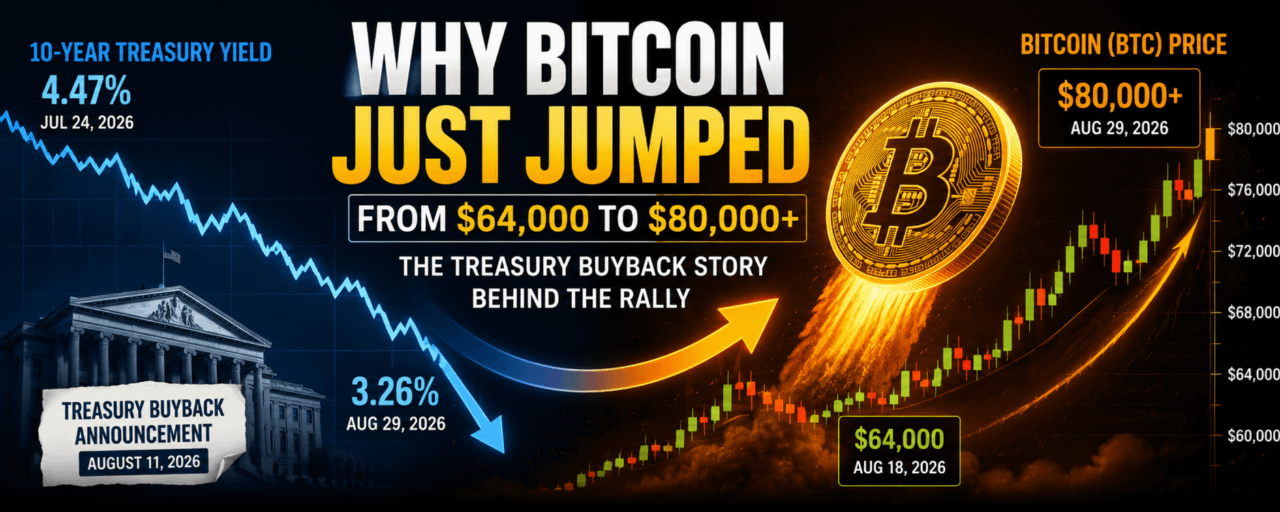
Bitcoin traded near $64,000 on August 18. A week later, it was changing hands above $80,000. That's a move of roughly 25% in seven trading days, and it didn't start with a crypto headline. It started with a bond market announcement most traders weren't watching.
What actually happened
On August 19, the U.S. Treasury Department said it would at least double the size of its debt buyback operations for longer-dated bonds, the 10-to-20-year and 20-to-30-year sectors, taking the ceiling from $2 billion to at least $4 billion per operation. Treasury Secretary Scott Bessent called it a way to "make a market" in those securities during thin August trading, and said the size could go higher still. The change takes effect September 9 and runs through early November.
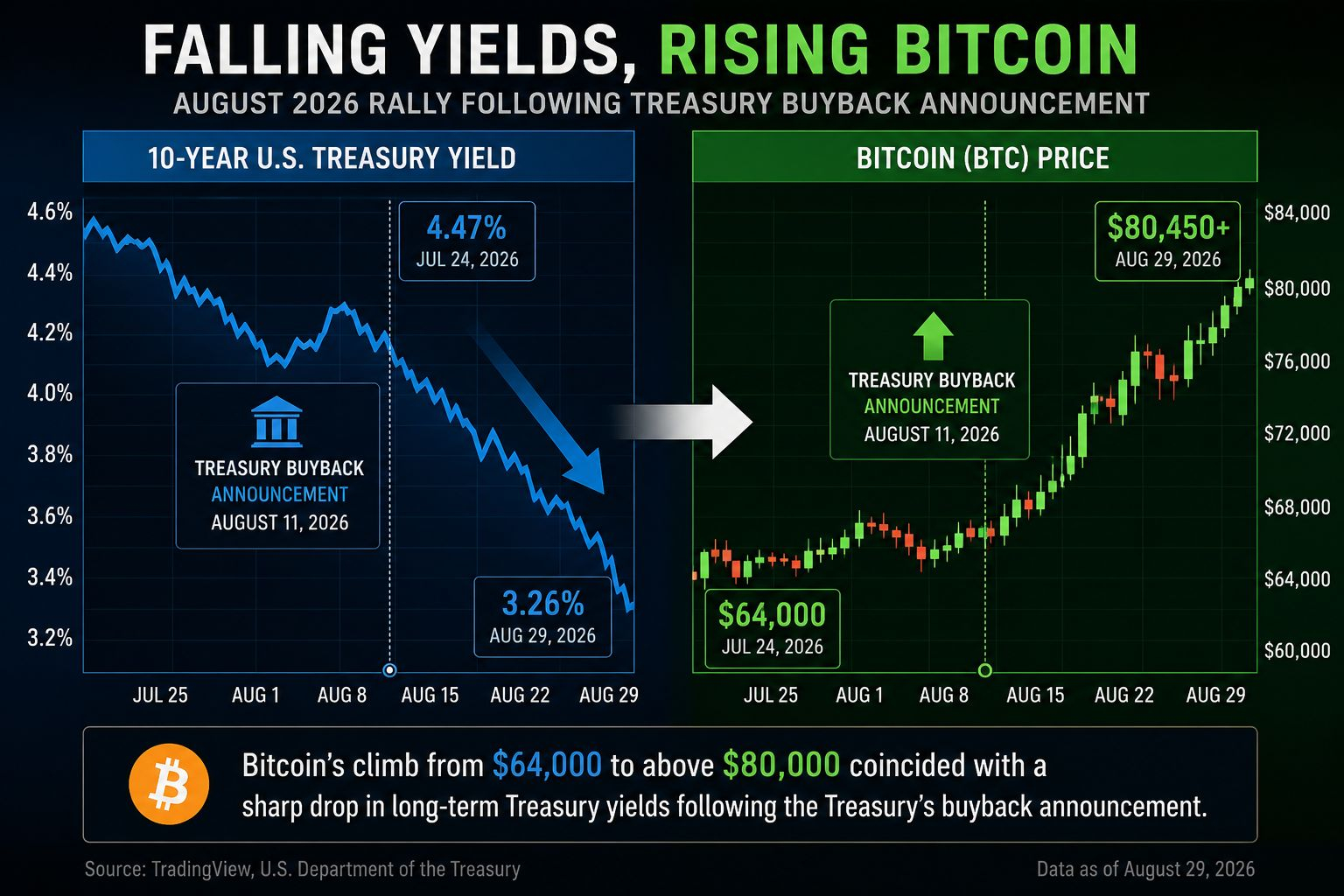
Bond traders read the move as a signal that Washington would lean against rising long-term borrowing costs. The reaction was immediate: the benchmark 10-year Treasury yield fell to 4.647%, and the 30-year dropped to 5.196% the same day, according to Treasury data cited by CNBC.
Lower long-term yields matter for Bitcoin for a specific reason: they reduce the return available from parking money in risk-free government debt, which pushes some of that capital toward higher-risk, higher-reward assets. That's the first domino.
The short squeeze that followed
Bitcoin had spent weeks trading below $67,000, and a large share of leveraged traders were positioned for the price to keep falling. When it didn't, those bets became losses, and exchanges began force-closing them automatically. That's a liquidation.
The scale was unusual. On August 19 alone, CoinGlass data put crypto short liquidations at $1.4 billion to $1.7 billion, with Bitcoin accounting for the largest share. Reuters and Bloomberg both flagged it as one of the largest single-day short-liquidation events since 2021. By the end of that week, cumulative short liquidations across crypto markets had passed $4 billion, according to Fortune and CoinDesk reporting on CoinGlass data.
Here's why that number matters more than it might seem to: liquidation-driven buying isn't the same as investors deciding Bitcoin is worth more. It's forced buying from traders covering losing bets. Every forced purchase pushed the price higher, which triggered the next wave of liquidations. That mechanical loop is what turned a bond market announcement into a 25% move in a week.
Where the ETF money fits in
The third piece is where the mechanical rally started to look more durable. U.S. spot Bitcoin ETFs took in $517 million on August 19, their largest single-day inflow since May 4. The next day brought $606 million, the biggest since May 1, extending a four-day inflow streak. By August 24, that streak had reached seven consecutive days, with $337.56 million added on that day alone, according to The Block.
ETF inflows work differently from short covering. A fund manager buying Bitcoin to back new ETF shares is acquiring real coins to hold, not closing out a losing bet. That's a persistent source of demand rather than a one-time mechanical push, and it's the reason analysts have been more willing to call this a genuine demand shift rather than just a squeeze.
Three forces, one direction
Catalyst What happened Why it mattered for Bitcoin Treasury buybacks Doubled to $4B per operation, effective Sept 9 Signaled liquidity support, pulled long-term yields down Falling yields 10-year yield fell to 4.647% Lowered the opportunity cost of holding risk assets Short liquidations Over $4 billion liquidated in one week Forced buying accelerated the price move ETF inflows Seven straight days of net inflows Added durable demand behind the squeeze.
Is the rally still running?
As of August 25, Bitcoin is trading around $79,000 to $80,500, up roughly 22% to 28% for the month, according to CoinGecko and multiple market trackers. The immediate question traders are watching is whether it can hold above $80,000 or whether the move was mostly the short squeeze working itself out.
There are reasons for caution. Fixed-income strategists quoted by CNBC and the Council on Foreign Relations noted that a buyback program doesn't resolve the underlying pressures pushing yields higher in the first place: a widening federal deficit, inflation still running above the Federal Reserve's target, and heavy corporate bond issuance competing for the same buyers. Yields ticked back up within a day of the initial announcement, which is why Bessent went public a second time to reaffirm that $4 billion was a floor, not a ceiling.
There's also a leverage question sitting underneath the rally. By August 24, notional open interest in Bitcoin derivatives was estimated near $48 billion, roughly 750,000 BTC worth of contracts, per CoinDesk reporting. That's a lot of leverage still in the system, which cuts both ways: it can fuel further squeezes on the way up, but it also raises the odds of sharp pullbacks if momentum stalls.
What to watch next
Bond market follow-through. Whether long-term yields stay lower once the actual buyback operations begin on September 9, or drift back up as they briefly did the day after the announcement.
ETF flow continuity. Whether daily inflows keep climbing or start fading as the initial catalyst gets priced in.
Derivatives positioning. Elevated open interest means the market can still move sharply in either direction on relatively modest triggers.
The Fed's September decision. Rate policy signals will interact directly with whatever the Treasury is doing on the long end of the curve.
The rally didn't start with a crypto-specific catalyst, and that's part of what makes it different from prior squeezes. Whether it holds depends less on crypto sentiment and more on whether Washington's bond market intervention actually works.
FAQ
Why did Bitcoin suddenly rally in August 2026? The rally followed a U.S. Treasury announcement that it would double its long-term bond buyback size to at least $4 billion per operation. That pushed the 10-year yield down to 4.647%, which triggered a wave of short liquidations totaling more than $4 billion over the following week, amplified by seven straight days of net inflows into spot Bitcoin ETFs.
Is this rally driven by real demand or just short covering? Both. The initial move on August 19 to 20 was driven largely by forced short liquidations. But the sustained streak of Bitcoin ETF inflows through August 24, including a seventh consecutive day of net buying, suggests real institutional demand followed the squeeze rather than the rally being purely mechanical.
Can Bitcoin hold above $80,000? That depends on whether Treasury yields stay lower once the actual buyback operations start on September 9, whether ETF inflows continue, and how the roughly $48 billion in outstanding Bitcoin derivatives positions unwind. Elevated leverage in the market means sharp moves in either direction remain possible.
#Bitcoin #BTC #CryptoNews #TreasuryBuybacks #BitcoinETF