


Spent some time reading and analysing DUSK
And here’s the core realization that completely changes how you look at this project: everyone talks about RWA tokenization like it’s a single bucket. It isn't.
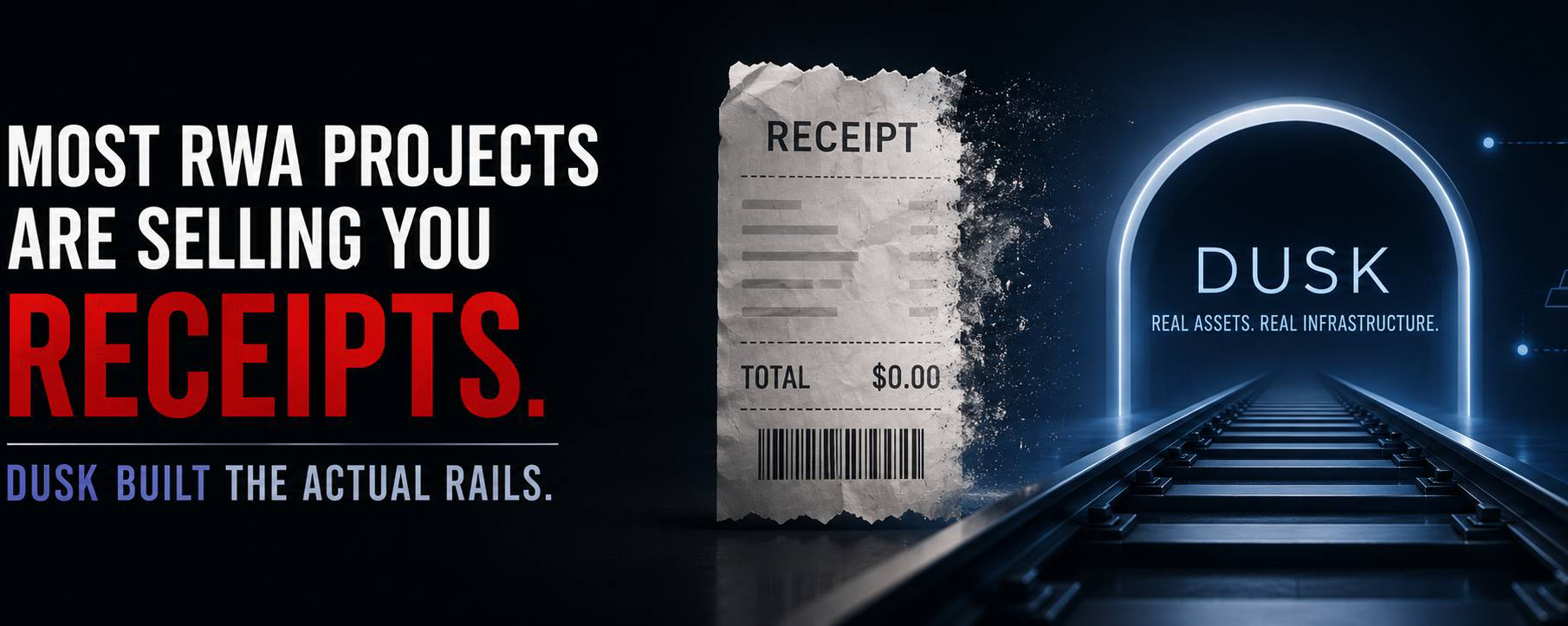
Most of what people call RWA is basic wrapping. A bond sits in some custodian's database, a protocol mints an ERC-20 token representing a claim on it, and everyone pretends that's on-chain finance. The actual asset stays trapped in traditional infrastructure the token is just a digital receipt. Dusk’s own team calls this out plainly: slapping a token skin on top of old rails doesn't solve settlement delays or fragmented compliance, it just covers them up.
Native issuance is a completely different monster:
the asset is born directly on-chain. Transfer restrictions, compliance rules, and clearing logic are written into the protocol layer itself, not added as an after-market band-aid. It's a massively harder legal and engineering problem which is exactly why most projects skip it and stick to basic wrappers. Real native issuance forces you to secure actual regulatory licenses instead of just deploying a smart contract.
The Infrastructure: Real Rails, Not Sandbox Demos
Dusk isn't pitching theoretical adoption. Their key partner, NPEX, is a fully regulated Dutch exchange holding an MTF, Broker, and ECSP license (giving them passporting rights for retail-funded investment products across the EU), with a DLT-TSS license in the pipeline. The compliance isn't sitting on top of the code; it’s directly inherited from a licensed institution handling around €300M in assets.
The rest of the ecosystem stack plugs directly into this pipeline:
1- Chainlink: CCIP enables cross-chain movement for NPEX’s tokenized assets, while DataLink and Data Streams feed NPEX exchange data on-chain as a verified oracle feed.
2- Quantoz (EURQ): A MiCA-regulated digital euro that gives the network a native, compliant fiat settlement currency.
3- Cordial Systems: Handles institutional custody. Regulated capital literally cannot move without clear, compliant custody answers.
The Tech Layer: DuskEVM & Hedger
The technical architecture boils down to two core components:
1. DuskEVM DuskEVM provides full EVM compatibility—allowing standard Solidity contracts, Hardhat, Foundry, and MetaMask tooling to run seamlessly while settling back to the Dusk base layer (DuskDS) for data availability and finality. Developers get to keep their existing Ethereum workflows without sacrificing compliance.
2. Hedger (Private & Auditable) Pure ZK-privacy is often a non-starter for financial regulators because it creates a black box. Hedger pairs ZK proofs with homomorphic encryption (specifically ElGamal over elliptic curves). Transfer values and account balances remain end-to-end encrypted to the public, yet remain fully provable and auditable to authorized regulators. Proof generation runs in-browser under 2 seconds providing privacy without forcing institutions into a trade-off against regulatory compliance.
The User Interface: Dusk Trade
Dusk Trade operates as the front-end execution gateway a neobroker layer designed for native tokenized assets. It handles wallet binding, onboarding, order matching, and settlement UX. The roadmap targets money market funds, bonds, and structured ETFs sourced directly through NPEX and 21X.
Regulated financial markets move at a bureaucratic pace. Licenses take time, institutional onboarding is a multi-year effort, and execution risks remain real. The DuskEVM sequencer architecture and Dusk Trade scaling are still actively rolling out.
However, the core distinction remains: while most of the RWA sector focuses on tokenizing existing receipts, Dusk is building privacy and compliance directly into the underlying settlement layer.
Is native issuance with privacy the only path for institutional RWA, or will simple asset wrappers hold the liquidity short-term?
(Not financial advice. DYOR.)