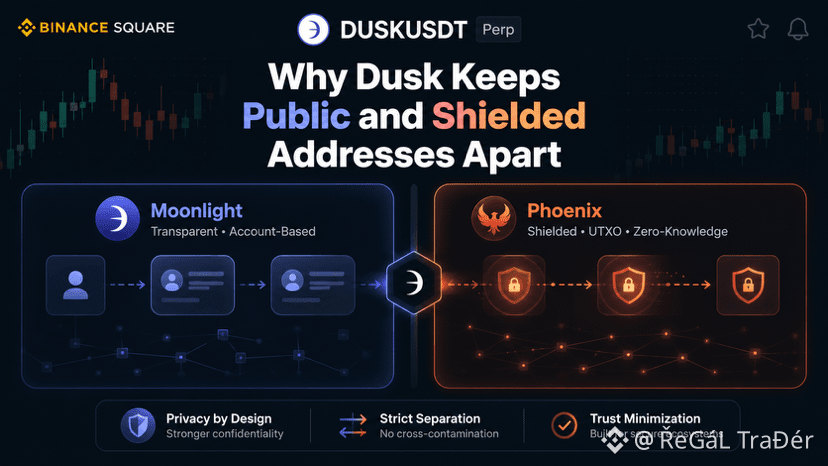

I was looking at DUSK again today, not only because of the price movement but because one design choice keeps standing out to me.
The chart has been pretty interesting. DUSKUSDT pushed toward $0.0797 recently, then came back into the $0.074 area. Nothing unusual for a volatile market, but it made me look again at what is happening underneath the token itself.
The thing I find different about Dusk is how it treats public and private activity.
Moonlight handles transparent transactions while Phoenix handles shielded ones using zero-knowledge proofs. But the important part is that these two worlds are not casually connected. The address formats are separate by design.
At first, I thought this was mainly a safety feature.
But the more i looked into it, the more I saw the tradeoff.
An exchange or custodian can stay on the public side without worrying about unexpected private transactions entering their system. That is a pretty clean approach for regulated environments.
The other side is that moving between confidential assets and public liquidity needs an extra conversion step. The privacy is stronger because the systems do not mix, but the workflow becomes more deliberate.
I think this is one of those design choices where there is no perfect answer.
More separation gives better privacy guarantees, but institutions also value speed and flexibility.
The question i am still watching is whether regulated markets will prefer this kind of strict isolation or eventually demand a smoother bridge between private and public liquidity.
That balance will probably decide how practical this model becomes. $DUSK #dusk
@Dusk
The chart has been pretty interesting. DUSKUSDT pushed toward $0.0797 recently, then came back into the $0.074 area. Nothing unusual for a volatile market, but it made me look again at what is happening underneath the token itself.
The thing I find different about Dusk is how it treats public and private activity.
Moonlight handles transparent transactions while Phoenix handles shielded ones using zero-knowledge proofs. But the important part is that these two worlds are not casually connected. The address formats are separate by design.
At first, I thought this was mainly a safety feature.
But the more i looked into it, the more I saw the tradeoff.
An exchange or custodian can stay on the public side without worrying about unexpected private transactions entering their system. That is a pretty clean approach for regulated environments.
The other side is that moving between confidential assets and public liquidity needs an extra conversion step. The privacy is stronger because the systems do not mix, but the workflow becomes more deliberate.
I think this is one of those design choices where there is no perfect answer.
More separation gives better privacy guarantees, but institutions also value speed and flexibility.
The question i am still watching is whether regulated markets will prefer this kind of strict isolation or eventually demand a smoother bridge between private and public liquidity.
That balance will probably decide how practical this model becomes. $DUSK #dusk
@Dusk