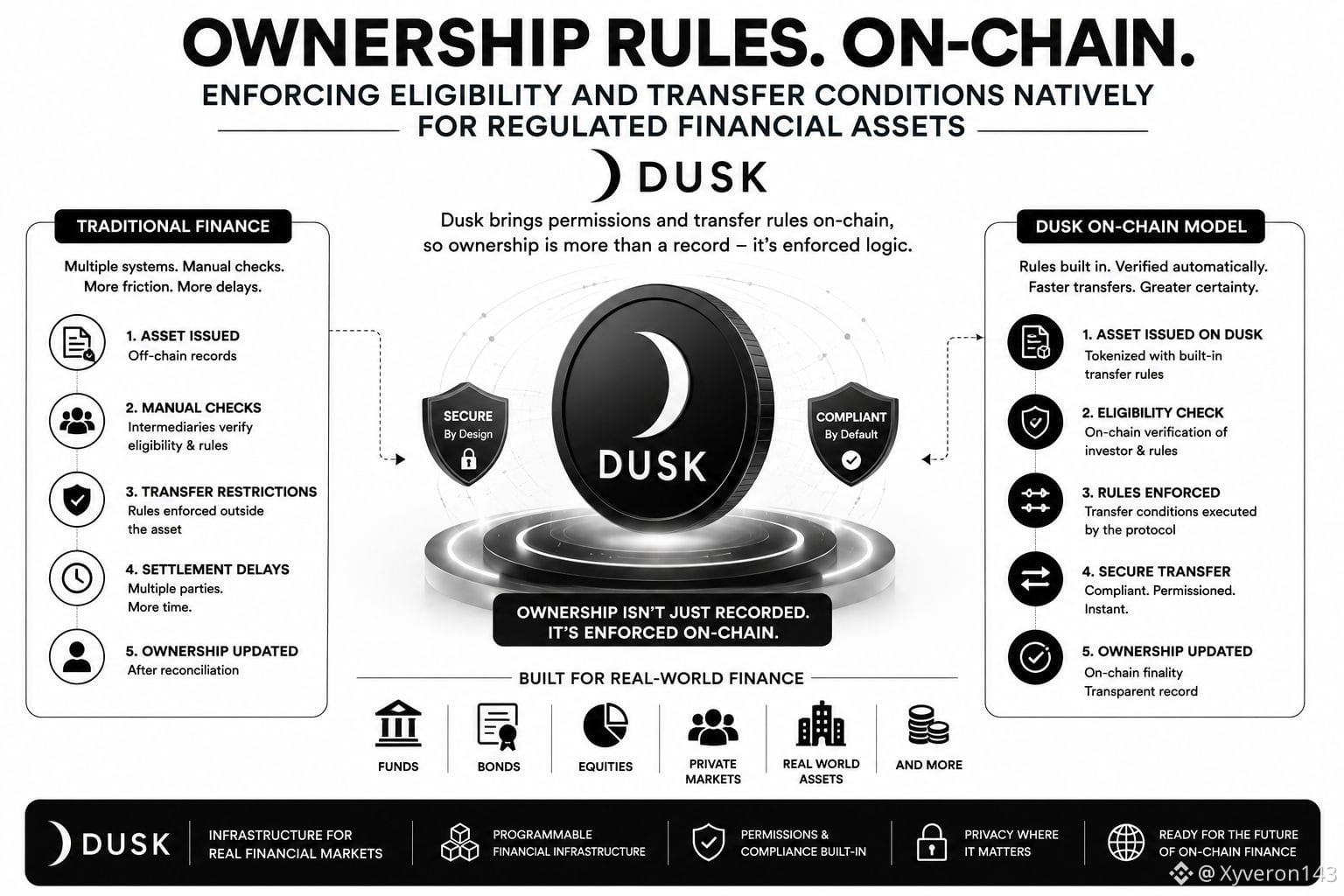
#dusk $DUSK @Dusk I was looking into another part of @dusk today, and this time I focused on something that can easily get overlooked: how ownership rules can work directly on-chain. In traditional finance, owning an asset does not always mean you can simply send it to anyone. There can be eligibility requirements, transfer restrictions, investor rules and other conditions that need to be checked before a transaction can happen. When assets move onto a blockchain, these rules still matter. That is why I find Dusk’s approach interesting. Instead of treating these requirements as something that exists completely outside the blockchain, Dusk is building infrastructure where permissions and transfer conditions can become part of the way financial assets work. This could be especially useful for regulated assets, where every transfer may need to follow specific rules. Imagine a tokenized financial asset that can automatically check whether a transfer is allowed before completing it. That makes the blockchain more than just a record of ownership. It becomes part of the logic that controls how the asset can actually move. For me, this is one of the more practical sides of blockchain adoption. The technology does not have to remove every rule from finance. It can actually make those rules easier to manage through programmable infrastructure. The more I explore Dusk, the more I understand why its focus is on building blockchain infrastructure for real financial markets. It is not only about putting assets on-chain, but also about making the rules around those assets work properly once they are there
$VELVET
$NVDAB
$VELVET
$NVDAB