🧑👀 Why Does Native Issuance Matter? 🌙
One of the biggest challenges in traditional finance is fragmentation.
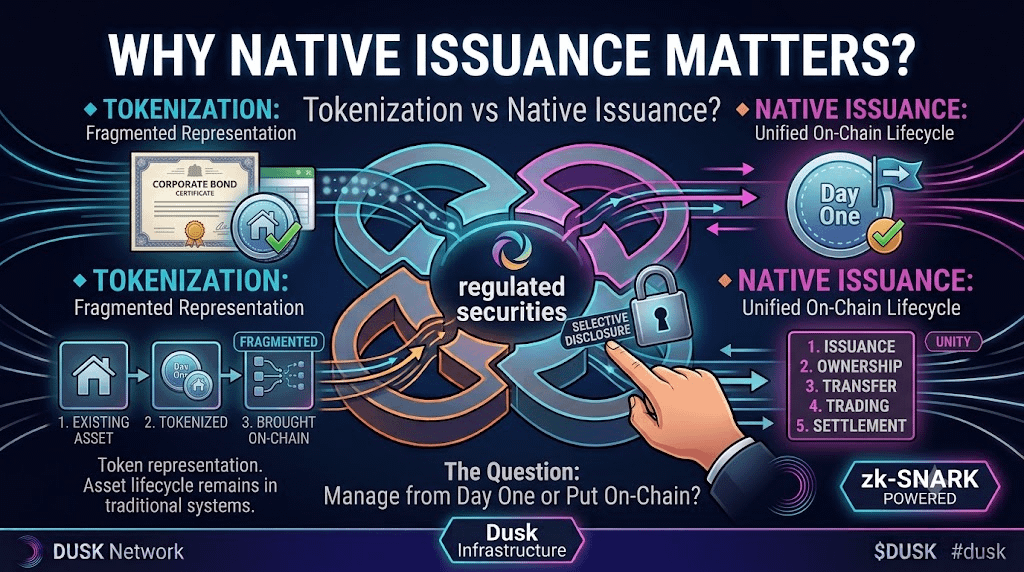
A single financial asset can involve multiple systems for: Issuance → Ownership → Trading → Clearing → Settlement
When these systems don't share the same infrastructure, information has to be reconciled between different parties and databases.
- Tokenization can bring a representation of the asset on-chain, but the underlying financial infrastructure may still remain fragmented.
- Native issuance offers another approach: Can more of the asset lifecycle run on the same programmable infrastructure from day one?
The potential benefit isn't simply “putting assets on-chain.”
It's reducing the distance between the asset, its ownership records, trading, and settlement.
That's where native issuance becomes interesting for regulated financial markets.
@Dusk $DUSK #dusk
---
#ThuyBNB
🧑👀 If you find this post useful,
please give me a like, share, and follow.
❤️ I really appreciate it.
One of the biggest challenges in traditional finance is fragmentation.
A single financial asset can involve multiple systems for: Issuance → Ownership → Trading → Clearing → Settlement
When these systems don't share the same infrastructure, information has to be reconciled between different parties and databases.
- Tokenization can bring a representation of the asset on-chain, but the underlying financial infrastructure may still remain fragmented.
- Native issuance offers another approach: Can more of the asset lifecycle run on the same programmable infrastructure from day one?
The potential benefit isn't simply “putting assets on-chain.”
It's reducing the distance between the asset, its ownership records, trading, and settlement.
That's where native issuance becomes interesting for regulated financial markets.
@Dusk $DUSK #dusk
---
#ThuyBNB
🧑👀 If you find this post useful,
please give me a like, share, and follow.
❤️ I really appreciate it.