I’ve been looking at Dusk from a slightly different angle: not just how it hides sensitive information, but how regulated financial assets actually move through their lifecycle.
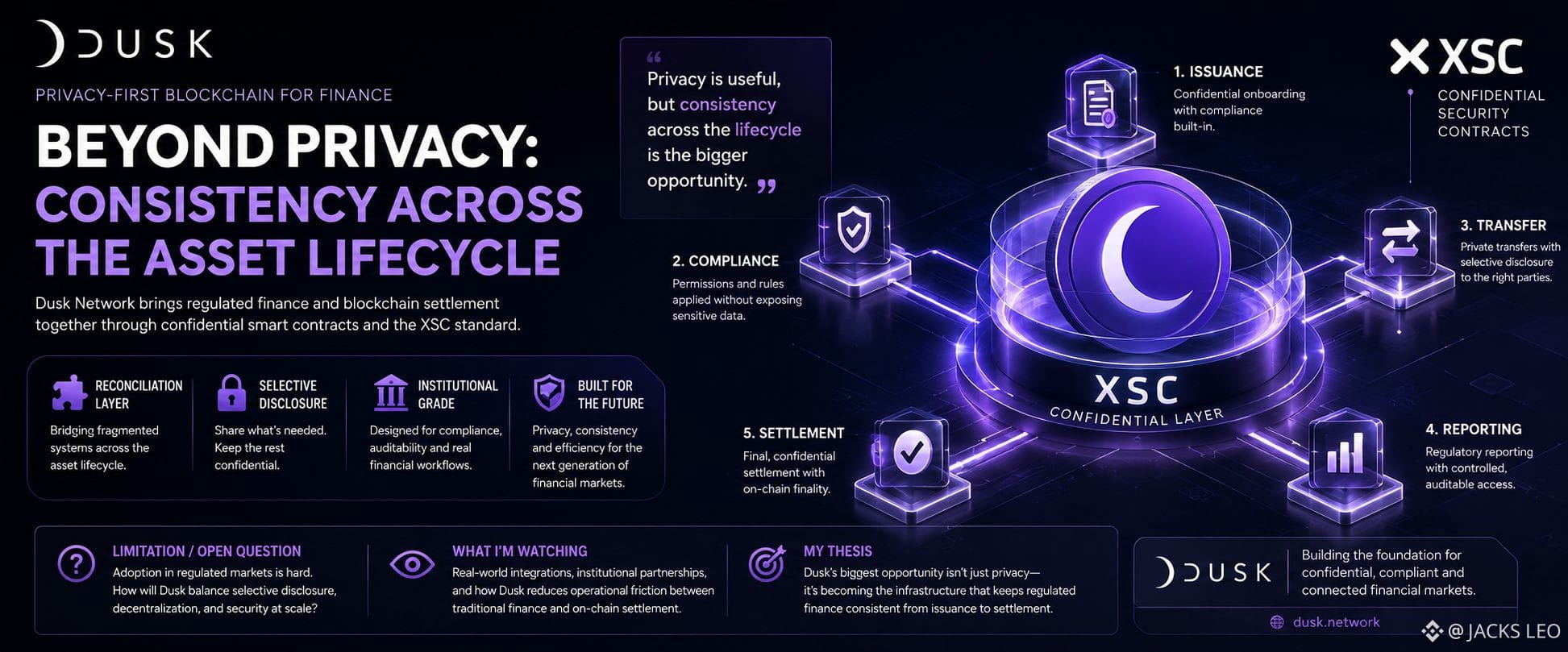
That is where I find Dusk more interesting. In traditional markets, issuance, compliance checks, transfers, reporting, and settlement often sit across different systems. Each handoff creates an operational gap. Dusk’s XSC framework could matter if it becomes a reconciliation layer where these steps can happen on shared infrastructure while sensitive data remains selectively accessible.
My takeaway is simple: privacy is useful, but consistency across the lifecycle may be the bigger opportunity.
For financial institutions, the challenge is rarely just “can this transaction be private?” It is whether the same asset can remain compliant, auditable, and correctly represented from issuance through settlement without creating endless reconciliation work.
The limitation is adoption. Better infrastructure does not automatically move regulated markets away from existing systems, custodians, and legal processes. I’m also watching how Dusk balances selective disclosure with decentralization and security assumptions as usage grows.
My current thesis: Dusk may be most interesting if it can reduce the operational friction between regulated finance and on-chain settlement, rather than simply being another privacy-focused L1.
@Dusk $DUSK #dusk
That is where I find Dusk more interesting. In traditional markets, issuance, compliance checks, transfers, reporting, and settlement often sit across different systems. Each handoff creates an operational gap. Dusk’s XSC framework could matter if it becomes a reconciliation layer where these steps can happen on shared infrastructure while sensitive data remains selectively accessible.
My takeaway is simple: privacy is useful, but consistency across the lifecycle may be the bigger opportunity.
For financial institutions, the challenge is rarely just “can this transaction be private?” It is whether the same asset can remain compliant, auditable, and correctly represented from issuance through settlement without creating endless reconciliation work.
The limitation is adoption. Better infrastructure does not automatically move regulated markets away from existing systems, custodians, and legal processes. I’m also watching how Dusk balances selective disclosure with decentralization and security assumptions as usage grows.
My current thesis: Dusk may be most interesting if it can reduce the operational friction between regulated finance and on-chain settlement, rather than simply being another privacy-focused L1.
@Dusk $DUSK #dusk