I used to look at Dusk and think, “okay, another blockchain talking about privacy and institutions.”
But honestly, I think that misses the more interesting part.
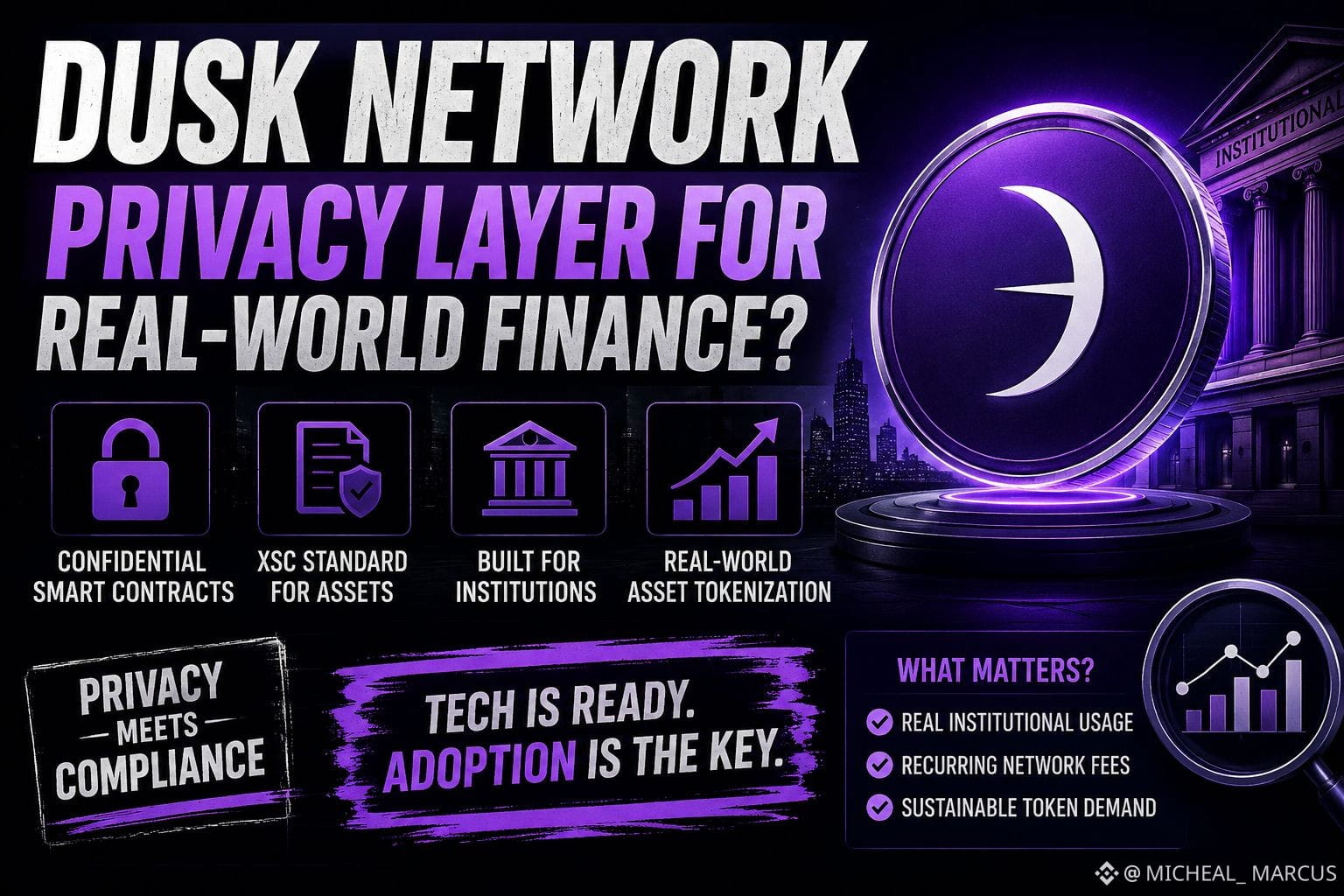
Dusk is trying to solve a pretty specific problem: how do you put financial assets on a blockchain without making sensitive information visible to everyone? Its Layer-1 uses confidential smart contracts and the XSC standard to handle things like regulated assets, where privacy and compliance actually matter.
That sounds technical, but the real-world idea is pretty simple. A financial institution could potentially issue or settle an asset on-chain while keeping certain investor and transaction details private.
The problem is that good technology alone doesn’t create demand.
This is where I’d be watching closely. Are institutions actually using the network repeatedly, or are we mostly looking at announcements and early deployments? And when incentives disappear, is there enough real activity to generate meaningful fees?
The same goes for DUSK. Having utility for gas and staking is useful, but token value ultimately needs sustained demand behind it. More supply entering the market without matching network usage can become a problem.
So I’m not watching Dusk because “institutional blockchain” sounds bullish.
I’m watching whether real financial activity starts producing real, recurring network demand.
That’s the part that would make the thesis interesting to me.
@Dusk #dusk $DUSK
But honestly, I think that misses the more interesting part.
Dusk is trying to solve a pretty specific problem: how do you put financial assets on a blockchain without making sensitive information visible to everyone? Its Layer-1 uses confidential smart contracts and the XSC standard to handle things like regulated assets, where privacy and compliance actually matter.
That sounds technical, but the real-world idea is pretty simple. A financial institution could potentially issue or settle an asset on-chain while keeping certain investor and transaction details private.
The problem is that good technology alone doesn’t create demand.
This is where I’d be watching closely. Are institutions actually using the network repeatedly, or are we mostly looking at announcements and early deployments? And when incentives disappear, is there enough real activity to generate meaningful fees?
The same goes for DUSK. Having utility for gas and staking is useful, but token value ultimately needs sustained demand behind it. More supply entering the market without matching network usage can become a problem.
So I’m not watching Dusk because “institutional blockchain” sounds bullish.
I’m watching whether real financial activity starts producing real, recurring network demand.
That’s the part that would make the thesis interesting to me.
@Dusk #dusk $DUSK