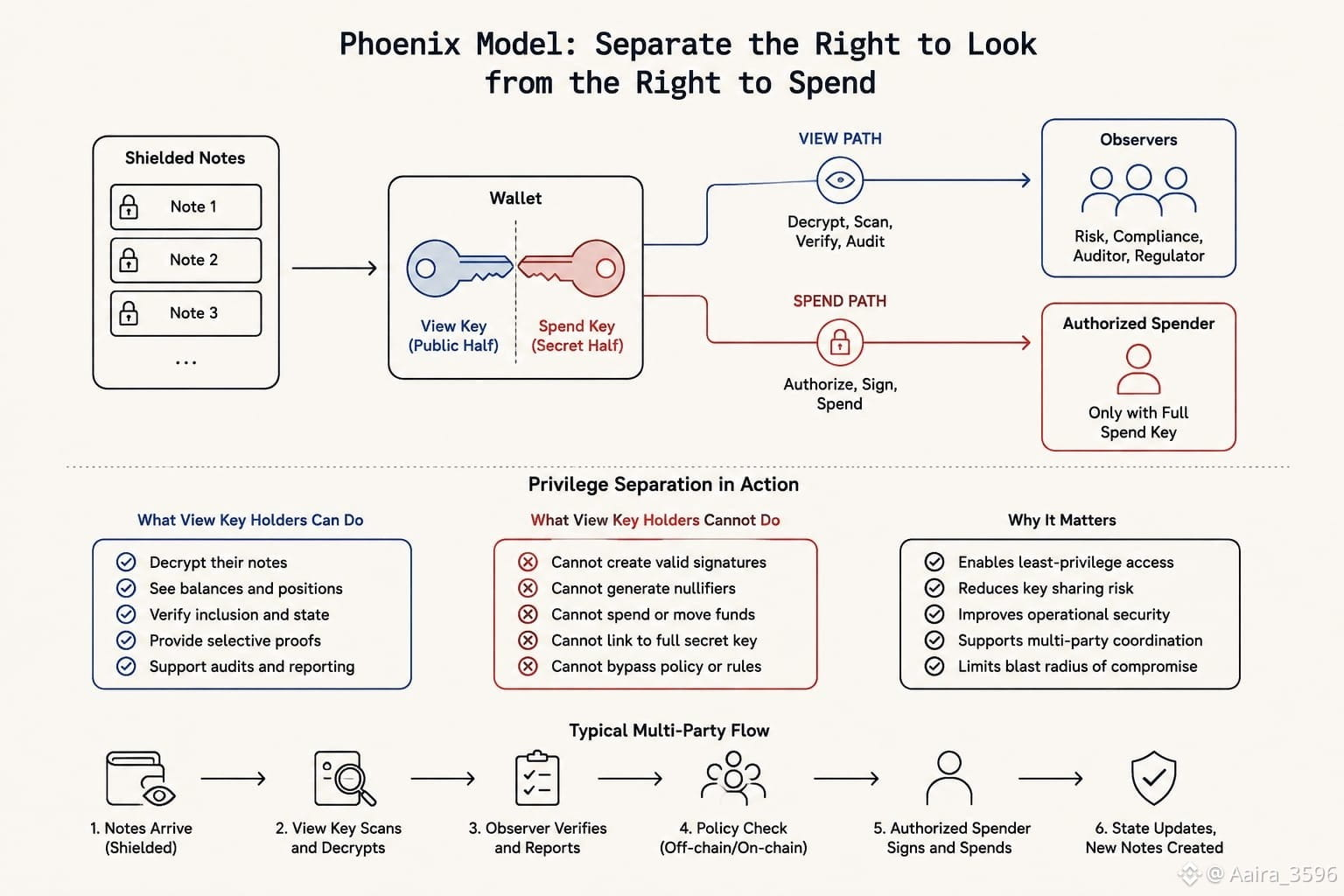
#dusk $DUSK @Dusk I was watching a node sync last week when a note scan stalled. The wallet had the view key, so it could decrypt the incoming shielded notes and tally the balance just fine. But the spend path kept failing on the nullifier. Turns out the operator had shared only the view half with the monitoring script. The full secret stayed offline.
That little gap is what the Phoenix design leans on. You can hand someone the ability to see every note that belongs to an address—values, positions, the whole local state—without ever giving them the scalar that finishes the note secret key. They can verify, they can audit, they can even prove ownership to a regulator. They just cannot move anything. The system treats “looking” and “authorizing” as two different privileges instead of one fused secret.
It changes how people coordinate. Risk teams can watch balances in real time. Compliance can pull selective history. The actual keys that sign stays with whoever is supposed to control the funds. You start seeing fewer “just share the seed for a second” requests, which is useful when the money is real.
Still not sure how cleanly this holds once you have dozens of parties needing different slices of visibility at the same time. The crypto boundary is sharp. The operational ones usually aren’t. Next time a multi-party settlement hits a view-key handoff under time pressure, I’ll be watching whether anyone reaches for the full secret out of habit.
That little gap is what the Phoenix design leans on. You can hand someone the ability to see every note that belongs to an address—values, positions, the whole local state—without ever giving them the scalar that finishes the note secret key. They can verify, they can audit, they can even prove ownership to a regulator. They just cannot move anything. The system treats “looking” and “authorizing” as two different privileges instead of one fused secret.
It changes how people coordinate. Risk teams can watch balances in real time. Compliance can pull selective history. The actual keys that sign stays with whoever is supposed to control the funds. You start seeing fewer “just share the seed for a second” requests, which is useful when the money is real.
Still not sure how cleanly this holds once you have dozens of parties needing different slices of visibility at the same time. The crypto boundary is sharp. The operational ones usually aren’t. Next time a multi-party settlement hits a view-key handoff under time pressure, I’ll be watching whether anyone reaches for the full secret out of habit.