@Dusk #dusk $DUSK
I'have been closely watching the $DUSK Network for the past few days, and honestly, what's made me think the most is their practical decisions.
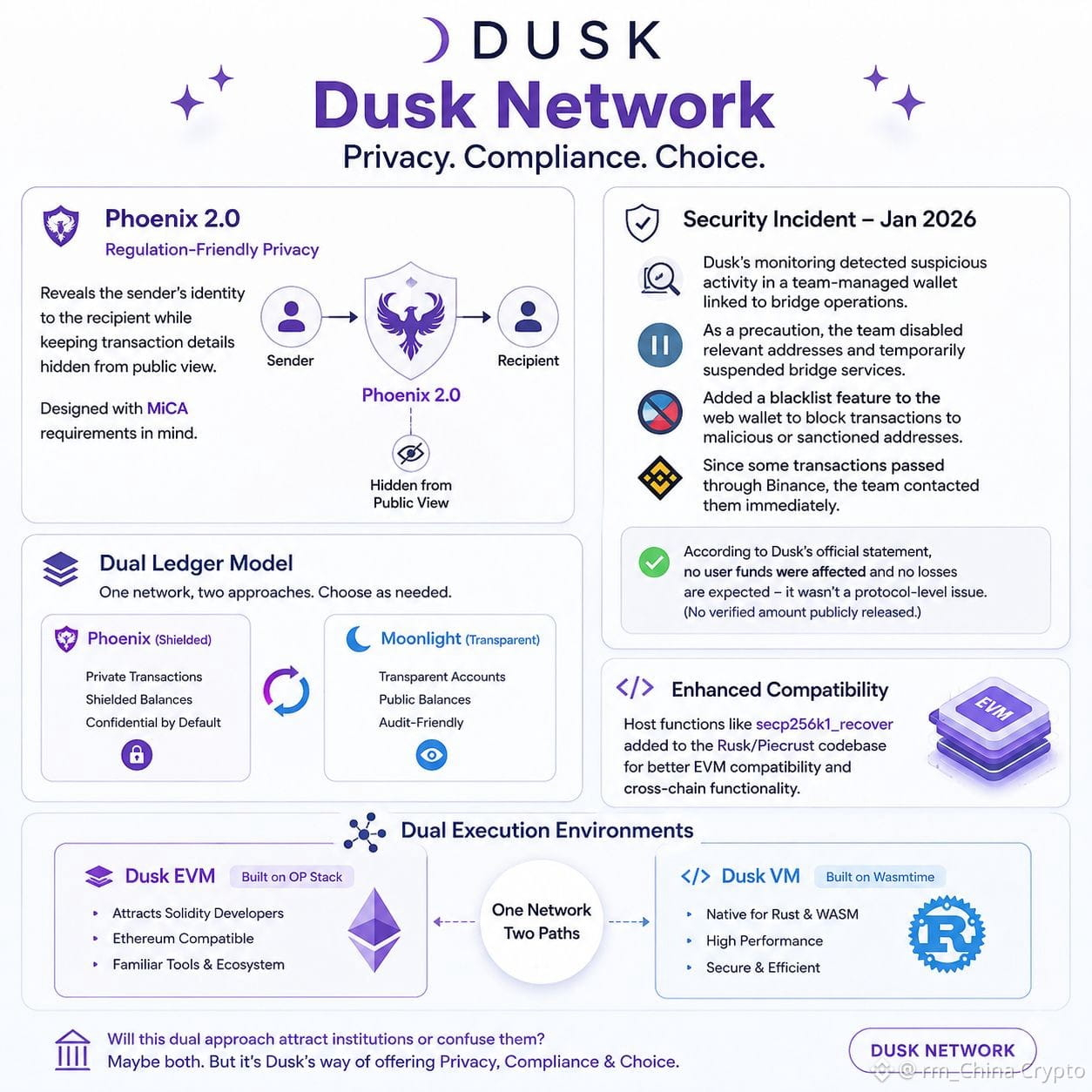
Phoenix 2.0 caught my attention because it reveals the sender's identity to the recipient while keeping the transaction hidden from public view. This isn't pure anonymity but rather regulation-friendly privacy specifically designed with MiCA requirements in mind, which makes sense for regulated financial institutions and centralized exchanges.
A bridge security incident also came up in January 2026. Dusk's monitoring detected suspicious activity in a team-managed wallet linked to bridge operations. As a precaution, the team disabled the relevant addresses, temporarily suspended bridge services, and added a blacklist feature to the web wallet that blocks transactions to known malicious or sanctioned addresses. Since some transactions passed through Binance's platform, the team contacted them immediately. According to Dusk's official statement, no user funds were affected in this incident, and no losses are expected it wasn't a protocol-level issue. Note: no verified figure for the amount involved has been publicly released.
Interestingly, $DUSK has split its ledger into two models Phoenix for shielded (private) transactions, and Moonlight for transparent accounts. One network, two approaches, choose as needed.
Additionally, host functions like secp256k1_recover have been added to the Rusk/Piecrust codebase to improve EVM compatibility and cross-chain functionality.
Now Dusk EVM (built on OP Stack) has attracted Solidity developers, while Dusk VM (built on Wasmtime) provides a native path for Rust and WASM. I'm curious whether this dual approach will attract institutions or confuse them maybe both.
I'have been closely watching the $DUSK Network for the past few days, and honestly, what's made me think the most is their practical decisions.
Phoenix 2.0 caught my attention because it reveals the sender's identity to the recipient while keeping the transaction hidden from public view. This isn't pure anonymity but rather regulation-friendly privacy specifically designed with MiCA requirements in mind, which makes sense for regulated financial institutions and centralized exchanges.
A bridge security incident also came up in January 2026. Dusk's monitoring detected suspicious activity in a team-managed wallet linked to bridge operations. As a precaution, the team disabled the relevant addresses, temporarily suspended bridge services, and added a blacklist feature to the web wallet that blocks transactions to known malicious or sanctioned addresses. Since some transactions passed through Binance's platform, the team contacted them immediately. According to Dusk's official statement, no user funds were affected in this incident, and no losses are expected it wasn't a protocol-level issue. Note: no verified figure for the amount involved has been publicly released.
Interestingly, $DUSK has split its ledger into two models Phoenix for shielded (private) transactions, and Moonlight for transparent accounts. One network, two approaches, choose as needed.
Additionally, host functions like secp256k1_recover have been added to the Rusk/Piecrust codebase to improve EVM compatibility and cross-chain functionality.
Now Dusk EVM (built on OP Stack) has attracted Solidity developers, while Dusk VM (built on Wasmtime) provides a native path for Rust and WASM. I'm curious whether this dual approach will attract institutions or confuse them maybe both.