
The thing that got me interested in Dusk was pretty simple: what if financial privacy doesn’t have to disappear just because regulation exists?
Sounds reasonable. But I kept thinking about what that actually means in practice.
Take Citadel.
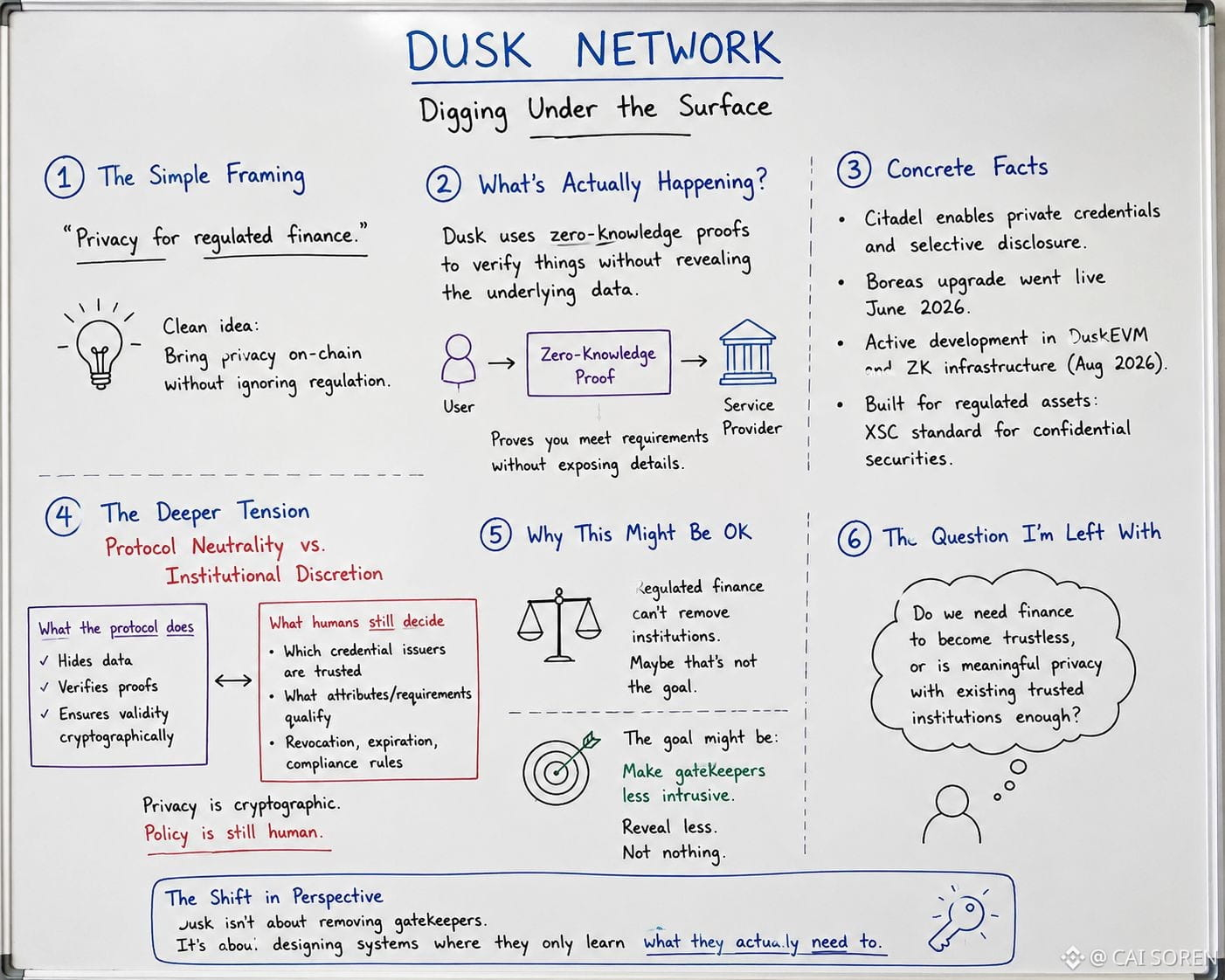
You can prove you have the right credentials without putting all your personal information on-chain. Nice idea. But there’s a detail I initially overlooked: the cryptography can prove a credential is valid, but it doesn’t decide who should be trusted to issue that credential in the first place.
Someone still makes that call.
A service provider chooses which issuers it accepts, what requirements matter, and how things like expiration or revocation are handled.
That changed my view of Dusk a little.
The interesting part isn’t that it removes institutions from finance. It doesn’t.
It tries to reduce how much those institutions need to know about you.
And maybe that’s a more realistic goal anyway. Especially if Dusk wants regulated securities and other real-world financial assets to exist on-chain.
So I don’t really see the human layer as a flaw.
I just think it makes the privacy claim more nuanced.
The question I’m left with is:
Do we actually need finance to become trustless, or would having to reveal far less to the people we already trust be meaningful enough?
@Dusk #dusk $DUSK
Sounds reasonable. But I kept thinking about what that actually means in practice.
Take Citadel.
You can prove you have the right credentials without putting all your personal information on-chain. Nice idea. But there’s a detail I initially overlooked: the cryptography can prove a credential is valid, but it doesn’t decide who should be trusted to issue that credential in the first place.
Someone still makes that call.
A service provider chooses which issuers it accepts, what requirements matter, and how things like expiration or revocation are handled.
That changed my view of Dusk a little.
The interesting part isn’t that it removes institutions from finance. It doesn’t.
It tries to reduce how much those institutions need to know about you.
And maybe that’s a more realistic goal anyway. Especially if Dusk wants regulated securities and other real-world financial assets to exist on-chain.
So I don’t really see the human layer as a flaw.
I just think it makes the privacy claim more nuanced.
The question I’m left with is:
Do we actually need finance to become trustless, or would having to reveal far less to the people we already trust be meaningful enough?
@Dusk #dusk $DUSK