#dusk $DUSK @Dusk I used to think Dusk was simply a privacy blockchain. Then I went deeper into the docs.
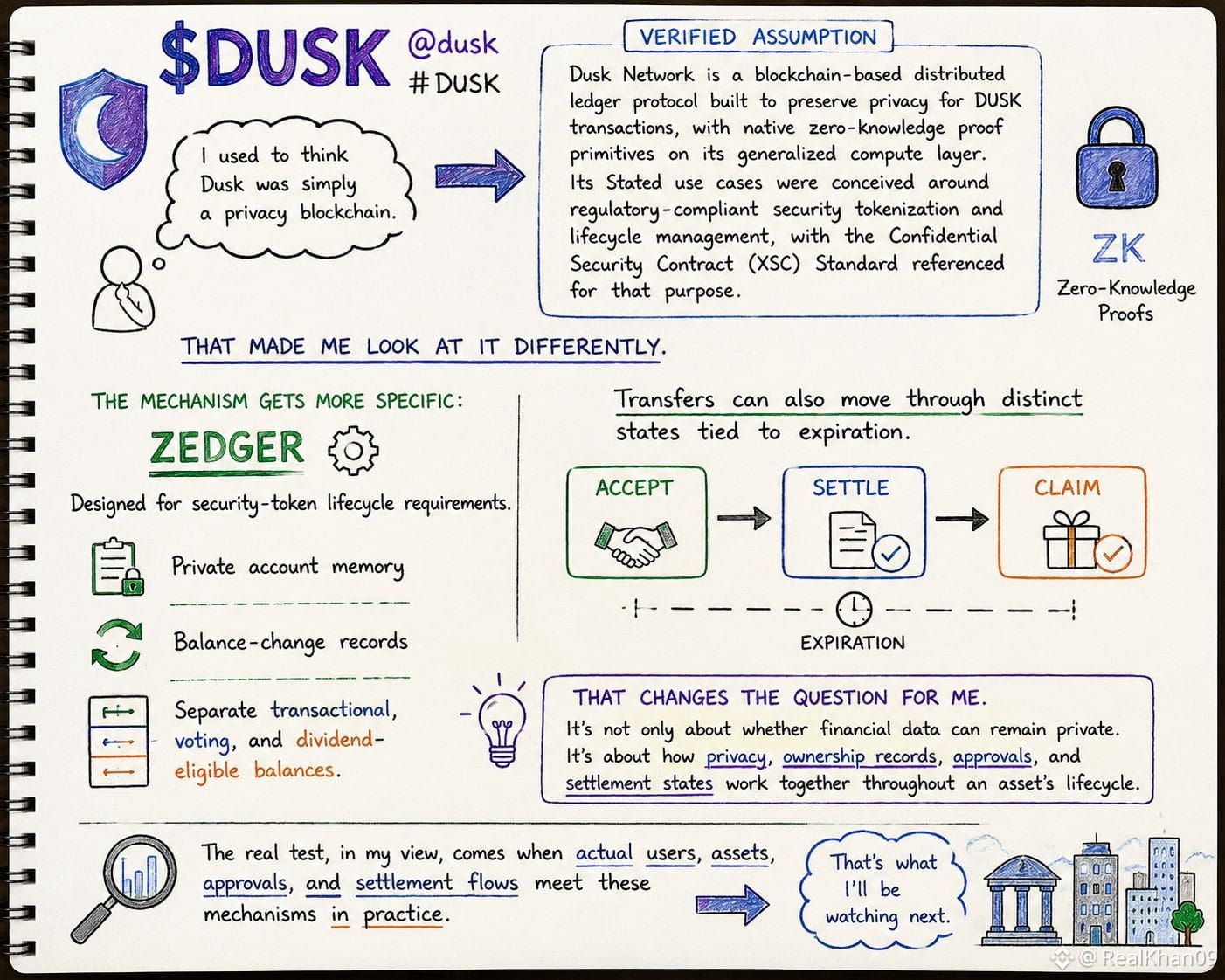
Dusk Network is described as a blockchain-based distributed ledger protocol built to preserve privacy for DUSK transactions, with native zero-knowledge proof primitives on its generalized compute layer. Its stated use cases were conceived around regulatory-compliant security tokenization and lifecycle management, with the Confidential Security Contract (XSC) Standard referenced for that purpose.
That made me look at it differently.
The part that caught my attention was Zedger. It was designed around security-token lifecycle requirements, including private account memory, balance-change records, and separate transactional, voting, and dividend-eligible balances.
Transfers can also move through distinct ACCEPT, SETTLE, and CLAIM states tied to expiration.
That changes the question for me.
It’s not only about whether financial data can remain private. It’s about how privacy, ownership records, approvals, and settlement states work together throughout an asset’s lifecycle.
The real test, in my view, comes when actual users, assets, approvals, and settlement flows meet these mechanisms in practice.
That’s what I’ll be watching next.
Dusk Network is described as a blockchain-based distributed ledger protocol built to preserve privacy for DUSK transactions, with native zero-knowledge proof primitives on its generalized compute layer. Its stated use cases were conceived around regulatory-compliant security tokenization and lifecycle management, with the Confidential Security Contract (XSC) Standard referenced for that purpose.
That made me look at it differently.
The part that caught my attention was Zedger. It was designed around security-token lifecycle requirements, including private account memory, balance-change records, and separate transactional, voting, and dividend-eligible balances.
Transfers can also move through distinct ACCEPT, SETTLE, and CLAIM states tied to expiration.
That changes the question for me.
It’s not only about whether financial data can remain private. It’s about how privacy, ownership records, approvals, and settlement states work together throughout an asset’s lifecycle.
The real test, in my view, comes when actual users, assets, approvals, and settlement flows meet these mechanisms in practice.
That’s what I’ll be watching next.