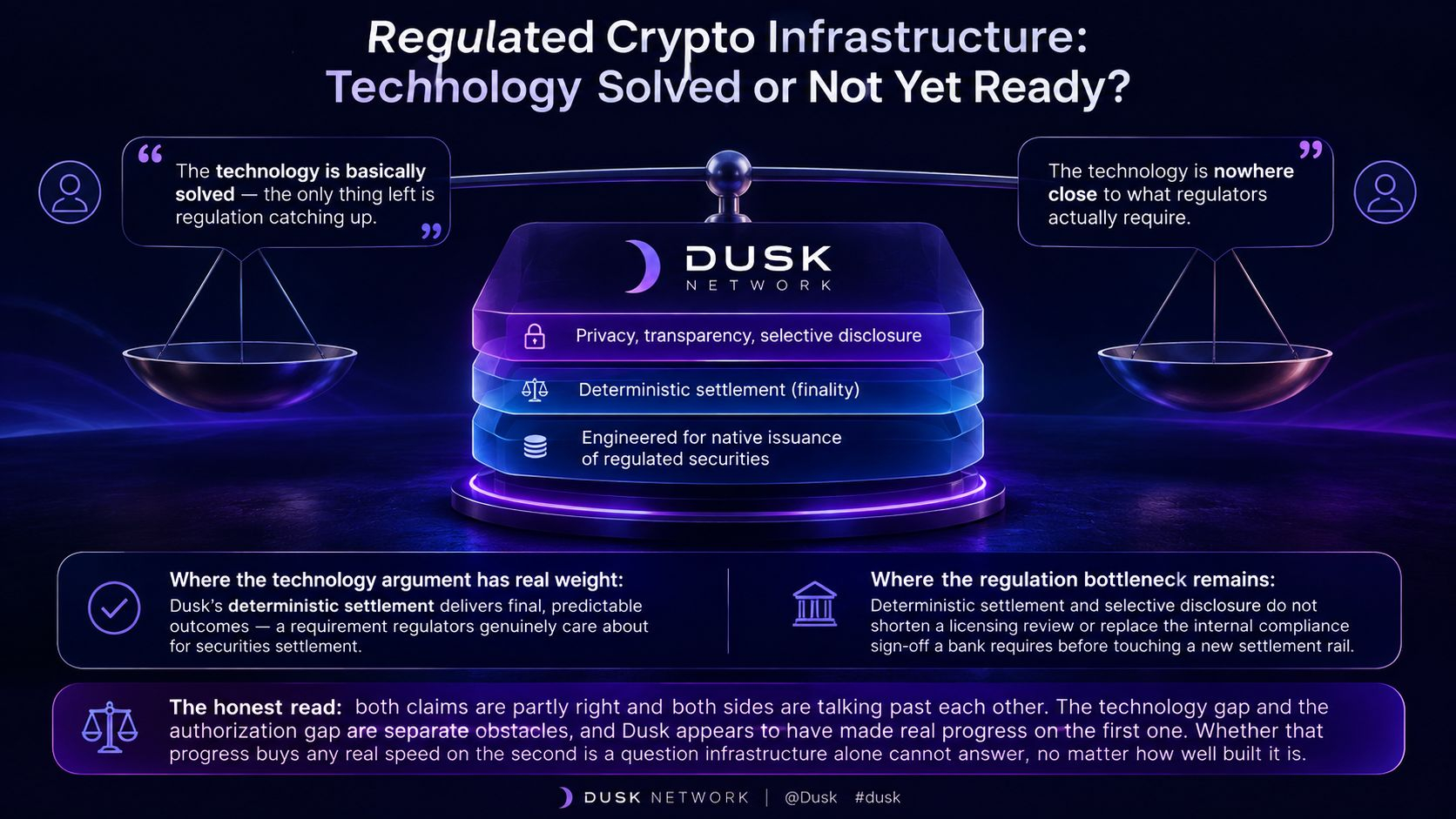
Somewhere in every conversation about regulated crypto infrastructure, someone claims the technology is basically solved and the only thing left is regulation catching up. Somewhere else in that same conversation, someone claims the technology is nowhere close to what regulators actually require. Dusk Network's own positioning sits closer to the middle of that argument than either extreme, and the fuzziness there is worth sitting with rather than resolving too quickly.
Dusk's base layer combines privacy, transparency, selective disclosure, and deterministic settlement, engineered specifically to support native issuance workflows for regulated securities. Deterministic settlement in particular addresses something regulators genuinely care about: a final, predictable outcome for every transaction, not a probabilistic one that could theoretically reorganize. On that specific point, the technology argument has real weight. A chain that cannot promise finality has a legitimate problem for securities settlement, and Dusk's architecture is built to close exactly that gap.
But Dusk is explicit that this infrastructure carries native issuance only when institutions and venues have the required authorization and product setup, which shifts the bottleneck somewhere the technology cannot reach. Deterministic settlement does not shorten a licensing review. Selective disclosure does not replace the internal compliance sign-off a bank needs before touching a new settlement rail. Those processes run on regulatory and institutional timelines that have nothing to do with how well engineered the underlying chain is.
My honest read is that both claims are partly right and both sides of that hypothetical argument are talking past each other. The technology gap and the authorization gap are separate obstacles, and Dusk appears to have made real progress on the first one. Whether that progress buys any real speed on the second is a question infrastructure alone cannot answer, no matter how well built it is.
@Dusk $DUSK #dusk
Dusk's base layer combines privacy, transparency, selective disclosure, and deterministic settlement, engineered specifically to support native issuance workflows for regulated securities. Deterministic settlement in particular addresses something regulators genuinely care about: a final, predictable outcome for every transaction, not a probabilistic one that could theoretically reorganize. On that specific point, the technology argument has real weight. A chain that cannot promise finality has a legitimate problem for securities settlement, and Dusk's architecture is built to close exactly that gap.
But Dusk is explicit that this infrastructure carries native issuance only when institutions and venues have the required authorization and product setup, which shifts the bottleneck somewhere the technology cannot reach. Deterministic settlement does not shorten a licensing review. Selective disclosure does not replace the internal compliance sign-off a bank needs before touching a new settlement rail. Those processes run on regulatory and institutional timelines that have nothing to do with how well engineered the underlying chain is.
My honest read is that both claims are partly right and both sides of that hypothetical argument are talking past each other. The technology gap and the authorization gap are separate obstacles, and Dusk appears to have made real progress on the first one. Whether that progress buys any real speed on the second is a question infrastructure alone cannot answer, no matter how well built it is.
@Dusk $DUSK #dusk