
#dusk $DUSK @Dusk The interesting part of last week’s Dusk incident wasn’t the cryptography.
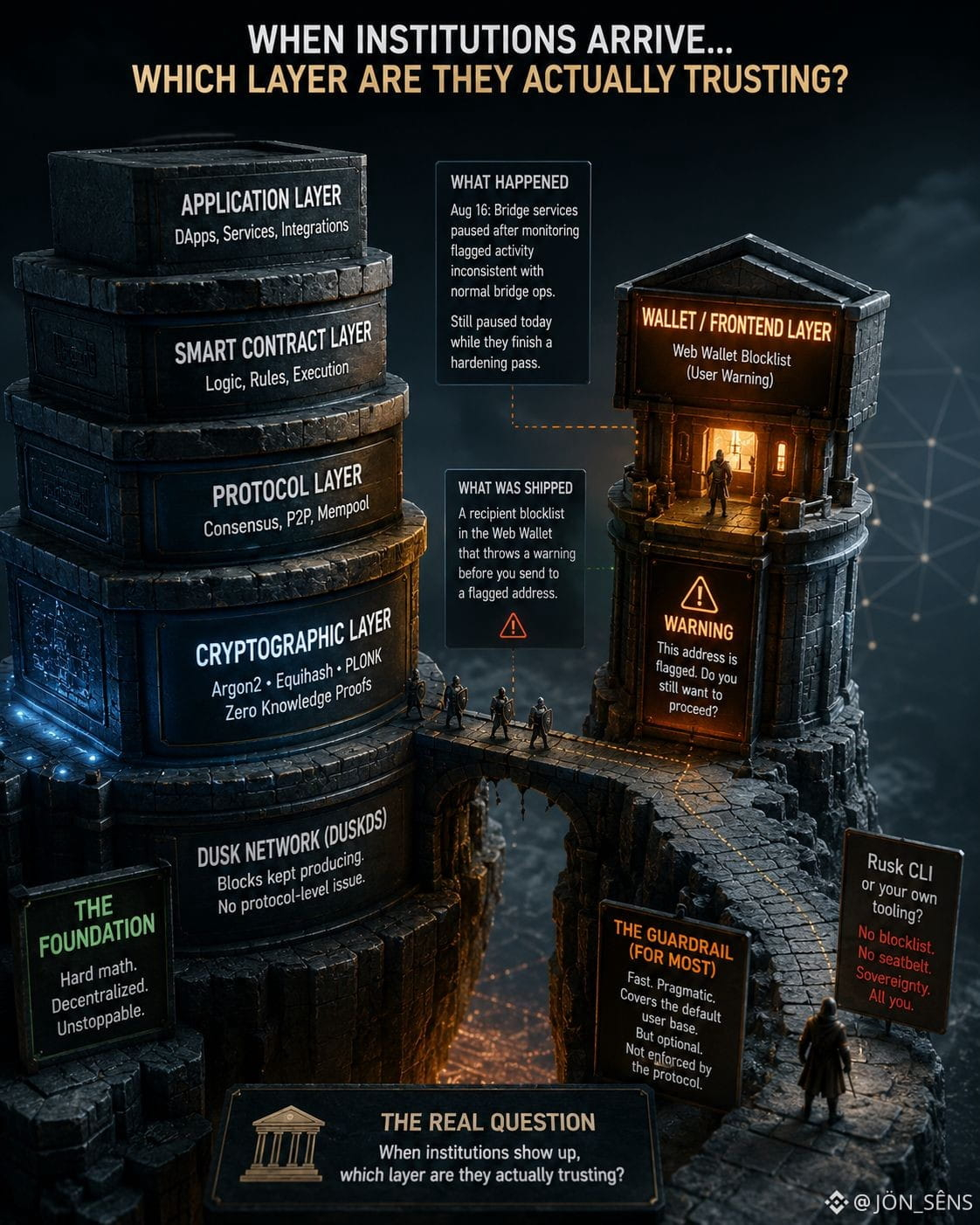
Argon2, Equihash, PLONK — serious math, serious infrastructure. But the actual risk surface was much more ordinary: a team-managed operational wallet behaving unexpectedly.
Bridge services were paused. Blocks kept producing. No protocol-level failure.
And the mitigation? Not a new proof system. A recipient blocklist in the Web Wallet, warning users before they send to a flagged address.
That’s pragmatic. Put the guardrail where most users already are and ship it fast.
But it raises the harder question:
If the safety control lives in the wallet, what happens to users on CLI tools, custom software, or institutional infrastructure?
That’s the sovereignty tradeoff nobody gets to hand-wave away.
When regulated markets finally arrive, institutions won’t just ask whether the cryptography is sound.
They’ll ask where the controls actually live — and who they trust to enforce them.
Argon2, Equihash, PLONK — serious math, serious infrastructure. But the actual risk surface was much more ordinary: a team-managed operational wallet behaving unexpectedly.
Bridge services were paused. Blocks kept producing. No protocol-level failure.
And the mitigation? Not a new proof system. A recipient blocklist in the Web Wallet, warning users before they send to a flagged address.
That’s pragmatic. Put the guardrail where most users already are and ship it fast.
But it raises the harder question:
If the safety control lives in the wallet, what happens to users on CLI tools, custom software, or institutional infrastructure?
That’s the sovereignty tradeoff nobody gets to hand-wave away.
When regulated markets finally arrive, institutions won’t just ask whether the cryptography is sound.
They’ll ask where the controls actually live — and who they trust to enforce them.