I’ve noticed something with financial apps that sounds minor until money actually has to move: opening the account can take longer than the transaction itself. That keeps making me question how we measure RWA infrastructure. We talk about settlement speed, but almost never measure the clock that starts when an investor first arrives.
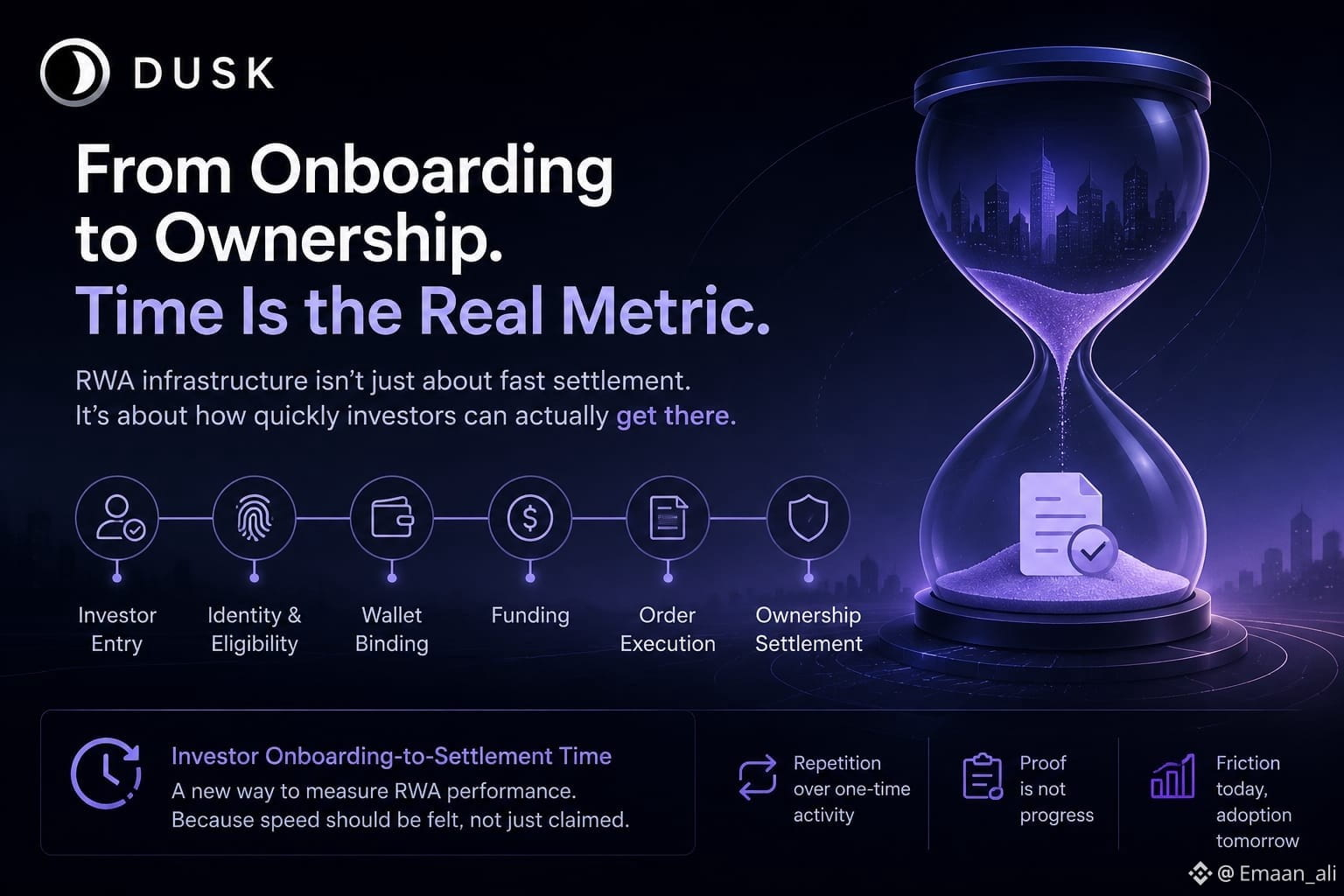
For $DUSK , I think “Investor Onboarding-to-Settlement Time” could become a more revealing metric.
The timer would start when someone enters a regulated workflow: identity checks, eligibility proof, wallet binding, funding, order execution, then final ownership settlement. A chain might settle the last step quickly, but if compliance still takes two days of duplicated checks and manual review, ten-second settlement does not describe the investor’s actual experience.
And proof is not the same as progress. An investor can prove eligibility once, but the useful question is whether that proof gets reused when they return. Repeated investors should become faster if the system is actually removing friction.
That distinction matters to me: one-time onboarding shows participation; declining settlement time across repeated activity could show infrastructure becoming useful.
But incentives could temporarily manufacture usage without improving that loop.
So I’d watch the second transaction more closely than the first.
#dusk $DUSK @Dusk
For $DUSK , I think “Investor Onboarding-to-Settlement Time” could become a more revealing metric.
The timer would start when someone enters a regulated workflow: identity checks, eligibility proof, wallet binding, funding, order execution, then final ownership settlement. A chain might settle the last step quickly, but if compliance still takes two days of duplicated checks and manual review, ten-second settlement does not describe the investor’s actual experience.
And proof is not the same as progress. An investor can prove eligibility once, but the useful question is whether that proof gets reused when they return. Repeated investors should become faster if the system is actually removing friction.
That distinction matters to me: one-time onboarding shows participation; declining settlement time across repeated activity could show infrastructure becoming useful.
But incentives could temporarily manufacture usage without improving that loop.
So I’d watch the second transaction more closely than the first.
#dusk $DUSK @Dusk