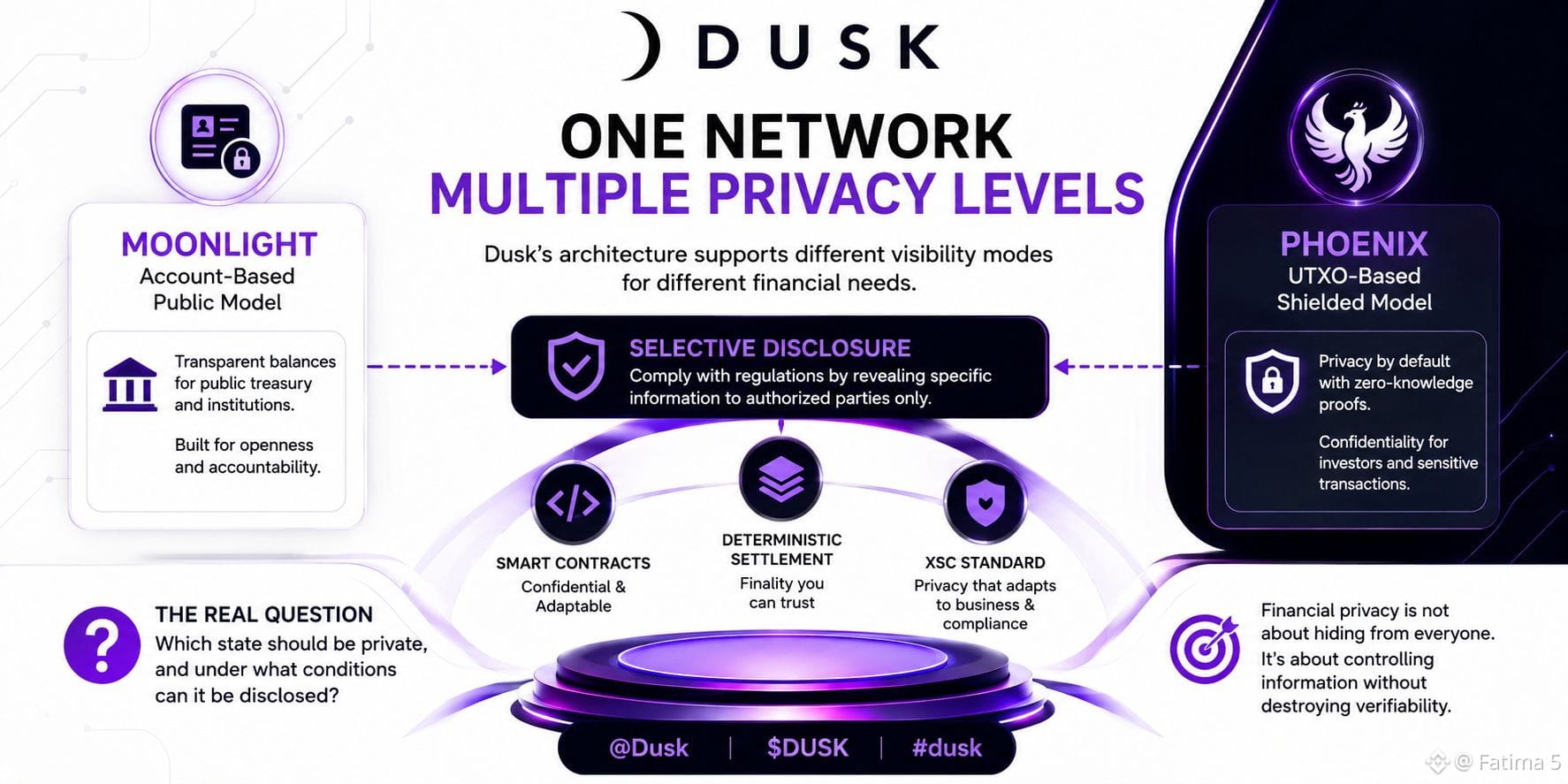
One interesting finding in my Dusk research is that its privacy model does not require every user to interact with the chain the same way. Moonlight is an account based public model Phoenix is a UTXO based shielded model.
That sounds like an implementation detail but it has a bigger implication. Different financial workflows have different information
requirements. A public treasury account may need transparent balances. A private investor position may need confidentiality. A regulated transfer may require selective disclosure to an authorized party.
This is why Dusk’s architecture is more nuanced than the usual “privacy coin” label. The network is trying to support multiple visibility modes inside one Layer-1 environment, while also providing smart-contract execution and deterministic settlement.
The XSC standard fits this philosophy because it treats confidential smart contracts as adaptable to business and compliance requirements. Instead of asking whether everything should be private, the better question becomes which state should be private and under what conditions it can be disclosed.
My research reinforced one lesson: financial privacy is not about hiding from everyone. It is about controlling information without destroying verifiability.
That is the problem @Dusk is trying to solve at the infrastructure level.
Do you think the future of onchain finance needs multiple privacy levels rather than one universal privacy model?
$DUSK #dusk @Dusk
That sounds like an implementation detail but it has a bigger implication. Different financial workflows have different information
requirements. A public treasury account may need transparent balances. A private investor position may need confidentiality. A regulated transfer may require selective disclosure to an authorized party.
This is why Dusk’s architecture is more nuanced than the usual “privacy coin” label. The network is trying to support multiple visibility modes inside one Layer-1 environment, while also providing smart-contract execution and deterministic settlement.
The XSC standard fits this philosophy because it treats confidential smart contracts as adaptable to business and compliance requirements. Instead of asking whether everything should be private, the better question becomes which state should be private and under what conditions it can be disclosed.
My research reinforced one lesson: financial privacy is not about hiding from everyone. It is about controlling information without destroying verifiability.
That is the problem @Dusk is trying to solve at the infrastructure level.
Do you think the future of onchain finance needs multiple privacy levels rather than one universal privacy model?
$DUSK #dusk @Dusk