
#dusk
Dusk Network is interesting to me for a reason that has little to do with hype around privacy.
I spend a lot of time watching how capital actually moves, and financial markets have a strange relationship with transparency. Crypto made everything visible by default: balances, transactions, wallet activity, flows. Great for verification. Not always great when the capital involved becomes serious.
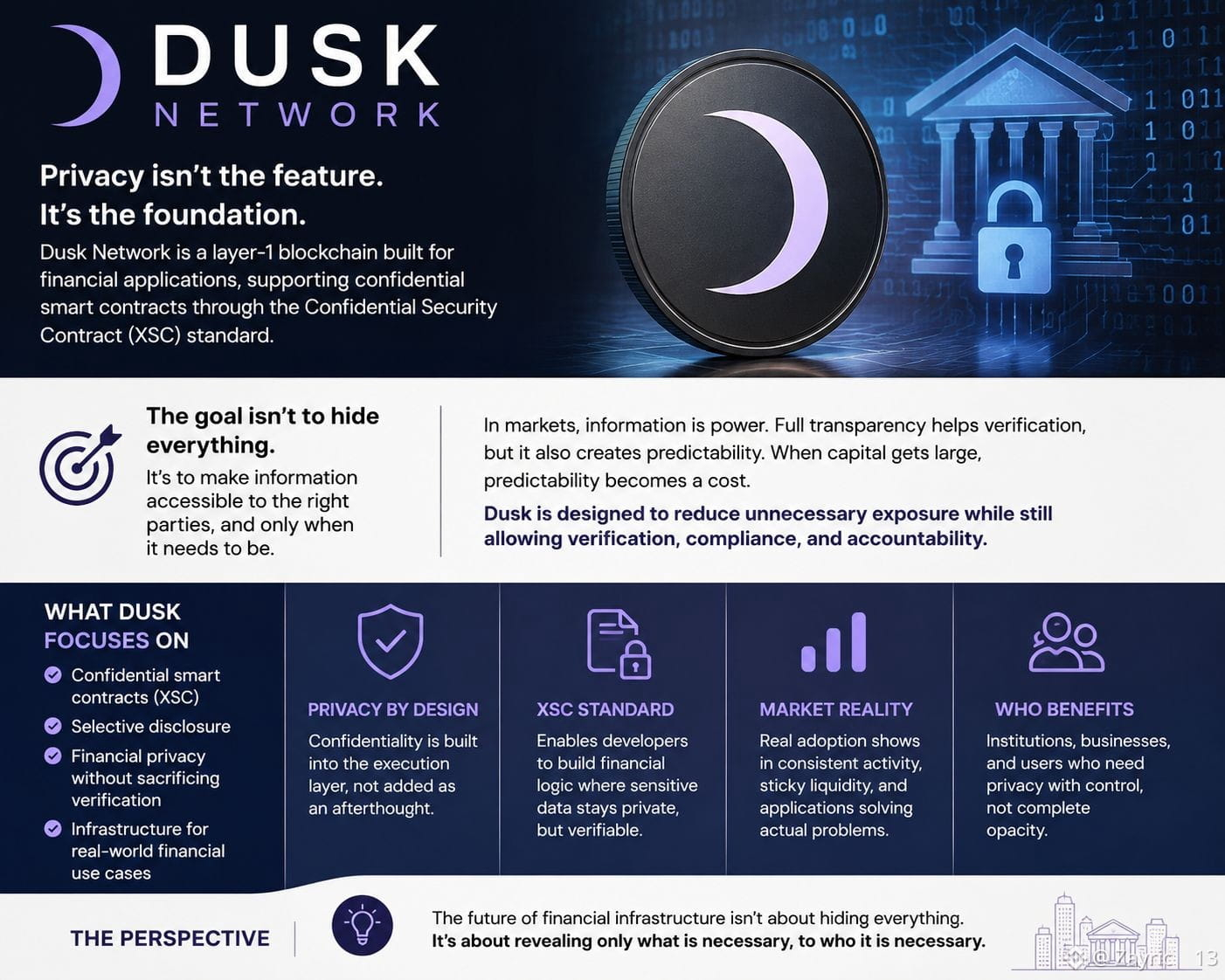
Dusk approaches the problem differently. As a layer-1 focused on financial applications, it supports confidential smart contracts through its Confidential Security Contract (XSC) standard. The important part is that privacy is being considered closer to where financial logic actually executes, rather than simply hiding transactions after the fact.
That creates real trade-offs.
Privacy does not mean everything becomes invisible. Serious financial infrastructure still needs verification, controls, selective disclosure, and accountability. The interesting question is who can see what, and under which conditions #dusk .
I would also watch usage rather than narratives. Real adoption should look repetitive and slightly boring: recurring transactions, sticky liquidity, applications generating genuine demand, and users returning without constant incentives.
Dusk doesn't need to prove that privacy sounds important. That part is obvious.
@Dusk
The harder test is whether confidential execution becomes useful enough that real financial activity starts depending on it.
That is where I think Dusk deserves attention.
$DUSK
Dusk Network is interesting to me for a reason that has little to do with hype around privacy.
I spend a lot of time watching how capital actually moves, and financial markets have a strange relationship with transparency. Crypto made everything visible by default: balances, transactions, wallet activity, flows. Great for verification. Not always great when the capital involved becomes serious.
Dusk approaches the problem differently. As a layer-1 focused on financial applications, it supports confidential smart contracts through its Confidential Security Contract (XSC) standard. The important part is that privacy is being considered closer to where financial logic actually executes, rather than simply hiding transactions after the fact.
That creates real trade-offs.
Privacy does not mean everything becomes invisible. Serious financial infrastructure still needs verification, controls, selective disclosure, and accountability. The interesting question is who can see what, and under which conditions #dusk .
I would also watch usage rather than narratives. Real adoption should look repetitive and slightly boring: recurring transactions, sticky liquidity, applications generating genuine demand, and users returning without constant incentives.
Dusk doesn't need to prove that privacy sounds important. That part is obvious.
@Dusk
The harder test is whether confidential execution becomes useful enough that real financial activity starts depending on it.
That is where I think Dusk deserves attention.
$DUSK