
#dusk $DUSK @Dusk
I’ve been looking at Dusk’s slashing model, and I like that it doesn’t treat every mistake the same way.
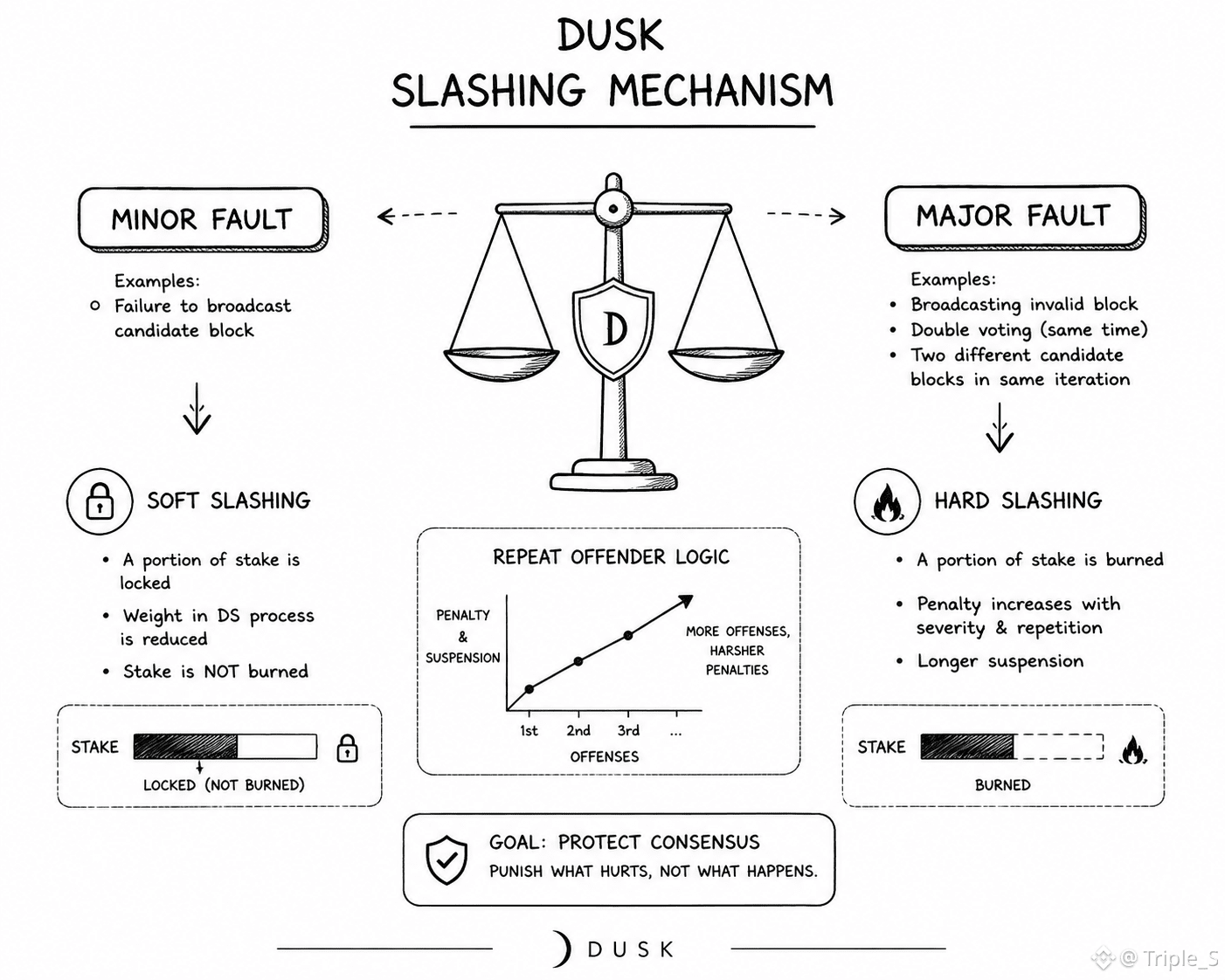
A minor fault, like failing to broadcast a candidate block, can lead to suspension and soft slashing. The stake isn’t burned, but its weight in the DS process is reduced.
Major faults are different. Invalid blocks, double voting, or sending conflicting candidate blocks can trigger hard slashing, where part of the stake is actually burned.
What I find more interesting is the repeat-offender logic.
One mistake gets a penalty. Repeated mistakes make the suspension harsher.
To me, that feels less like punishment for punishment’s sake and more like a way to protect consensus without overreacting to every small failure.
The real question is how well this balance holds when the network is under stress. That’s what I’m watching.
$FORM
$SPK
I’ve been looking at Dusk’s slashing model, and I like that it doesn’t treat every mistake the same way.
A minor fault, like failing to broadcast a candidate block, can lead to suspension and soft slashing. The stake isn’t burned, but its weight in the DS process is reduced.
Major faults are different. Invalid blocks, double voting, or sending conflicting candidate blocks can trigger hard slashing, where part of the stake is actually burned.
What I find more interesting is the repeat-offender logic.
One mistake gets a penalty. Repeated mistakes make the suspension harsher.
To me, that feels less like punishment for punishment’s sake and more like a way to protect consensus without overreacting to every small failure.
The real question is how well this balance holds when the network is under stress. That’s what I’m watching.
$FORM
$SPK