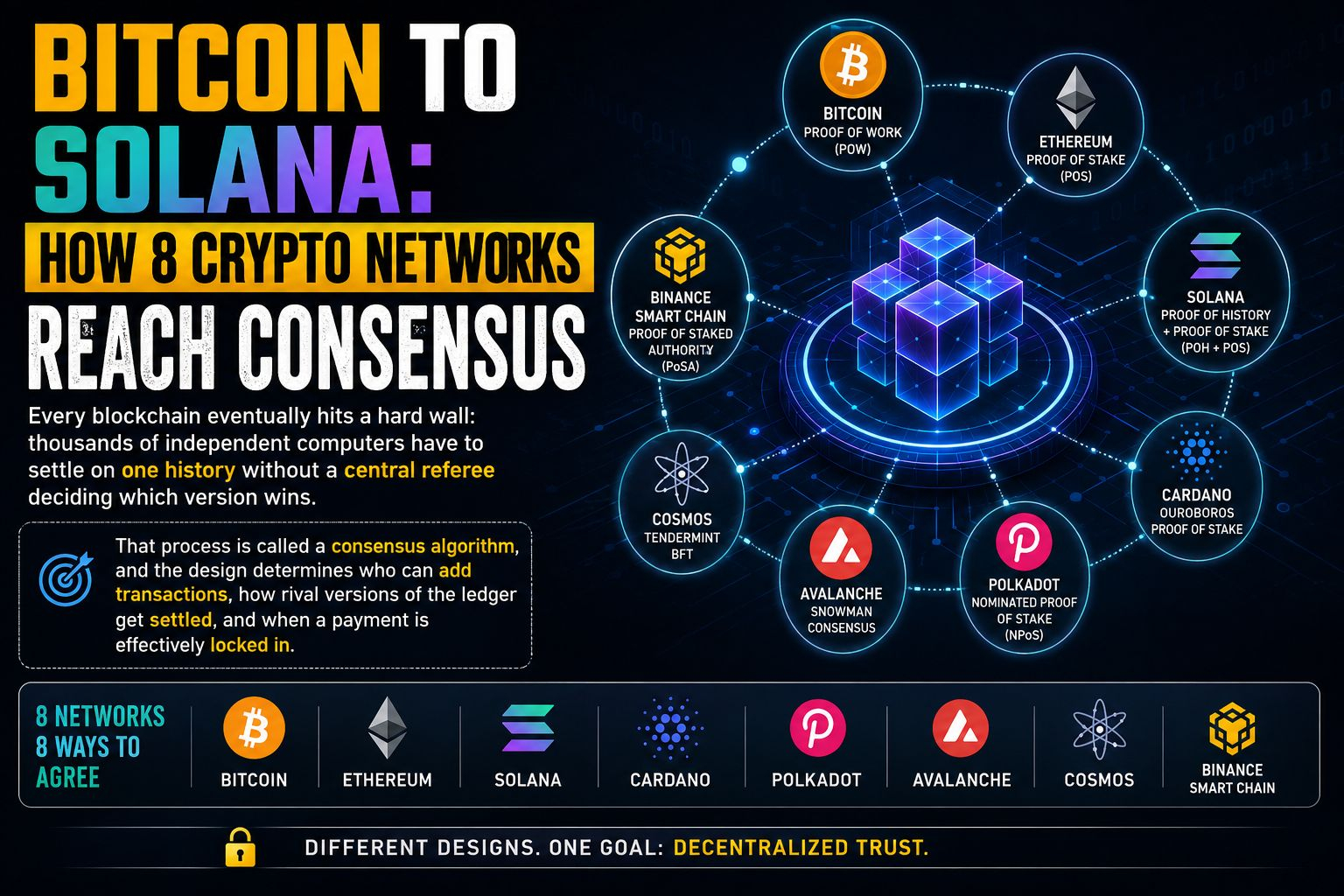
Bitcoin to Solana: How 8 Crypto Networks Reach Consensus
Every blockchain faces the same major challenge: thousands of independent computers must agree on a single version of transaction history without a central authority.
This process is called a consensus algorithm. It determines who can validate transactions, add new blocks, resolve competing versions of the blockchain, and decide when a payment is considered final.
Bitcoin uses Proof of Work, where miners compete to solve complex computational problems. Ethereum uses Proof of Stake, where validators help secure the network by staking cryptocurrency. Solana combines Proof of History with Proof of Stake to organize and process transactions at high speed.
Other networks use different approaches. Cardano uses Ouroboros Proof of Stake, Polkadot uses Nominated Proof of Stake, Avalanche uses Snow Consensus, Cosmos uses Tendermint BFT, and Binance Smart Chain uses Proof of Staked Authority.
Each system has a different design, but they all share one goal: creating trust without relying on a central referee.
Consensus is the technology that helps decentralized networks agree on the truth.
Different Designs. One Goal: Decentralized Trust.$NVDAB
$NVDA.US
#SolanaGovernanceVoteToDoubleDeflationRate #SamsungFalls6.4%OnReturnPlanMiss
Every blockchain faces the same major challenge: thousands of independent computers must agree on a single version of transaction history without a central authority.
This process is called a consensus algorithm. It determines who can validate transactions, add new blocks, resolve competing versions of the blockchain, and decide when a payment is considered final.
Bitcoin uses Proof of Work, where miners compete to solve complex computational problems. Ethereum uses Proof of Stake, where validators help secure the network by staking cryptocurrency. Solana combines Proof of History with Proof of Stake to organize and process transactions at high speed.
Other networks use different approaches. Cardano uses Ouroboros Proof of Stake, Polkadot uses Nominated Proof of Stake, Avalanche uses Snow Consensus, Cosmos uses Tendermint BFT, and Binance Smart Chain uses Proof of Staked Authority.
Each system has a different design, but they all share one goal: creating trust without relying on a central referee.
Consensus is the technology that helps decentralized networks agree on the truth.
Different Designs. One Goal: Decentralized Trust.$NVDAB
$NVDA.US
#SolanaGovernanceVoteToDoubleDeflationRate #SamsungFalls6.4%OnReturnPlanMiss