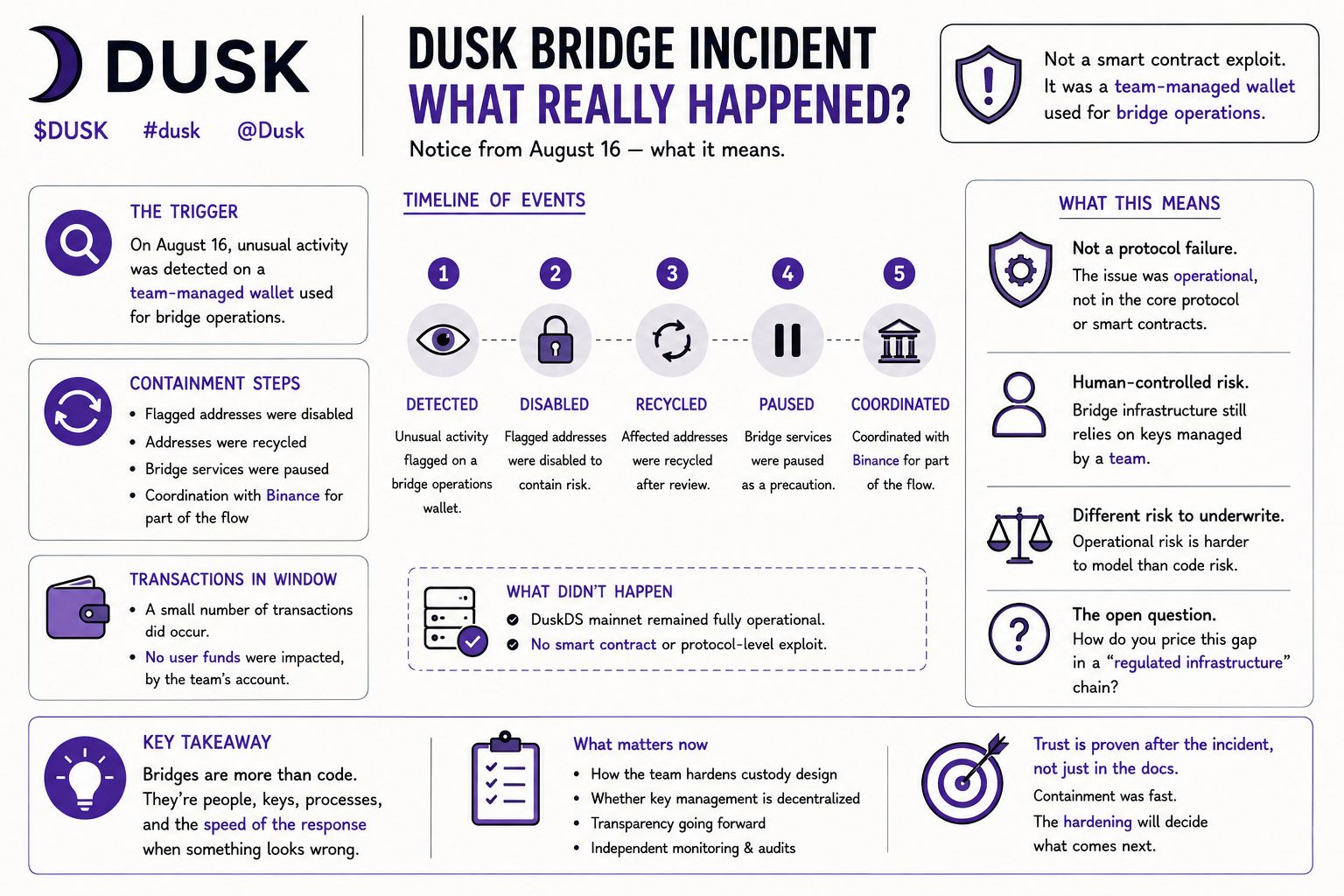

Spent the afternoon going through @Dusk incident notice instead of the usual CreatorPad prompts, and one line stopped me: the wallet flagged on August 16 wasn't a smart contract exploit, it was a team-managed wallet used for bridge operations. I'd assumed $DUSK 's bridge risk lived entirely in code. Turns out it also lives in whoever holds the keys to move funds across chains.
What's interesting is what didn't happen. DuskDS mainnet kept running, no protocol-level fault, and the team said no user funds were impacted after disabling and recycling the flagged addresses. A small number of transactions did occur inside that window, and part of the flow apparently touched Binance before containment.
My first reaction was mild annoyance that "not a protocol issue" gets repeated as reassurance. It is true, but it also quietly admits the bridge's weak point was operational, not cryptographic. That's a different kind of risk to underwrite than the one in the whitepaper.
Still not sure how you price that gap when you're evaluating a "regulated infrastructure" chain.
#dusk
What's interesting is what didn't happen. DuskDS mainnet kept running, no protocol-level fault, and the team said no user funds were impacted after disabling and recycling the flagged addresses. A small number of transactions did occur inside that window, and part of the flow apparently touched Binance before containment.
My first reaction was mild annoyance that "not a protocol issue" gets repeated as reassurance. It is true, but it also quietly admits the bridge's weak point was operational, not cryptographic. That's a different kind of risk to underwrite than the one in the whitepaper.
Still not sure how you price that gap when you're evaluating a "regulated infrastructure" chain.
#dusk