#dusk $DUSK @Dusk
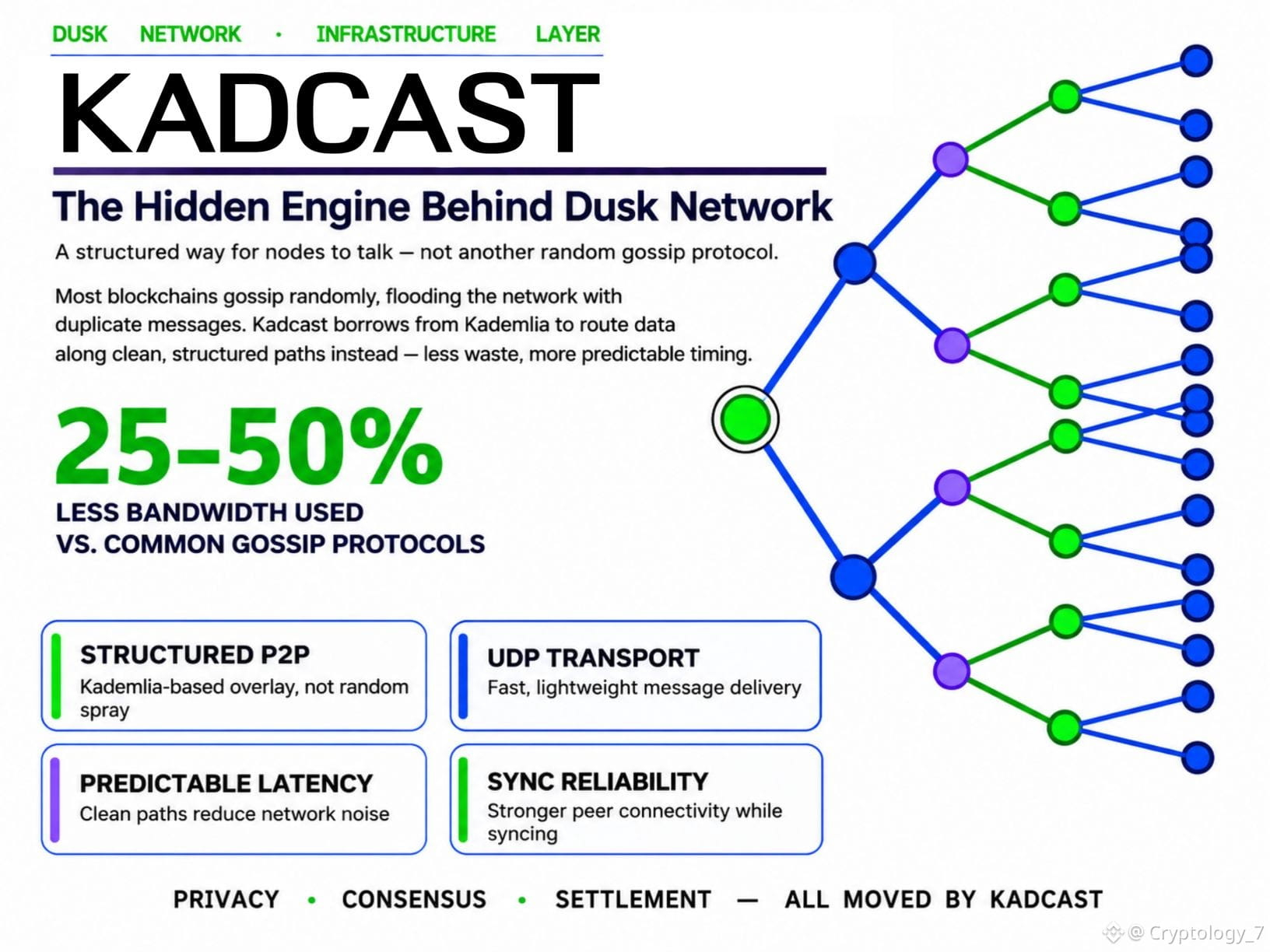
Honestly, I didn’t expect Kadcast to catch my attention. I thought it was just another way for blockchain nodes to gossip. Then I found something that changed how I see Dusk’s network layer differently. Kadcast can cut bandwidth use by 25–50% compared with common protocols.
How do you move information across a growing network without wasting bandwidth or creating unnecessary delays?
In a traditional gossip-style network, the same message can travel thrOugh many peers, creating extra network traffic. Depending on the design, this overhead can be significant.
Kadcast takes a smarter route.
Instead of letting messages spread through an unstructured web of connections, Dusk uses a structured P2P overlay designed to make communication more efficient and latency more predictable.. Kadcast builds on Kademlia, using XOR distance to organize peer routing.
And it gets more interesting.
Kadcast uses UDP, while @Dusk has also worked on things like routing improvements, UDP message size controls, network version checks, message flow tracking, and stronger peer connectivity during synchronization.
To me, this shows that Kadcast isn’t just some technical feature buried in the docs. It’s part of the foundation that keeps Dusk communicating.
Privacy protects sensitive information.
Consensus creates agreement.
Settlement moves value.
Kadcast helps move the information that makes all of it possible.
Sometimes, the technology doing the most important work is the technology users never notice.
If the best network layer is invisible to users, how far can Dusk go as its infrastructure becomes smarter and more efficient?
#dusk
Honestly, I didn’t expect Kadcast to catch my attention. I thought it was just another way for blockchain nodes to gossip. Then I found something that changed how I see Dusk’s network layer differently. Kadcast can cut bandwidth use by 25–50% compared with common protocols.
How do you move information across a growing network without wasting bandwidth or creating unnecessary delays?
In a traditional gossip-style network, the same message can travel thrOugh many peers, creating extra network traffic. Depending on the design, this overhead can be significant.
Kadcast takes a smarter route.
Instead of letting messages spread through an unstructured web of connections, Dusk uses a structured P2P overlay designed to make communication more efficient and latency more predictable.. Kadcast builds on Kademlia, using XOR distance to organize peer routing.
And it gets more interesting.
Kadcast uses UDP, while @Dusk has also worked on things like routing improvements, UDP message size controls, network version checks, message flow tracking, and stronger peer connectivity during synchronization.
To me, this shows that Kadcast isn’t just some technical feature buried in the docs. It’s part of the foundation that keeps Dusk communicating.
Privacy protects sensitive information.
Consensus creates agreement.
Settlement moves value.
Kadcast helps move the information that makes all of it possible.
Sometimes, the technology doing the most important work is the technology users never notice.
If the best network layer is invisible to users, how far can Dusk go as its infrastructure becomes smarter and more efficient?
#dusk