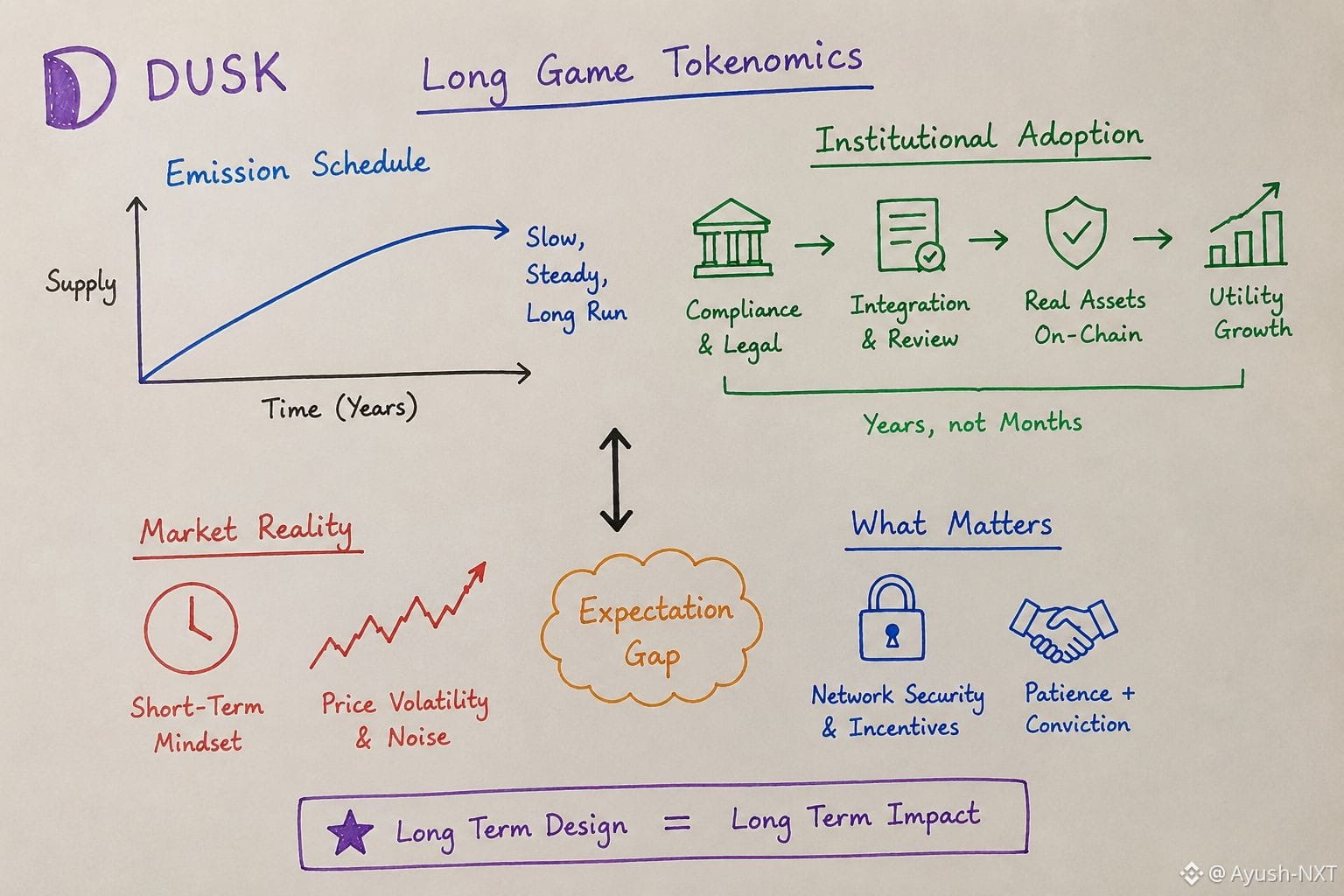
I was thinking about DUSK's long-term emission schedule the other day, trying to understand how token supply mechanics interact with a project whose value proposition is built around institutional trust rather than speculative demand. I noticed most conversations around DUSK tend to focus on short-term price action, but the emission curve itself seems designed with a much longer adoption timeline in mind, which feels almost mismatched with how the market usually reacts to it.
What seems interesting is the tension this creates between token economics and the actual use case. A privacy-focused chain aimed at regulated finance presumably needs years for institutional integration, legal review, and real securities issuance to build up, yet token holders and traders operate on much shorter time horizons. It makes me wonder whether the emission schedule was calibrated more for network security and validator incentives than for matching market sentiment cycles.
The question that comes to mind is whether this mismatch creates pressure internally, where community expectations move faster than the institutional adoption the token is ultimately meant to support. I'm not completely sure how the team balances near-term token holder patience against a roadmap that seems to require sustained, unglamorous groundwork before real utility demand shows up.
Looking from the outside, tokenomics designed for a long game only work if the ecosystem actually reaches that later stage intact, both technically and in terms of community conviction. Whether DUSK's supply design ages well probably depends entirely on whether the institutional thesis plays out as expected... anyway, time will tell👍
#dusk $DUSK @Dusk
What seems interesting is the tension this creates between token economics and the actual use case. A privacy-focused chain aimed at regulated finance presumably needs years for institutional integration, legal review, and real securities issuance to build up, yet token holders and traders operate on much shorter time horizons. It makes me wonder whether the emission schedule was calibrated more for network security and validator incentives than for matching market sentiment cycles.
The question that comes to mind is whether this mismatch creates pressure internally, where community expectations move faster than the institutional adoption the token is ultimately meant to support. I'm not completely sure how the team balances near-term token holder patience against a roadmap that seems to require sustained, unglamorous groundwork before real utility demand shows up.
Looking from the outside, tokenomics designed for a long game only work if the ecosystem actually reaches that later stage intact, both technically and in terms of community conviction. Whether DUSK's supply design ages well probably depends entirely on whether the institutional thesis plays out as expected... anyway, time will tell👍
#dusk $DUSK @Dusk