#dusk $DUSK @Dusk
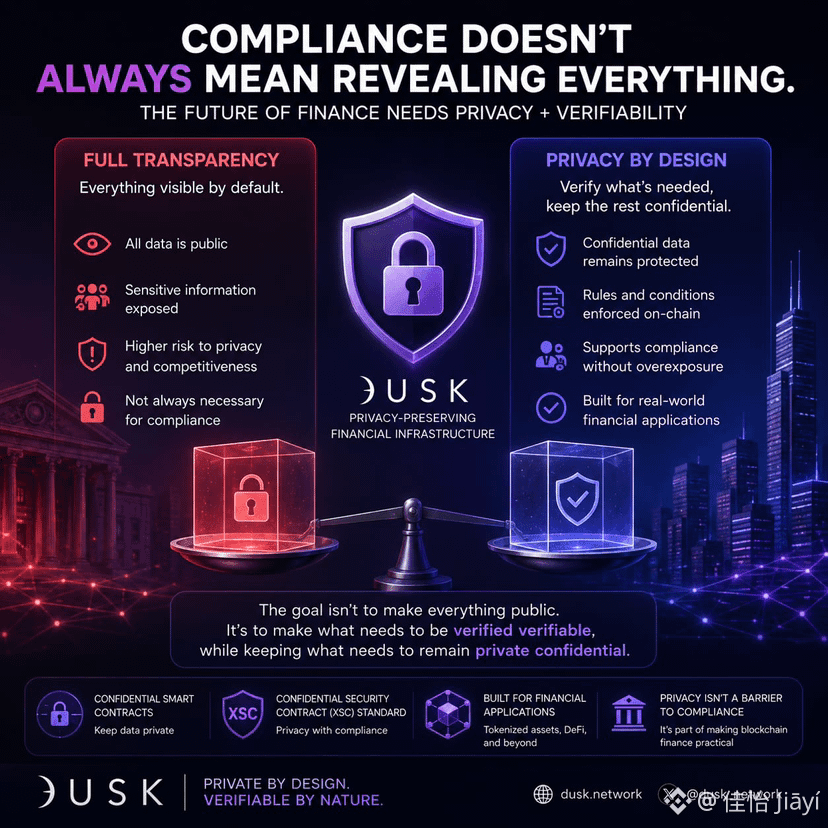
Compliance doesn't always mean revealing everything.
That's an important distinction when thinking about blockchain and financial markets.
Traditional financial systems often rely on controlled access to sensitive information. Regulators may need to verify certain facts, while counterparties, investors, or the public may not need to see every underlying detail.
A fully transparent blockchain can create the opposite problem: everything becomes visible by default.
Dusk Network takes a different direction by focusing on privacy for financial applications through confidential smart contracts and its Confidential Security Contract (XSC) standard.
The interesting part isn't simply hiding transactions.
It's the possibility of designing financial applications where confidential information can remain protected while relevant rules and conditions can still be enforced on-chain.
Consider a tokenized financial asset. A system may need to establish that a transaction follows specific requirements without exposing every piece of sensitive information connected to that transaction.
That changes how we think about blockchain transparency.
The goal may not be:
“Make everything public.”
It could be:
“Make what needs to be verified verifiable, while keeping what needs to remain private confidential.”
For financial infrastructure, that distinction could be critical.
Privacy isn't necessarily a barrier to compliance. In some designs, it may be part of making blockchain-based finance more practical.
$TUT
$NVDAB
Compliance doesn't always mean revealing everything.
That's an important distinction when thinking about blockchain and financial markets.
Traditional financial systems often rely on controlled access to sensitive information. Regulators may need to verify certain facts, while counterparties, investors, or the public may not need to see every underlying detail.
A fully transparent blockchain can create the opposite problem: everything becomes visible by default.
Dusk Network takes a different direction by focusing on privacy for financial applications through confidential smart contracts and its Confidential Security Contract (XSC) standard.
The interesting part isn't simply hiding transactions.
It's the possibility of designing financial applications where confidential information can remain protected while relevant rules and conditions can still be enforced on-chain.
Consider a tokenized financial asset. A system may need to establish that a transaction follows specific requirements without exposing every piece of sensitive information connected to that transaction.
That changes how we think about blockchain transparency.
The goal may not be:
“Make everything public.”
It could be:
“Make what needs to be verified verifiable, while keeping what needs to remain private confidential.”
For financial infrastructure, that distinction could be critical.
Privacy isn't necessarily a barrier to compliance. In some designs, it may be part of making blockchain-based finance more practical.
$TUT
$NVDAB