

DeFi May Be Moving Beyond The Idea Of “Which Chain?”
For years, users had to think in chains.
$TON liquidity was here.
$ETH liquidity was there.
$TRX, $BNB, $SOL and other ecosystems had their own markets.
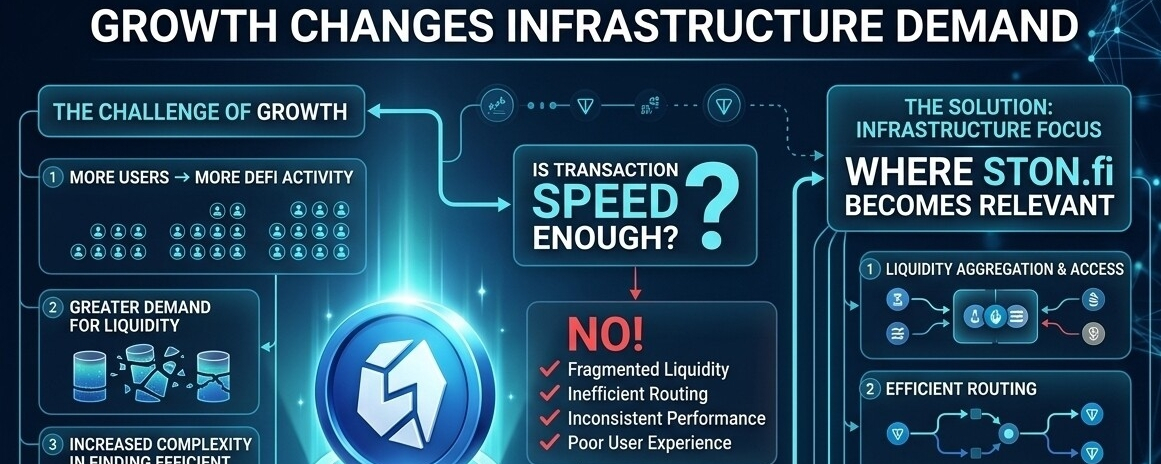
The problem was not always a lack of liquidity.
It was fragmentation.
As DeFi becomes more multichain, the more important question becomes:
“How easily can users access liquidity across those networks?”
This is where cross-chain execution becomes important.
STON.fi is building in this direction with Omniston, a bridge-free execution layer that uses resolver liquidity and atomic settlement to coordinate cross-chain swaps. 0
The user does not need to manually manage every bridge, liquidity source or route.
The infrastructure handles the complexity behind the transaction.
That creates a different model for DeFi:
More chains.
More liquidity.
Less fragmentation.
For $TON, this can mean broader access to liquidity outside its native ecosystem.
For $STON, it strengthens the infrastructure narrative beyond being a traditional DEX.
And the opportunity is not limited to one network.
STON.fi currently supports cross-chain swaps across $TON, $ETH, $BNB, $TRX, $BASE and other major ecosystems through its self-custodial interface. 1
That matters because liquidity does not naturally live in one place.
It moves toward better opportunities.
The infrastructure connecting those liquidity environments therefore becomes increasingly important.
The next phase of DeFi may not be about choosing the “best” chain.
It may be about making different chains feel like one connected liquidity environment.
That is a much bigger infrastructure problem.
And potentially a much bigger opportunity for $STON and Omniston.
Could cross-chain execution become more important than the individual chain itself in the next phase of DeFi?
$STON $TON $ETH $TRX $BNB $SOL $BASE $ARB $OP
#BTCETFInflowsSurge #ETHTests2500 #NvidiaServerPriceHike