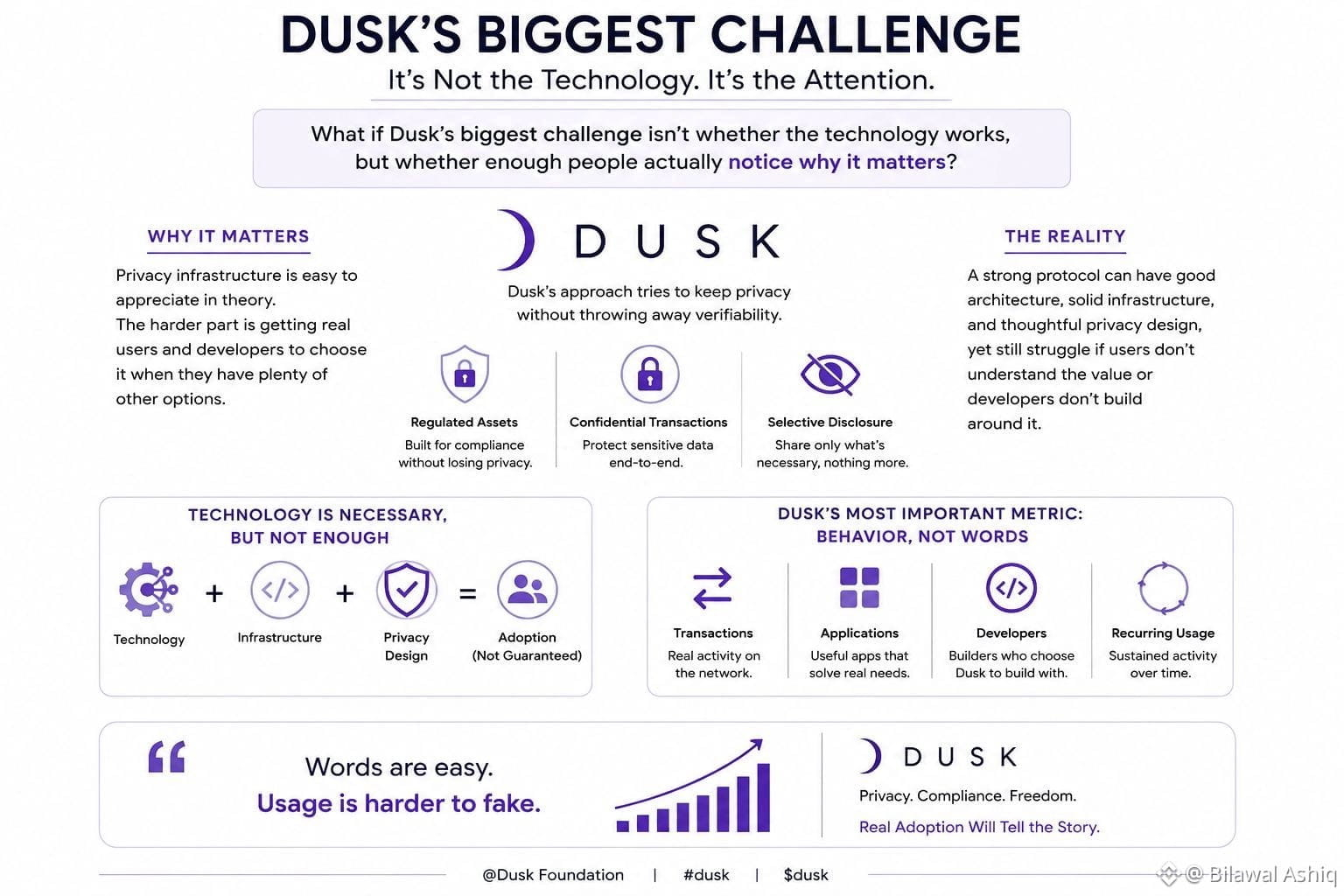

What if Dusk’s biggest challenge isn’t whether the technology works, but whether enough people actually notice why it matters?
I’ve been thinking about this with Dusk because privacy infrastructure is easy to appreciate in theory. The harder part is getting real users and developers to choose it when they have plenty of other options.
Dusk’s approach to regulated assets, confidential transactions, and selective disclosure is interesting to me because it tries to keep privacy without throwing away verifiability.
But that only matters if people actually use it.
A strong protocol can have good architecture, solid infrastructure, and thoughtful privacy design, yet still struggle if users don’t understand the value or developers don’t build around it.
For me, Dusk’s most important metric over time may be behavior: transactions, applications, developers, and recurring usage.
Words are easy. Usage is harder to fake.
@Dusk _Foundation #dusk $DUSK @Dusk #dusk $DUSK
I’ve been thinking about this with Dusk because privacy infrastructure is easy to appreciate in theory. The harder part is getting real users and developers to choose it when they have plenty of other options.
Dusk’s approach to regulated assets, confidential transactions, and selective disclosure is interesting to me because it tries to keep privacy without throwing away verifiability.
But that only matters if people actually use it.
A strong protocol can have good architecture, solid infrastructure, and thoughtful privacy design, yet still struggle if users don’t understand the value or developers don’t build around it.
For me, Dusk’s most important metric over time may be behavior: transactions, applications, developers, and recurring usage.
Words are easy. Usage is harder to fake.
@Dusk _Foundation #dusk $DUSK @Dusk #dusk $DUSK