Was digging into the Aug 16 bridge incident for Dusk $DUSK #dusk Network @Dusk Foundation and it landed differently this time — less "how did they respond" and more "why did this even need responding to."
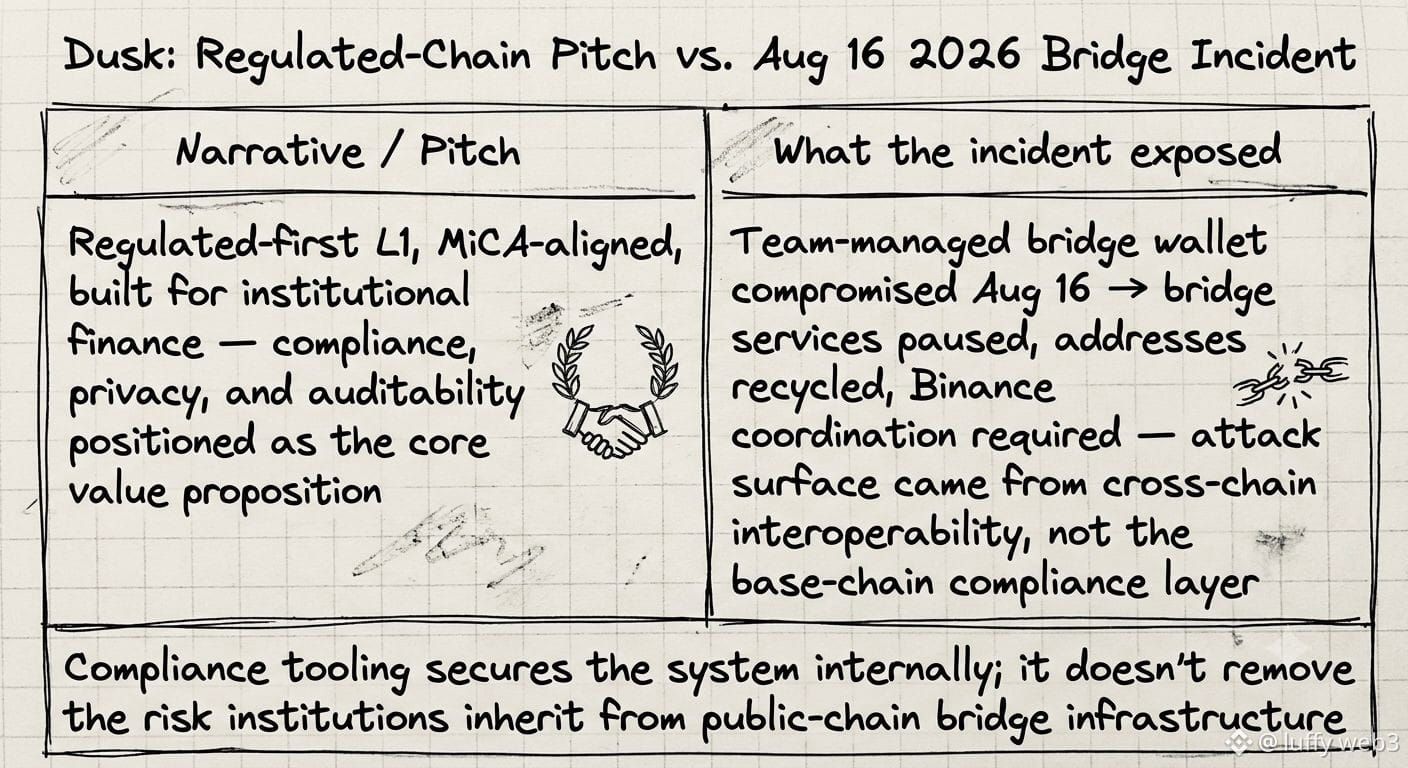
Here's the thing: a team-managed wallet used in bridge operations got compromised. Not user error, not a smart contract exploit — a bridge wallet, the exact kind of infrastructure that has to exist for a public chain to talk to other chains. Dusk pitches itself as regulated-first, MiCA-aligned, built for institutions. And it still had to pause bridge services, recycle addresses, coordinate with Binance mid-incident.
That's the part that stuck, hold up—. Traditional finance doesn't have "bridge wallets" as an attack surface. A stock exchange doesn't need a cross-chain messaging layer to settle a trade. The moment any institutional-grade chain plugs into the broader multichain ecosystem, it inherits that ecosystem's risk profile, regardless of how tight the compliance layer is on its own base chain.
Kind of shifted how I read the whole "regulated L1" pitch. Compliance tooling protects you inside the system. It doesn't shrink the attack surface that comes from being public and interoperable in the first place.
Wondering if institutions weigh that bridge-risk tradeoff separately from the privacy pitch, or lump it all together.
Here's the thing: a team-managed wallet used in bridge operations got compromised. Not user error, not a smart contract exploit — a bridge wallet, the exact kind of infrastructure that has to exist for a public chain to talk to other chains. Dusk pitches itself as regulated-first, MiCA-aligned, built for institutions. And it still had to pause bridge services, recycle addresses, coordinate with Binance mid-incident.
That's the part that stuck, hold up—. Traditional finance doesn't have "bridge wallets" as an attack surface. A stock exchange doesn't need a cross-chain messaging layer to settle a trade. The moment any institutional-grade chain plugs into the broader multichain ecosystem, it inherits that ecosystem's risk profile, regardless of how tight the compliance layer is on its own base chain.
Kind of shifted how I read the whole "regulated L1" pitch. Compliance tooling protects you inside the system. It doesn't shrink the attack surface that comes from being public and interoperable in the first place.
Wondering if institutions weigh that bridge-risk tradeoff separately from the privacy pitch, or lump it all together.