There was a time I sat for nearly two hours just to draw an RWA transaction flow: Investor goes through KYC, Institution Issuer issues Credential, Phoenix processes Note, Auditor holds View Key... the whole page was covered before I realized Privacy isn’t simply about “hiding wallet addresses”.
I simulated 10 Investor, each profile containing 12 Compliance Fields. if Identity Card, Tax ID and Transaction History all move through every step, that becomes 120 data fields; while an Eligibility Check sometimes needs only 2 attributes.
Citadel changed the way I look at it.
Institution-Issued Credential + ZK Proof Generation + Selective Disclosure make it possible to prove Qualified Investor status without exposing identity. Phoenix uses Note Commitment, UTXO-like Isolation to separate Balance and Counterparty; Moonlight keeps Transparent Account. Auditor uses View Key, public only sees Commitment.
to be candid, I like the fact that Data Minimization becomes architecture rather than a Compliance slogan.
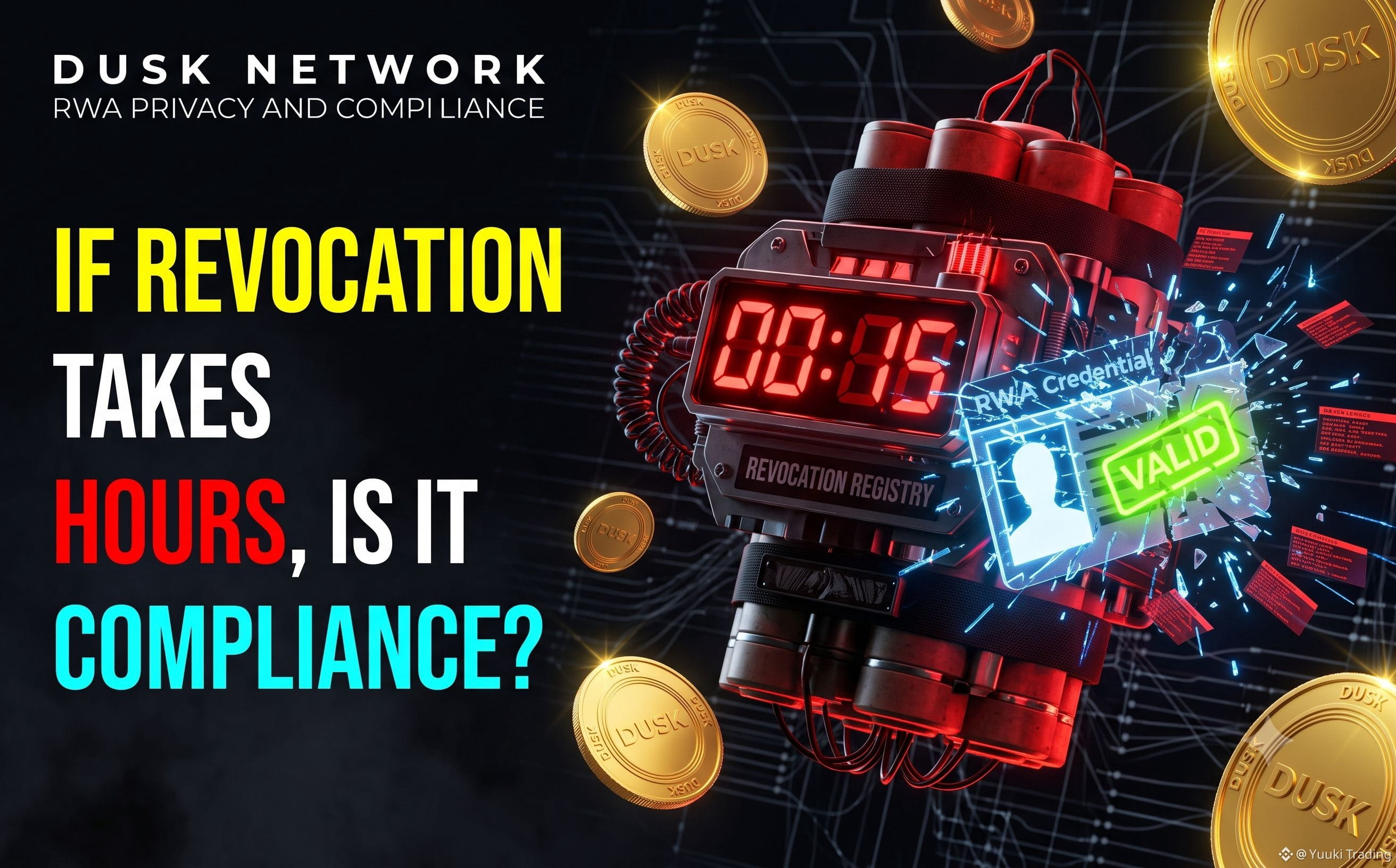
but once it comes to Credential Revocation, things start getting difficult...
who updates the Issuer Whitelist? if the Revocation Registry is delayed by 20 minutes, can a credential that has just become invalid still generate a ZK Proof? how should Cross-Jurisdiction Mapping between MiFID and Accredited Investor be handled? where does the Off-Chain Oracle obtain Regulatory Status from?
PLONK, dusk-plonk, Selector, Verification Key, ZK Circuit, Oracle, Chain of Trust... the deeper I dig, the more I realize Cryptography only solves the parts that can be formalized.
as for Legal Liability, Credential Mutual Recognition and Commercial Execution, there is no compiler that can save you.
I rate Dusk highly because it forces me to ask: who is allowed to see what, who is allowed to prove what, and when an Issuer loses authority, how quickly can the Trust Root react?
if Privacy can be proven within seconds but Revocation takes hours to synchronize, can that still be called Compliance by design?
#dusk $DUSK @Dusk
I simulated 10 Investor, each profile containing 12 Compliance Fields. if Identity Card, Tax ID and Transaction History all move through every step, that becomes 120 data fields; while an Eligibility Check sometimes needs only 2 attributes.
Citadel changed the way I look at it.
Institution-Issued Credential + ZK Proof Generation + Selective Disclosure make it possible to prove Qualified Investor status without exposing identity. Phoenix uses Note Commitment, UTXO-like Isolation to separate Balance and Counterparty; Moonlight keeps Transparent Account. Auditor uses View Key, public only sees Commitment.
to be candid, I like the fact that Data Minimization becomes architecture rather than a Compliance slogan.
but once it comes to Credential Revocation, things start getting difficult...
who updates the Issuer Whitelist? if the Revocation Registry is delayed by 20 minutes, can a credential that has just become invalid still generate a ZK Proof? how should Cross-Jurisdiction Mapping between MiFID and Accredited Investor be handled? where does the Off-Chain Oracle obtain Regulatory Status from?
PLONK, dusk-plonk, Selector, Verification Key, ZK Circuit, Oracle, Chain of Trust... the deeper I dig, the more I realize Cryptography only solves the parts that can be formalized.
as for Legal Liability, Credential Mutual Recognition and Commercial Execution, there is no compiler that can save you.
I rate Dusk highly because it forces me to ask: who is allowed to see what, who is allowed to prove what, and when an Issuer loses authority, how quickly can the Trust Root react?
if Privacy can be proven within seconds but Revocation takes hours to synchronize, can that still be called Compliance by design?
#dusk $DUSK @Dusk