#dusk $DUSK @Dusk When consensus rewards become an incentive problem
I went into the Dusk docs expecting to find the usual story: validators secure the network, rewards are distributed, everyone has an economic reason to behave correctly.
What caught my attention instead was the difference between producing a block and participating in consensus.
That distinction matters because a PoS system isn't only paying people for holding or staking capital. It is also deciding which actions deserve the largest slice of the newly created rewards.
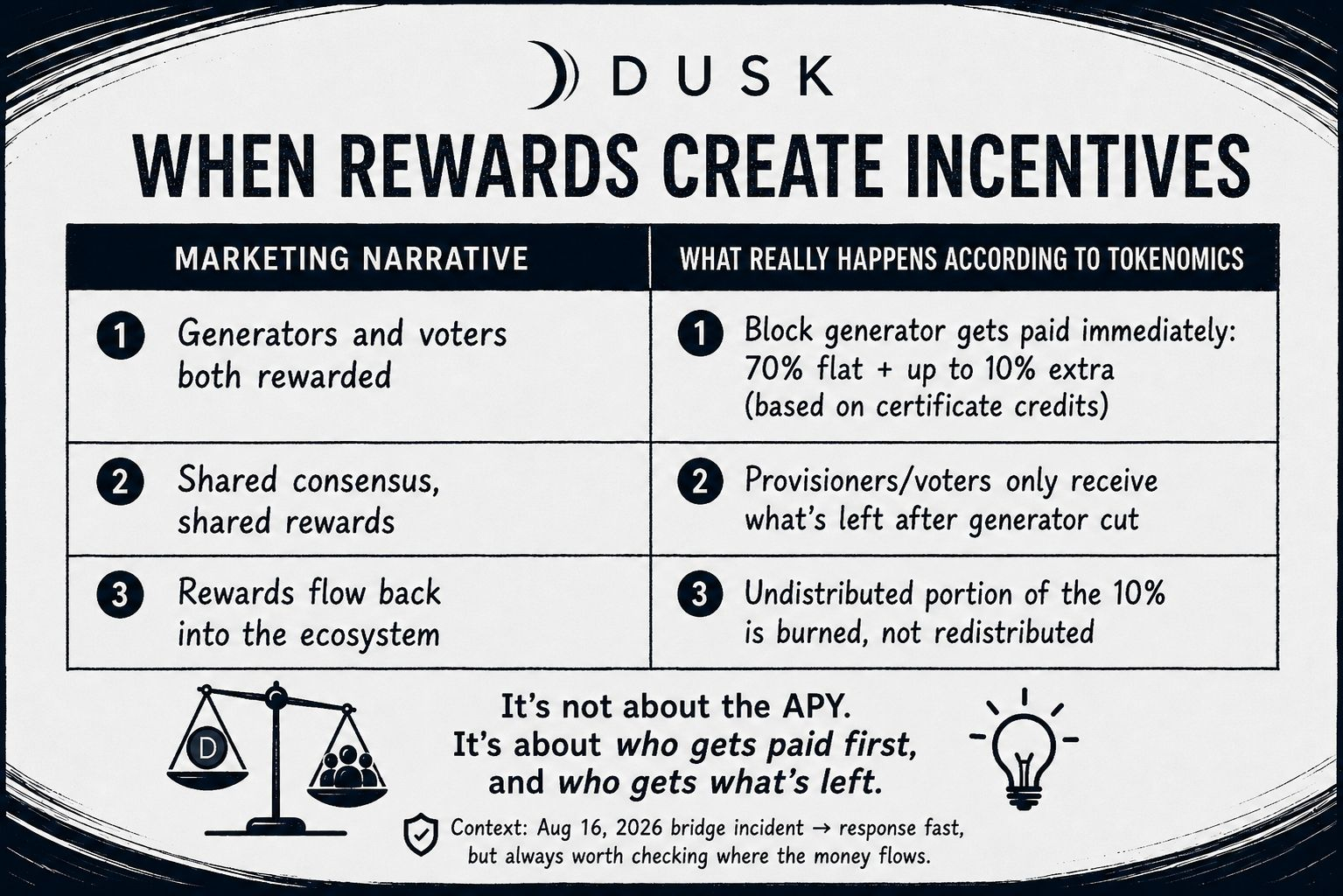
On Dusk, block generation and provisioner voting don't appear to have identical economic weight. The generator can capture a significant portion of the reward, while the remaining amount is distributed through the consensus process.
That creates an interesting question: does the reward structure primarily incentivize being selected to generate blocks, or does it sufficiently compensate the people continuously providing attestations and helping maintain consensus?
I think this is more important than simply looking at the headline APY.
A staking yield can look attractive on paper, but the real economics depend on where the reward originates, which role receives it, and how much is actually distributed rather than removed from circulation.
That is the part of $DUSK tokenomics I find more interesting than the raw percentage.
I went into the Dusk docs expecting to find the usual story: validators secure the network, rewards are distributed, everyone has an economic reason to behave correctly.
What caught my attention instead was the difference between producing a block and participating in consensus.
That distinction matters because a PoS system isn't only paying people for holding or staking capital. It is also deciding which actions deserve the largest slice of the newly created rewards.
On Dusk, block generation and provisioner voting don't appear to have identical economic weight. The generator can capture a significant portion of the reward, while the remaining amount is distributed through the consensus process.
That creates an interesting question: does the reward structure primarily incentivize being selected to generate blocks, or does it sufficiently compensate the people continuously providing attestations and helping maintain consensus?
I think this is more important than simply looking at the headline APY.
A staking yield can look attractive on paper, but the real economics depend on where the reward originates, which role receives it, and how much is actually distributed rather than removed from circulation.
That is the part of $DUSK tokenomics I find more interesting than the raw percentage.