#dusk $DUSK @Dusk
Everyone talks about consensus. Almost nobody talks about how the block even reaches the people voting on it. That's the part I got stuck on.
Dusk uses something called Kadcast for propagating messages across the network a structured overlay network, not the gossip-style flooding most chains use. Gossip protocols just push data to random peers and hope it spreads. Kadcast instead routes messages through a defined structure, closer to how Kademlia-based peer-to-peer systems organize nodes by distance.
That sounded like a minor infrastructure choice until I thought about timing. Consensus rounds in Dusk are built for near-instant finality. But finality is only as fast as the slowest honest node that needs the block data to vote. If propagation is structured rather than random, delivery time becomes more predictable — but it also means the path a block takes depends on network topology, not chance.
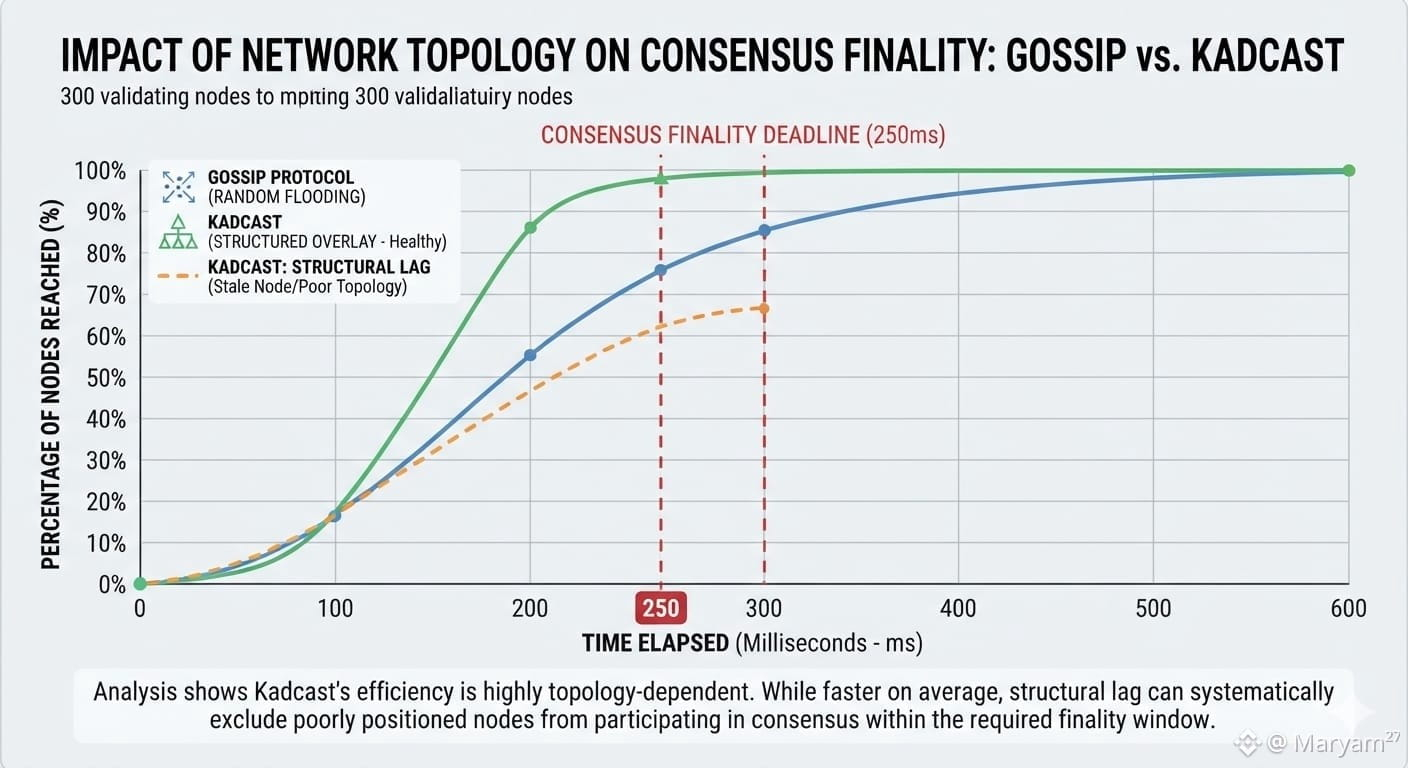
Picture 300 validating nodes. In pure gossip, a message might reach 90% of them through unpredictable, overlapping paths within a few hops. In a structured system like Kadcast, that path is determined by each node's position in the structure — more efficient on average, but any node poorly placed, or slow to update its routing table, could lag in a way that's structural rather than random.
Nobody frames propagation as a trust question, but it quietly is one. You're trusting the shape of the network as much as the people running it.
So what happens to "near-instant" finality the moment topology and consensus timing stop being separate problems, and start being the same one?
$DUSK #dusk @Dusk
Everyone talks about consensus. Almost nobody talks about how the block even reaches the people voting on it. That's the part I got stuck on.
Dusk uses something called Kadcast for propagating messages across the network a structured overlay network, not the gossip-style flooding most chains use. Gossip protocols just push data to random peers and hope it spreads. Kadcast instead routes messages through a defined structure, closer to how Kademlia-based peer-to-peer systems organize nodes by distance.
That sounded like a minor infrastructure choice until I thought about timing. Consensus rounds in Dusk are built for near-instant finality. But finality is only as fast as the slowest honest node that needs the block data to vote. If propagation is structured rather than random, delivery time becomes more predictable — but it also means the path a block takes depends on network topology, not chance.
Picture 300 validating nodes. In pure gossip, a message might reach 90% of them through unpredictable, overlapping paths within a few hops. In a structured system like Kadcast, that path is determined by each node's position in the structure — more efficient on average, but any node poorly placed, or slow to update its routing table, could lag in a way that's structural rather than random.
Nobody frames propagation as a trust question, but it quietly is one. You're trusting the shape of the network as much as the people running it.
So what happens to "near-instant" finality the moment topology and consensus timing stop being separate problems, and start being the same one?
$DUSK #dusk @Dusk