I kept coming back to one question while studying @Dusk: is privacy the hardest problem in regulated finance, or just one layer of a much bigger infrastructure challenge?
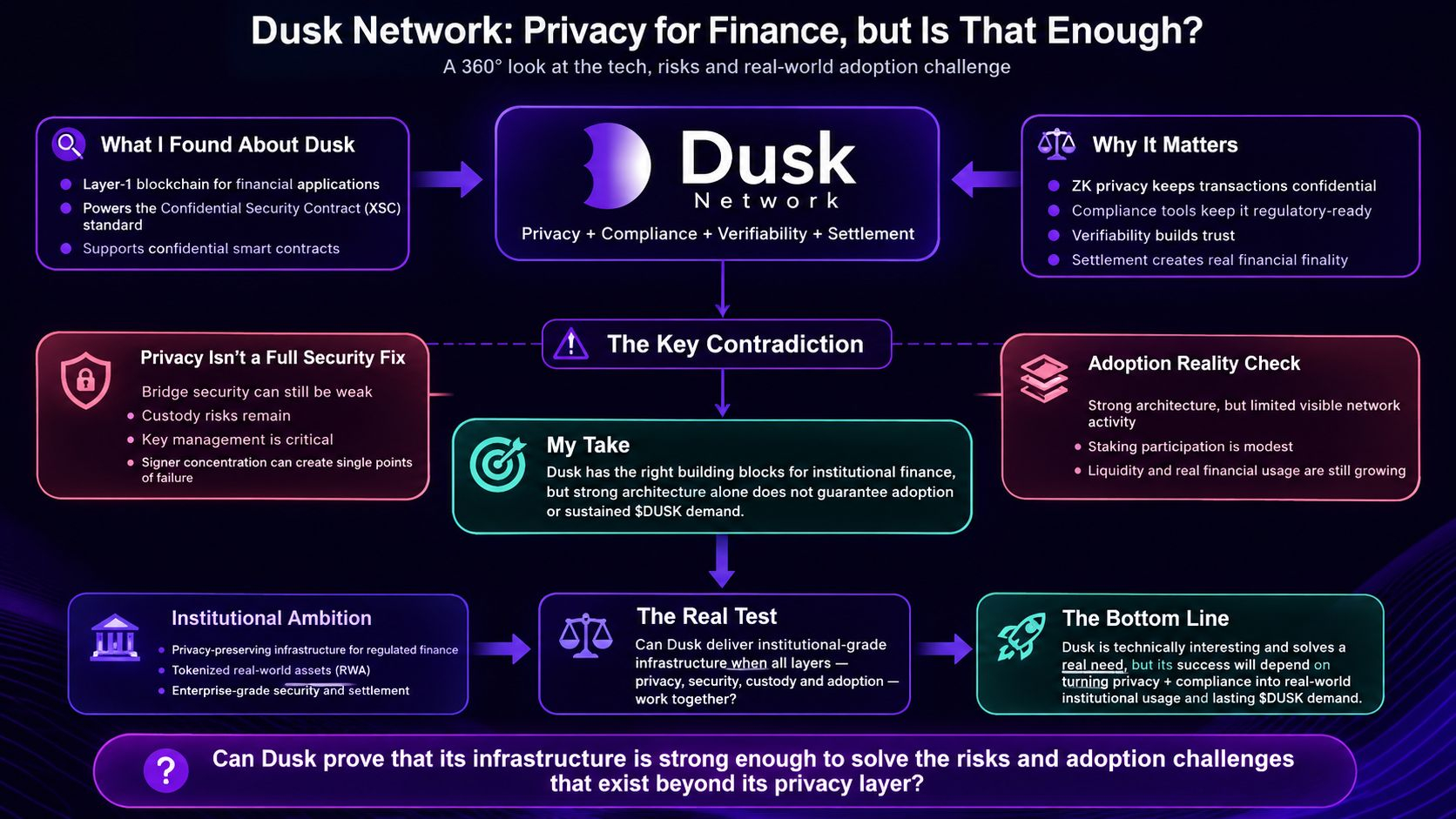
Dusk’s architecture is genuinely interesting to me. It is a Layer-1 built for financial applications, powering the Confidential Security Contract (XSC) standard and confidential smart contracts. The combination of privacy, compliance, verifiability, and settlement makes technical sense for regulated assets and institutional workflows.
But I also see an important contradiction.
Sophisticated ZK-based privacy does not automatically remove traditional risks. Bridges can still fail. Custody still matters. Key management remains critical. Signer concentration can create weaknesses outside the privacy layer.
Then there is adoption.
I looked beyond the architecture and kept asking what institutional ambition looks like in practice: network activity, staking participation, liquidity, and evidence of real financial usage. A strong design can create the conditions for adoption, but it cannot force institutions to use the network or create lasting demand for $DUSK .
That is why I find Dusk more interesting as an open question than a finished story.
The technology addresses a real need, but institutional-grade infrastructure requires every layer to work together—not just privacy.
Can Dusk prove that its infrastructure is strong enough to solve the risks and adoption challenges that exist beyond its privacy layer?
@Dusk #dusk $DUSK
Dusk’s architecture is genuinely interesting to me. It is a Layer-1 built for financial applications, powering the Confidential Security Contract (XSC) standard and confidential smart contracts. The combination of privacy, compliance, verifiability, and settlement makes technical sense for regulated assets and institutional workflows.
But I also see an important contradiction.
Sophisticated ZK-based privacy does not automatically remove traditional risks. Bridges can still fail. Custody still matters. Key management remains critical. Signer concentration can create weaknesses outside the privacy layer.
Then there is adoption.
I looked beyond the architecture and kept asking what institutional ambition looks like in practice: network activity, staking participation, liquidity, and evidence of real financial usage. A strong design can create the conditions for adoption, but it cannot force institutions to use the network or create lasting demand for $DUSK .
That is why I find Dusk more interesting as an open question than a finished story.
The technology addresses a real need, but institutional-grade infrastructure requires every layer to work together—not just privacy.
Can Dusk prove that its infrastructure is strong enough to solve the risks and adoption challenges that exist beyond its privacy layer?
@Dusk #dusk $DUSK