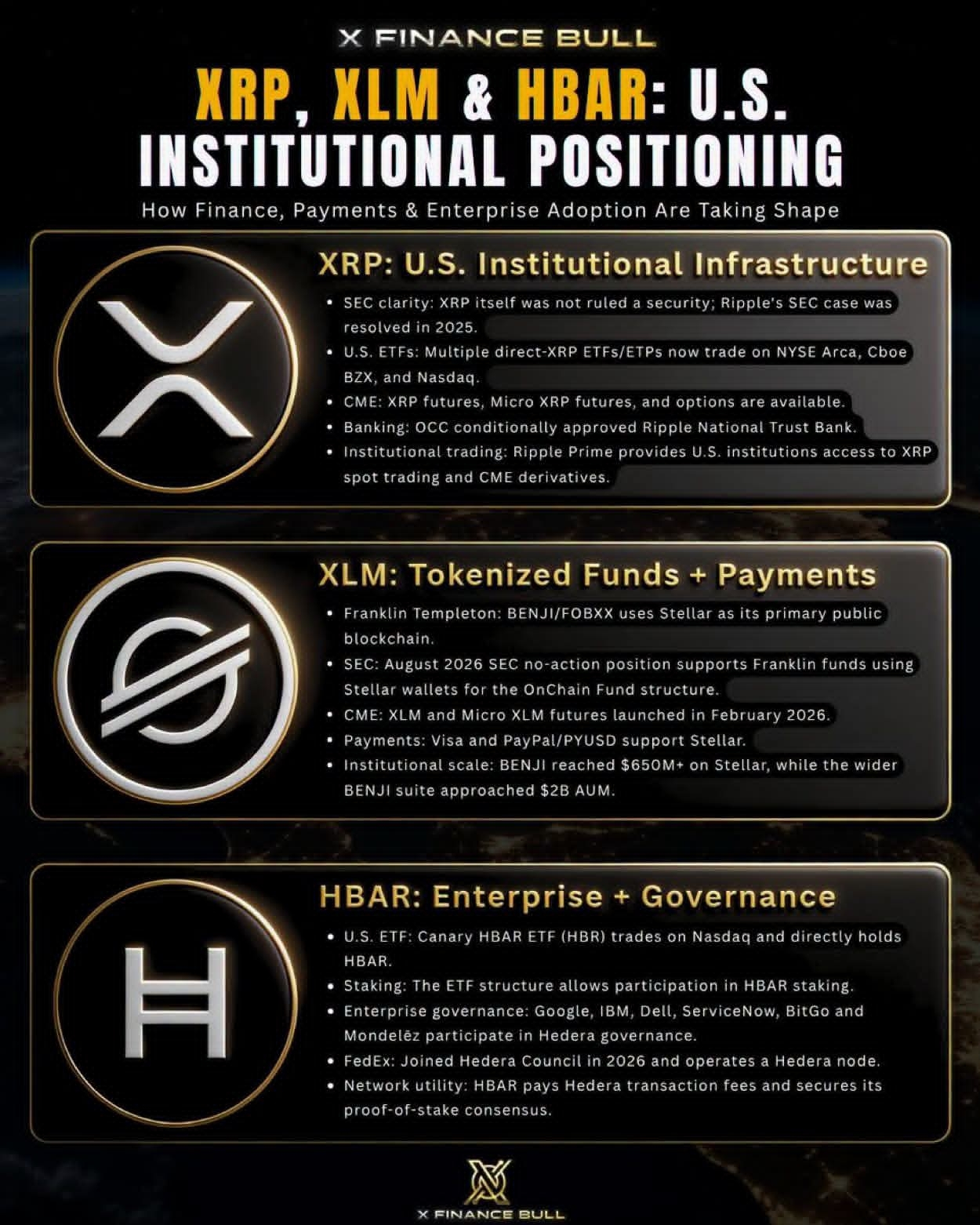
I believe $XRP , $XLM and $HBAR will play a major role in America’s digital financial system. The receipts are already piling up. 🇺🇸
Forget price for a minute and follow where regulated U.S. money can actually go.
Money can enter XRP through direct exchange-traded products on NYSE Arca, Nasdaq and Cboe.
Institutions can hedge XRP through CME Group.
They can access XRP through Ripple Prime.
And Ripple now has preliminary conditional OCC approval for Ripple National Trust Bank.
That is an institutional path from investment product → derivatives → prime brokerage → banking infrastructure.
Now follow XLM.
Franklin Templeton's BENJI ecosystem has already put a U.S.-registered government money fund on Stellar.
The SEC's August arrangement allows Franklin's registered funds to use that OnChain Fund for cash management and securities-lending collateral, with participating funds receiving Stellar wallets.
Then Visa uses Stellar in its stablecoin settlement infrastructure.
PayPal's PYUSD is live there.
CME XLM futures give institutions another regulated access point.
And with HBAR, the story moves into corporate America.
The Canary HBAR ETF trades directly on Nasdaq and can stake its HBAR.
Hedera governance includes Google, IBM, Dell, ServiceNow, FedEx, Mondelēz and BitGo.
FedEx isn't only a logo on a website either.
It joined the Hedera Council and operates a network node.
Then Accenture entered in 2026.
Now zoom out.
Each asset is becoming tied to actual network function too.
XRP pays XRPL fees and supports reserves.
XLM pays Stellar fees and maintains network reserves.
HBAR pays every Hedera transaction fee and secures consensus.
So my thesis isn't simply that America will “adopt crypto.”
It’s that pieces of American finance are already being connected to these three networks in very real ways.
Forget price for a minute and follow where regulated U.S. money can actually go.
Money can enter XRP through direct exchange-traded products on NYSE Arca, Nasdaq and Cboe.
Institutions can hedge XRP through CME Group.
They can access XRP through Ripple Prime.
And Ripple now has preliminary conditional OCC approval for Ripple National Trust Bank.
That is an institutional path from investment product → derivatives → prime brokerage → banking infrastructure.
Now follow XLM.
Franklin Templeton's BENJI ecosystem has already put a U.S.-registered government money fund on Stellar.
The SEC's August arrangement allows Franklin's registered funds to use that OnChain Fund for cash management and securities-lending collateral, with participating funds receiving Stellar wallets.
Then Visa uses Stellar in its stablecoin settlement infrastructure.
PayPal's PYUSD is live there.
CME XLM futures give institutions another regulated access point.
And with HBAR, the story moves into corporate America.
The Canary HBAR ETF trades directly on Nasdaq and can stake its HBAR.
Hedera governance includes Google, IBM, Dell, ServiceNow, FedEx, Mondelēz and BitGo.
FedEx isn't only a logo on a website either.
It joined the Hedera Council and operates a network node.
Then Accenture entered in 2026.
Now zoom out.
Each asset is becoming tied to actual network function too.
XRP pays XRPL fees and supports reserves.
XLM pays Stellar fees and maintains network reserves.
HBAR pays every Hedera transaction fee and secures consensus.
So my thesis isn't simply that America will “adopt crypto.”
It’s that pieces of American finance are already being connected to these three networks in very real ways.