Dusk Network Is Built for the Privacy That Regulated Assets Actually Need
Dusk Network's most distinctive idea is not simply hiding financial data. It is trying to make confidentiality compatible with the uneven levels of access and control that regulated assets require.
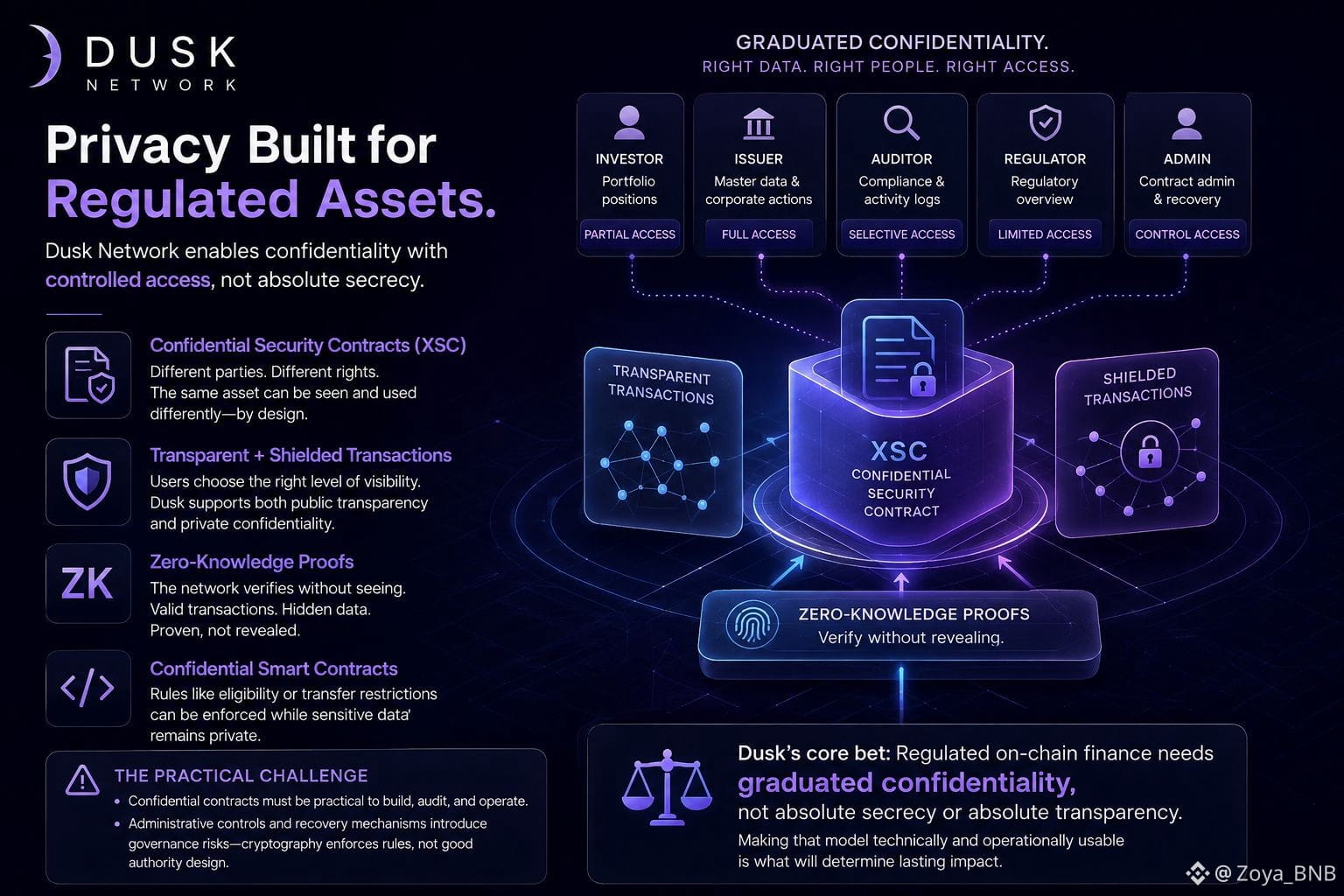
That is the logic behind its Confidential Security Contract standard, XSC. An investor, issuer, auditor, or other authorized party may need different rights around the same asset. Dusk aims to support that without putting every position and transaction detail on a fully transparent ledger.
Its architecture combines transparent and shielded transaction models, with zero-knowledge proofs allowing the network to validate private activity without exposing the underlying data. The harder step is extending that idea into smart contracts, where rules such as eligibility or transfer restrictions may need to be enforced while sensitive information remains hidden.
This creates Dusk's biggest practical challenge. Privacy infrastructure is only useful if confidential contracts remain practical to build, audit, and operate. Administrative controls and recovery mechanisms also introduce governance questions: cryptography can enforce the rules, but it cannot make poorly designed authority structures safe.
Dusk's core bet is that regulated on-chain finance needs graduated confidentiality, not absolute secrecy or absolute transparency. Making that model technically and operationally usable is what will determine whether its architecture has real staying power.
#dusk $DUSK @Dusk
Dusk Network's most distinctive idea is not simply hiding financial data. It is trying to make confidentiality compatible with the uneven levels of access and control that regulated assets require.
That is the logic behind its Confidential Security Contract standard, XSC. An investor, issuer, auditor, or other authorized party may need different rights around the same asset. Dusk aims to support that without putting every position and transaction detail on a fully transparent ledger.
Its architecture combines transparent and shielded transaction models, with zero-knowledge proofs allowing the network to validate private activity without exposing the underlying data. The harder step is extending that idea into smart contracts, where rules such as eligibility or transfer restrictions may need to be enforced while sensitive information remains hidden.
This creates Dusk's biggest practical challenge. Privacy infrastructure is only useful if confidential contracts remain practical to build, audit, and operate. Administrative controls and recovery mechanisms also introduce governance questions: cryptography can enforce the rules, but it cannot make poorly designed authority structures safe.
Dusk's core bet is that regulated on-chain finance needs graduated confidentiality, not absolute secrecy or absolute transparency. Making that model technically and operationally usable is what will determine whether its architecture has real staying power.
#dusk $DUSK @Dusk