
Blockchain transparency sounds ideal—until the information being made transparent is financial.
Imagine a business using blockchain for a financial process where everyone needs to verify that certain rules were followed. The company may want the transaction to be provable, but it may not want every sensitive detail exposed to everyone watching the chain.
That is the interesting problem @Dusk is trying to address.
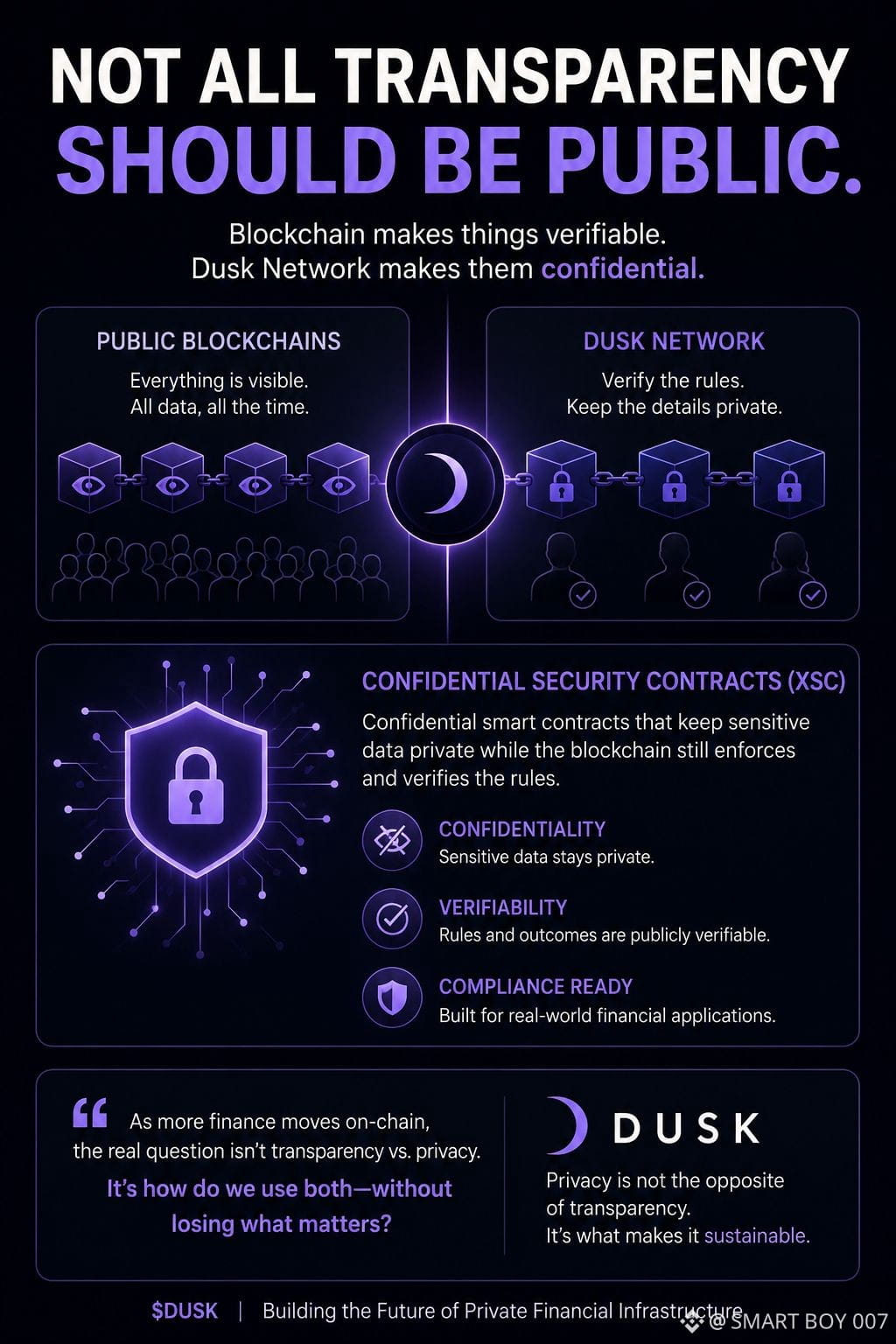
Instead of treating privacy as simply “hiding transactions,” Dusk Network is building a Layer-1 focused on financial applications where confidentiality can exist alongside on-chain verification.
Its Confidential Security Contract (XSC) standard is particularly interesting here. In simple terms, confidential smart contracts are designed for situations where the blockchain still needs to enforce logic, while sensitive information does not have to become completely public.
That distinction matters.
For financial applications, the real challenge may not be choosing between transparency and privacy. It may be finding a way to use both without one destroying the value of the other.
That’s why $DUSK caught my attention. The more financial activity moves on-chain, the more important this question becomes:
Do we really need every piece of financial information to be public just because the transaction uses a blockchain?
#dusk
Imagine a business using blockchain for a financial process where everyone needs to verify that certain rules were followed. The company may want the transaction to be provable, but it may not want every sensitive detail exposed to everyone watching the chain.
That is the interesting problem @Dusk is trying to address.
Instead of treating privacy as simply “hiding transactions,” Dusk Network is building a Layer-1 focused on financial applications where confidentiality can exist alongside on-chain verification.
Its Confidential Security Contract (XSC) standard is particularly interesting here. In simple terms, confidential smart contracts are designed for situations where the blockchain still needs to enforce logic, while sensitive information does not have to become completely public.
That distinction matters.
For financial applications, the real challenge may not be choosing between transparency and privacy. It may be finding a way to use both without one destroying the value of the other.
That’s why $DUSK caught my attention. The more financial activity moves on-chain, the more important this question becomes:
Do we really need every piece of financial information to be public just because the transaction uses a blockchain?
#dusk