#dusk $DUSK @Dusk
I’ve been looking at Dusk’s privacy model as a question of policy portability, and that seems more important than the privacy setting itself.
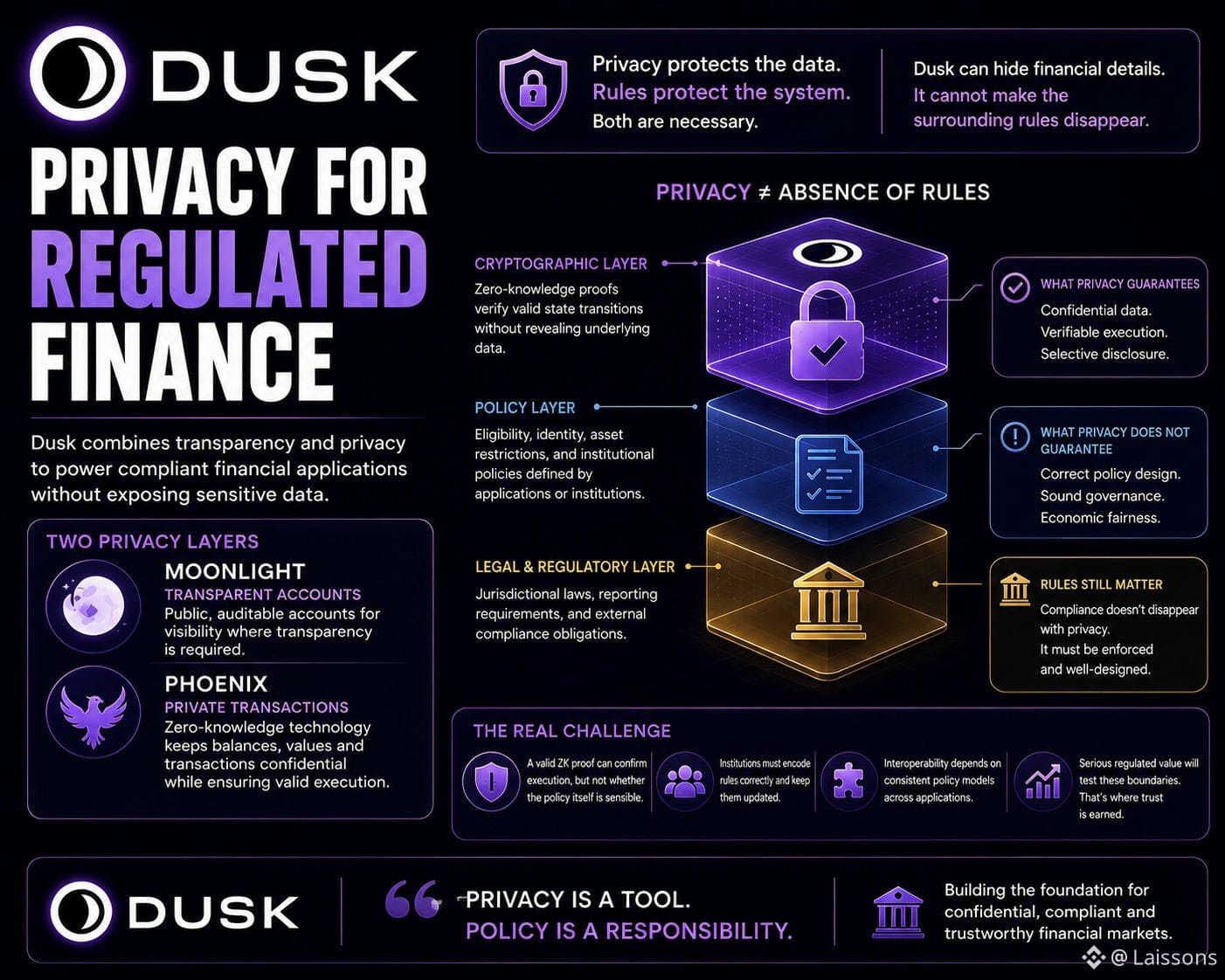
Moonlight and Phoenix show that Dusk can support different visibility models, with Phoenix using zero-knowledge proofs to keep transaction values and balances confidential. But a financial institution still needs its rules to travel with the transaction: who is eligible, which assets can move, what limits apply, and when disclosure is required.
That creates an interesting verification problem.
A ZK proof can establish that a transaction followed the encoded conditions. It cannot tell an institution whether those conditions were designed correctly in the first place.
“Private execution does not equal correct policy.”
For investors, I think this creates a useful way to assess Dusk’s institutional thesis. The question is not simply whether sensitive information stays hidden. It is whether applications can make compliance rules precise enough to be verified consistently across repeated financial workflows.
The weakness is governance and integration. If every institution defines eligibility, disclosure and asset restrictions differently, the cryptographic layer may remain strong while the operational layer becomes fragmented.
I’d watch how Dusk handles policy updates, credential verification and selective disclosure as real financial workflows scale. That is where privacy infrastructure either becomes dependable financial infrastructure or remains a technical capability.
#Dusk $TUT $TRUMP
I’ve been looking at Dusk’s privacy model as a question of policy portability, and that seems more important than the privacy setting itself.
Moonlight and Phoenix show that Dusk can support different visibility models, with Phoenix using zero-knowledge proofs to keep transaction values and balances confidential. But a financial institution still needs its rules to travel with the transaction: who is eligible, which assets can move, what limits apply, and when disclosure is required.
That creates an interesting verification problem.
A ZK proof can establish that a transaction followed the encoded conditions. It cannot tell an institution whether those conditions were designed correctly in the first place.
“Private execution does not equal correct policy.”
For investors, I think this creates a useful way to assess Dusk’s institutional thesis. The question is not simply whether sensitive information stays hidden. It is whether applications can make compliance rules precise enough to be verified consistently across repeated financial workflows.
The weakness is governance and integration. If every institution defines eligibility, disclosure and asset restrictions differently, the cryptographic layer may remain strong while the operational layer becomes fragmented.
I’d watch how Dusk handles policy updates, credential verification and selective disclosure as real financial workflows scale. That is where privacy infrastructure either becomes dependable financial infrastructure or remains a technical capability.
#Dusk $TUT $TRUMP